
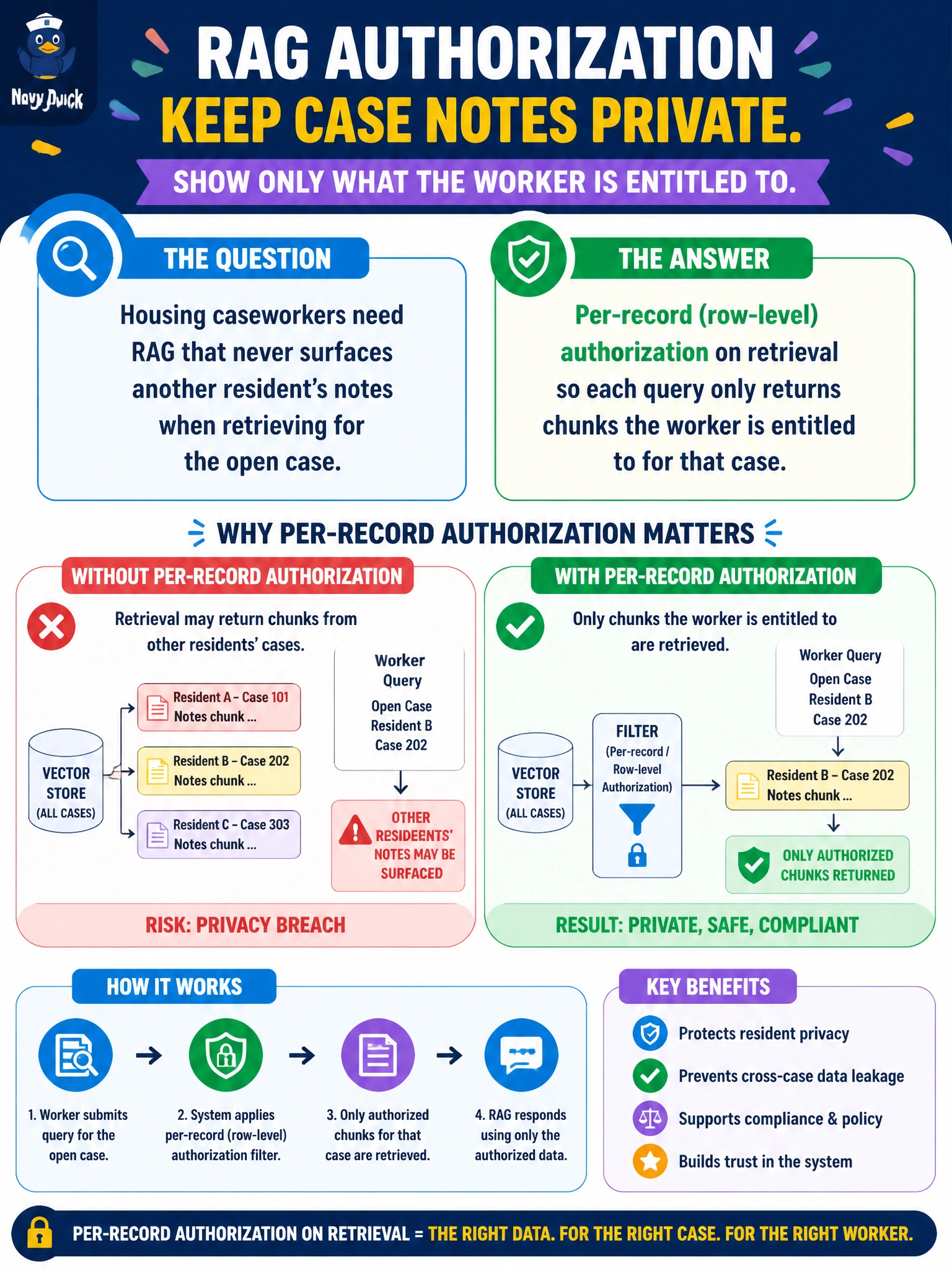
Housing caseworkers need RAG that never surfaces another resident's notes when retrieving for the open case. What authorization design is required?
Select an answer to reveal the explanation.
Short Explanation
Casework RAG isn't a group fridge—you don't get everyone else's leftovers. Enforce row-level retrieval so opening Ms. A's case never pulls Mr. B's notes into the prompt.
Full Explanation
Per-record (row-level) authorization on retrieval so each query only returns chunks the worker is entitled to for that case is the required design. Housing caseworkers must not see another resident’s notes when retrieving for the open case. Department-wide embedding search without row filters will pull similar cases into context across residents. Bind retrieval to case ID and worker entitlements server-side before chunks enter the prompt; do not rely on post-hoc cleanup.
Department-wide read on all case embeddings to speed search fails by concept: speed does not justify cross-resident disclosure of case notes. Client-side filtering of names after the model generates an answer fails because unauthorized chunks already entered the model context and may influence the answer before any UI filter. A single shared “all residents” collection with post-hoc LLM redaction fails because redaction after retrieve is unreliable and still processes out-of-scope personal data.
Exam caveat: Casework RAG needs row-level security equivalent to the case system. Collection-wide similarity without case binding is a privacy incident waiting to happen.
Operational check: Open case A as worker W, attempt retrieve for case B notes, confirm zero foreign chunks, verify filters are server-enforced, and audit denied cross-case retrieves.