
County IT merges several departments' fine-tunes into one shared checkpoint without change control. What governance failure does this create?
Select an answer to reveal the explanation.
Short Explanation
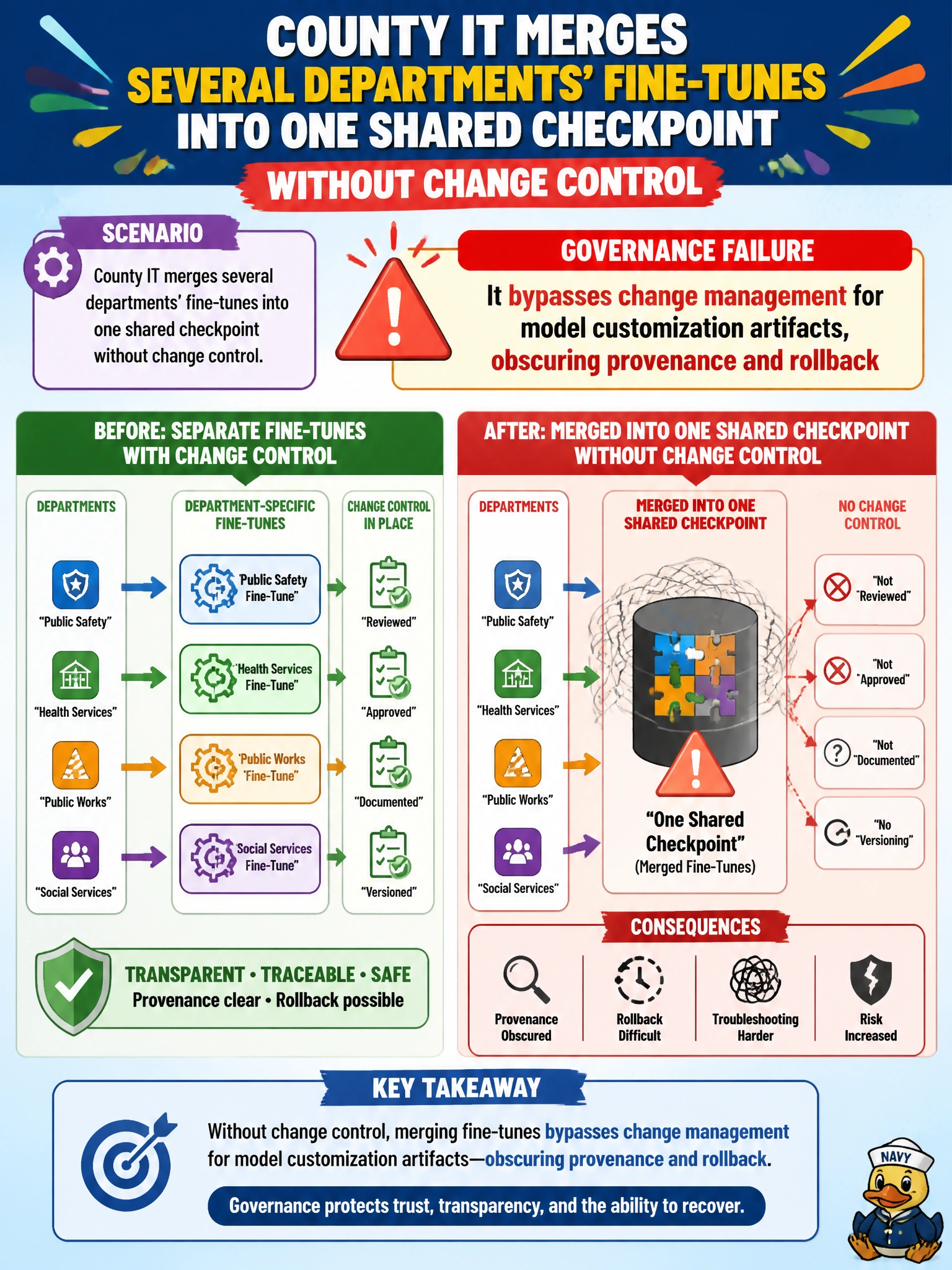
Mashing every department's fine-tune into one mystery checkpoint is like dumping all key cabinets into one unlabeled box. Without change control, nobody knows what changed—or how to roll back.
Full Explanation
Merging several departments' fine-tunes into one shared checkpoint without change control bypasses change management for model customization artifacts. Provenance of which departmental data and objectives entered the merge is lost, rollback to a known-good departmental model becomes unclear, and safety behavior can drift unpredictably across municipal use cases. County IT creates a governance failure that obscures accountability for the combined civic model.
The merge does not automatically create immutable signed model cards for every department—that requires deliberate documentation and signing workflows. It does not guarantee identical safety behavior across use cases; blending objectives often produces uneven refusals and domain errors. Storage-cost savings never eliminate the need for alignment testing; cheaper disks do not replace evaluation gates.
Exam caveat: Model merges and multi-department checkpoints are change-controlled releases, not casual file concatenations. Candidates may confuse operational convenience with automatic governance outputs like model cards. Spot the missing change management and provenance.
Operational check: Treat each fine-tune and any merge as a versioned release with owner, data sources, eval results, and rollback pointer. Prohibit ad-hoc merges on shared storage; require CAB or MLOps promotion approval; retain pre-merge departmental checkpoints; and re-run departmental safety suites on the merged candidate before any county-wide deployment.