
City appsec reviews a 311 bot and must choose where to place moderation and alignment controls. Which approach best matches layered defense for civic GenAI?
Select an answer to reveal the explanation.
Short Explanation
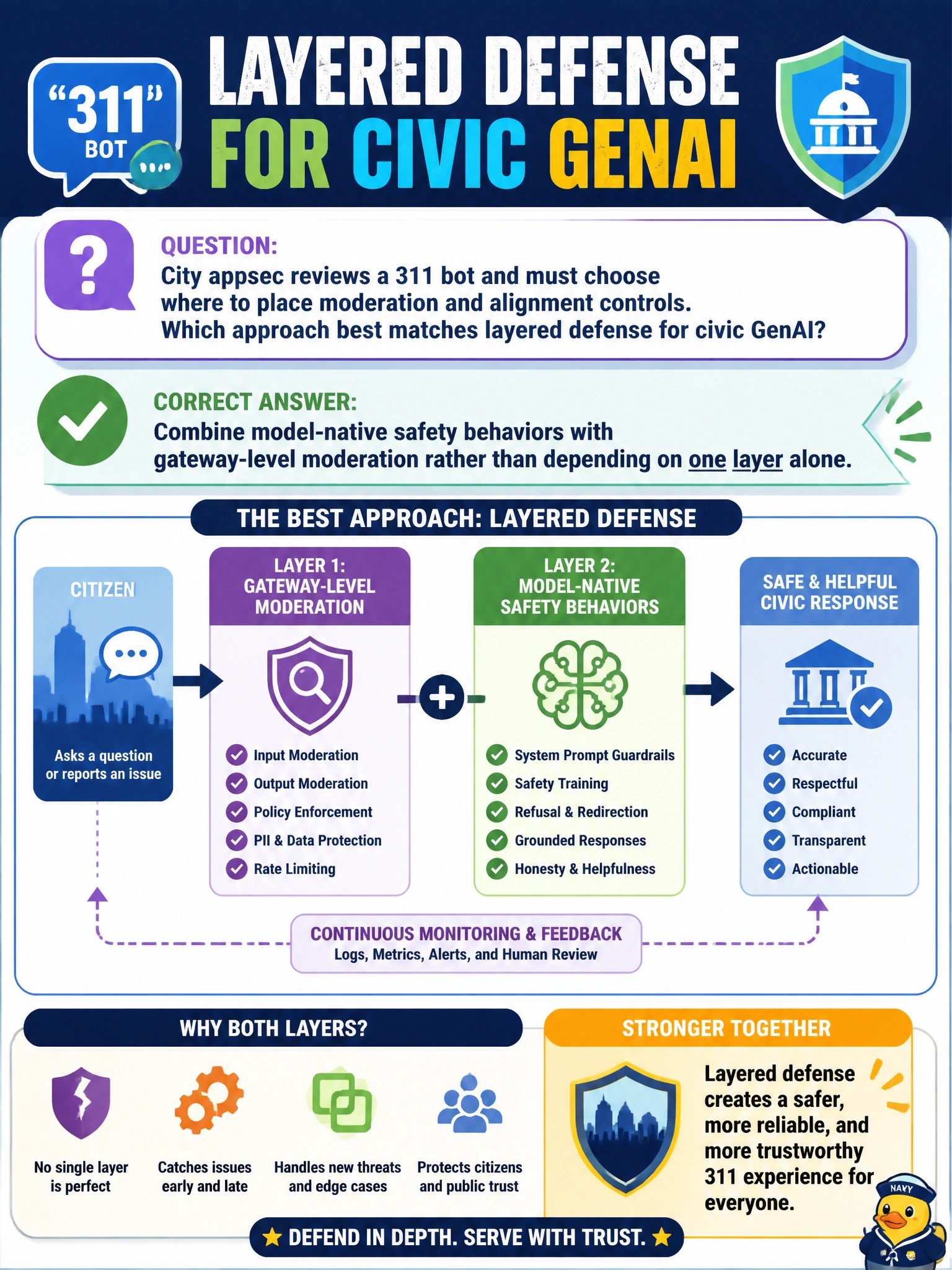
One filter is a single lock on City Hall's front door. For 311 bots, stack model-side safety with gateway moderation—if one layer misses, the other still has a chance.
Full Explanation
Layered defense for a civic 311 GenAI bot means not depending on a single moderation or alignment mechanism. Combining model-native safety behaviors (trained refusals, aligned base models) with gateway-level moderation (policy filters, classifiers, allow or deny categories) gives defense in depth: if one layer misses a harmful or off-policy reply, another still has a chance to catch it before residents see the output. City appsec should place controls at multiple chokepoints in the serving path.
Disabling all moderation to avoid refusal messages removes safety for convenience and fails public-service duty of care. Relying only on end-user browser extensions pushes protection outside municipal control and fails for users without those extensions. Applying moderation solely inside an offline spreadsheet of banned words is brittle, incomplete, and not enforced on the live response path.
Exam caveat: Alignment is not only a model-card checkbox or a single word list. Distinguish client-side hope from server-side enforced controls. GAIPS layered-defense items typically reward combinations of model-native and gateway controls over any one layer alone.
Operational check: Document the 311 response path showing model safety settings plus gateway moderation hooks, test known-bad and known-good prompts through the full stack, verify logging of blocks at each layer, and run periodic red-team samples. Confirm that disabling either layer in a non-production experiment increases miss rate, proving both layers carry real load for municipal service traffic.