
Public-records staff ask how stochastic decoding affects reproducibility of AI-drafted FOIA response letters. Which explanation is most accurate?
Select an answer to reveal the explanation.
Short Explanation
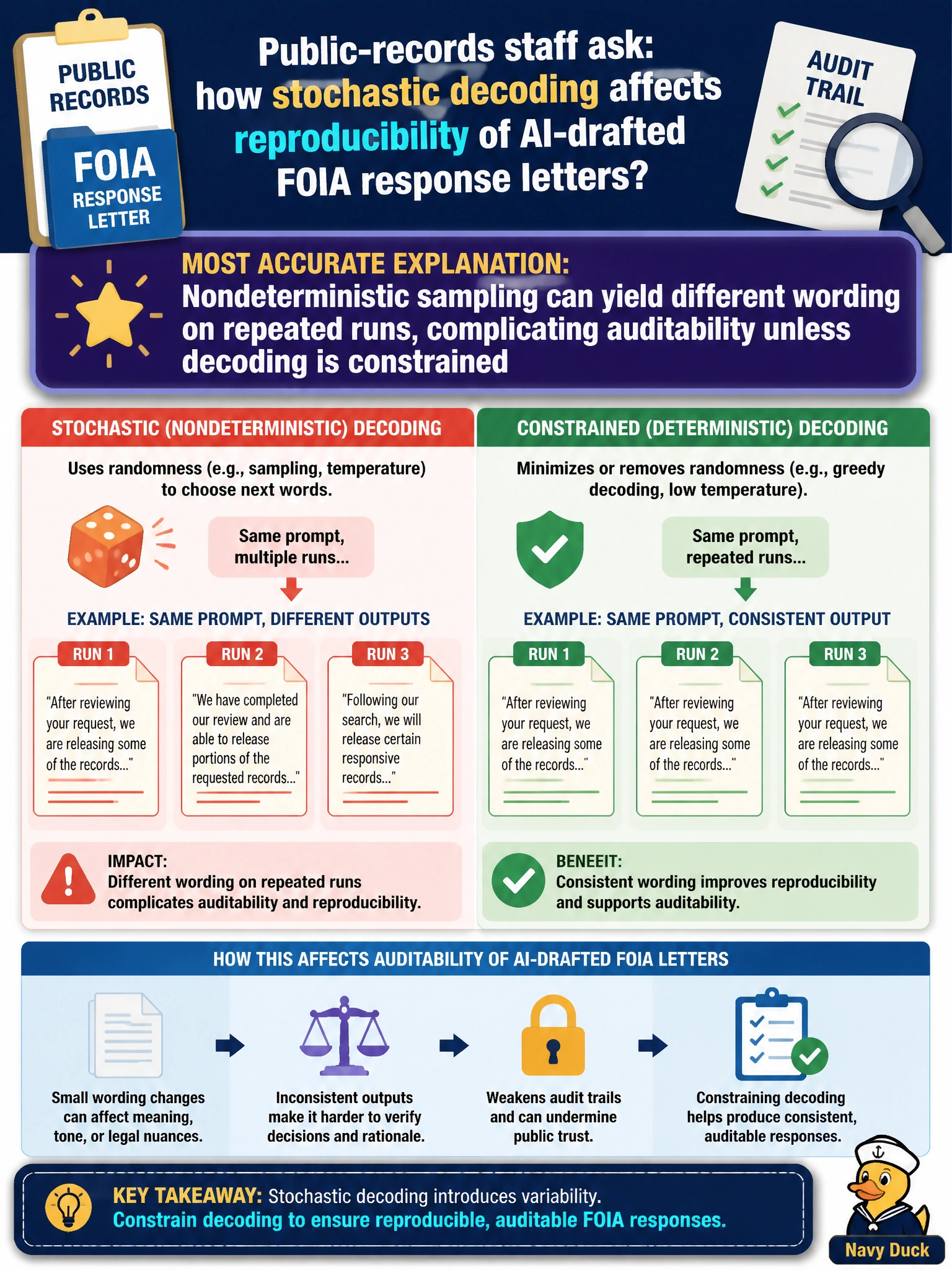
Roll the dice on wording and you may not get the same FOIA draft twice — tough luck for auditors who want a replay. Turn down randomness or log seeds/settings when reproducibility matters. Public records care about being able to explain what the AI produced and why.
Full Explanation
Stochastic decoding samples from probability distributions over tokens, so identical prompts can yield different wording across runs. For AI-drafted FOIA response letters, that nondeterminism complicates auditability, reproducibility, and "what did we say?" reconstructions unless decoding is constrained (lower temperature, deterministic settings) and parameters are logged. Public-records staff need this accurate explanation to set expectations for AI-assisted correspondence.
Stochastic decoding does not force every FOIA letter to be identical across years; randomness works against identical wording. Attention heads do not store immutable SHA-256 hashes that guarantee FOIA reproducibility—that confuses cryptography with neural attention. Stochastic decoding is not limited to image models; text LLMs commonly use temperature and nucleus sampling.
Exam caveat: even with temperature zero, floating-point and batching differences can produce rare drift across engines. Reproducibility of wording differs from reproducibility of legal sufficiency—humans still review. Caching a finalized approved letter is often better than regenerating for audit.
Operational check: pin decoding parameters for FOIA drafts; store seed/settings when available; snapshot approved final text in the records system; avoid regenerating historical replies from prompts alone; and label AI-assisted drafts in the workflow. Records procedures should require saving the issued letter bytes, not relying on the model to recreate them later.