
Security reviews whether logit bias or stop sequences can help a 311 bot avoid emitting internal ticket ID formats. What are these controls in GenAI foundations terms?
Select an answer to reveal the explanation.
Short Explanation
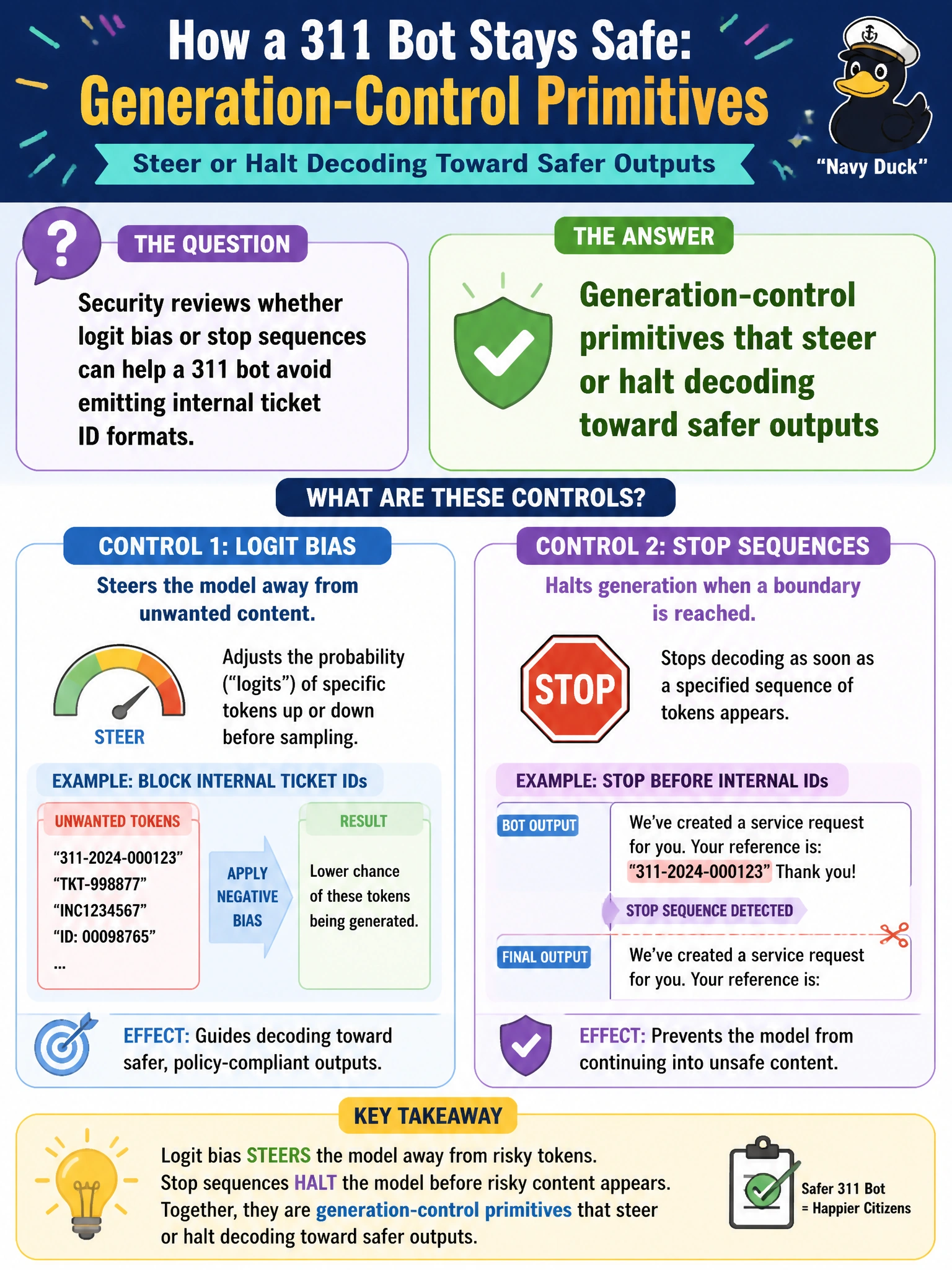
Logit bias and stop sequences are the model's steering wheel and brakes during token-by-token driving — not firewall rules on the street outside. Use them as defensive levers so 311 answers do not spit internal ticket IDs. They complement, not replace, app-layer filters.
Full Explanation
Logit bias and stop sequences are generation-control primitives applied during decoding: they steer token preferences or halt generation when certain strings appear. In GenAI foundations terms, they help a 311 bot avoid emitting internal ticket ID formats by shaping or stopping output—not by changing network ACLs. Understanding them as decoding levers clarifies where they sit in the stack relative to filters, RAG, and application post-processing.
Network ACLs blocking TCP 443 to the model vendor cut connectivity; they do not selectively bias tokens away from ticket ID patterns. Physical HSM attestations for every resident message are not what logit bias/stop sequences are, and attesting phones does not steer decoding. Mandatory VPN profiles on resident phones address remote access paths, not next-token control inside the model.
Exam caveat: decoding controls are brittle against creative encodings and paraphrases; combine with output regex filters and server-side redaction. Stop sequences can truncate useful answers if too aggressive. Logit bias is model/API-specific and may not transfer across vendors.
Operational check: define forbidden ticket ID patterns; apply stop sequences and post-filters; test bypass spellings; keep true secrets out of prompts so the model has less reason to emit them; and document decoding settings in the 311 runbook. Treat generation controls as defense-in-depth, not as the only barrier to internal identifier disclosure.