
An organization is choosing which SDLC activities to keep human-driven versus automate with agents. They have four candidates: (1) gathering ambiguous stakeholder requirements, (2) generating boilerplate service scaffolding from an approved template, (3) performing final architectural review of a new microservice, and (4) running regression tests after each commit. Which TWO activities are MOST appropriate for full agent automation?
Select an answer to reveal the explanation.
Short Explanation and Infographic
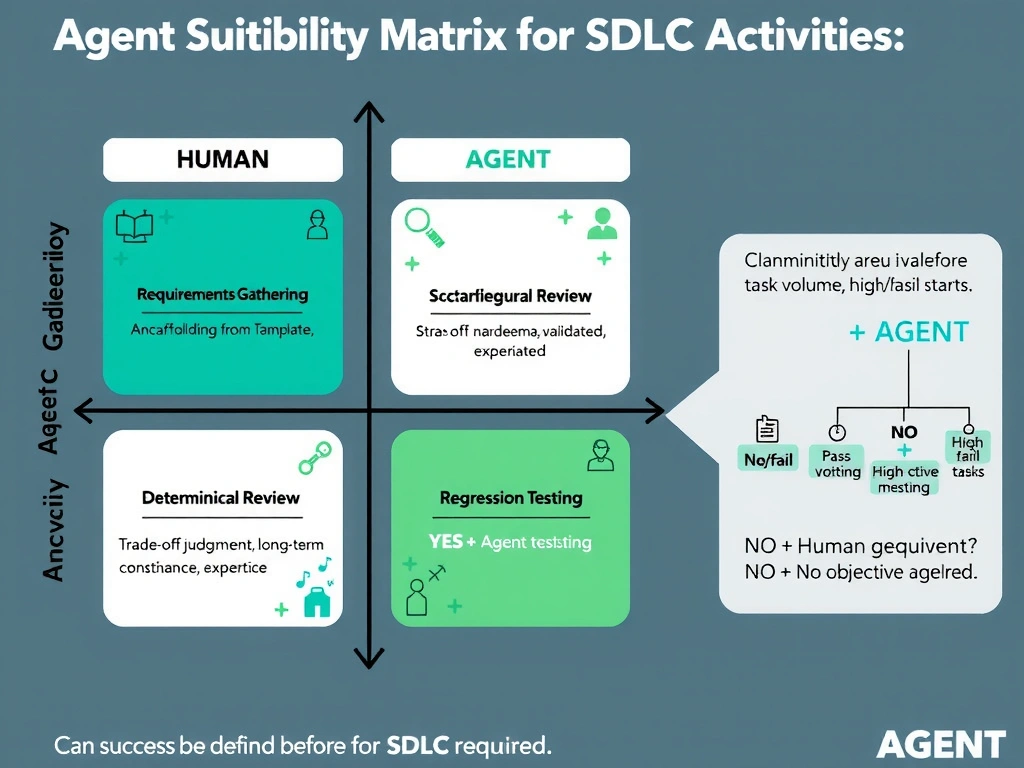
Agents thrive where the success criteria are clear before the work starts — like a robot stamping identical parts. Scaffolding from a template has a defined output schema; regression tests have pass/fail results. Ambiguous requirements gathering requires negotiation, judgment, and relationship management. Architectural review requires deep contextual judgment about trade-offs that may not be expressible as rules. Keep humans on the judgment calls.
Full explanation below image
Full Explanation
The fundamental question for agent suitability is: can success be defined objectively before the task begins? When the answer is yes, agents excel. When the answer requires human judgment, context, or relationship navigation, agent automation adds risk.
Option A pairs ambiguous requirements gathering (1) and architectural review (3) as agent tasks. Both are wrong. Requirements gathering for ambiguous stakeholder needs requires active listening, follow-up questions, political navigation, and the ability to detect what stakeholders mean but didn't say — none of which current agents handle reliably. Architectural review requires evaluating emergent trade-offs, organizational context, team capability, and long-term maintainability — again, judgment-heavy work where agent errors could have major downstream consequences.
Option B is correct. Scaffolding from an approved template (2) is ideal for agents: the input is a specification, the transformation rules are fixed, the output can be validated against the template, and there is no ambiguity. Regression testing (4) is the canonical agent task: run a defined set of tests, collect pass/fail results, report. Both activities are high-volume, repetitive, rule-based, and produce objectively measurable outputs.
Option C pairs requirements gathering (1) with regression testing (4). AI's natural language processing does not make requirements gathering agent-safe — the bottleneck is judgment and relationship management, not language processing. The second half (4) is correct but the first half is wrong.
Option D pairs architectural review (3) with regression testing (4). Architectural review is too judgment-intensive and high-stakes for full agent automation. It may benefit from agent-assisted analysis (e.g., detecting anti-patterns in code), but final review authority should remain human.