
A team designs a single 'super-agent' that, when triggered, reads the full repository, generates an implementation plan, writes all required code changes, runs the test suite, reviews its own output for quality, and opens a PR — all within one agentic loop. After three months, the team observes frequent mid-run failures, inconsistent PR quality, and difficulty diagnosing which step failed. Which architectural principle does this design MOST violate?
Select an answer to reveal the explanation.
Short Explanation and Infographic
A Swiss Army knife is convenient until you need to sharpen it — when everything is one blade, you can't fix just the scissors. A mega-agent collapses distinct SDLC stages into a single opaque loop where a failure anywhere restarts everything, self-review cannot be objective, and observability is nearly impossible. Specialized agents per stage give you independent failure surfaces and clean feedback loops.
Full explanation below image
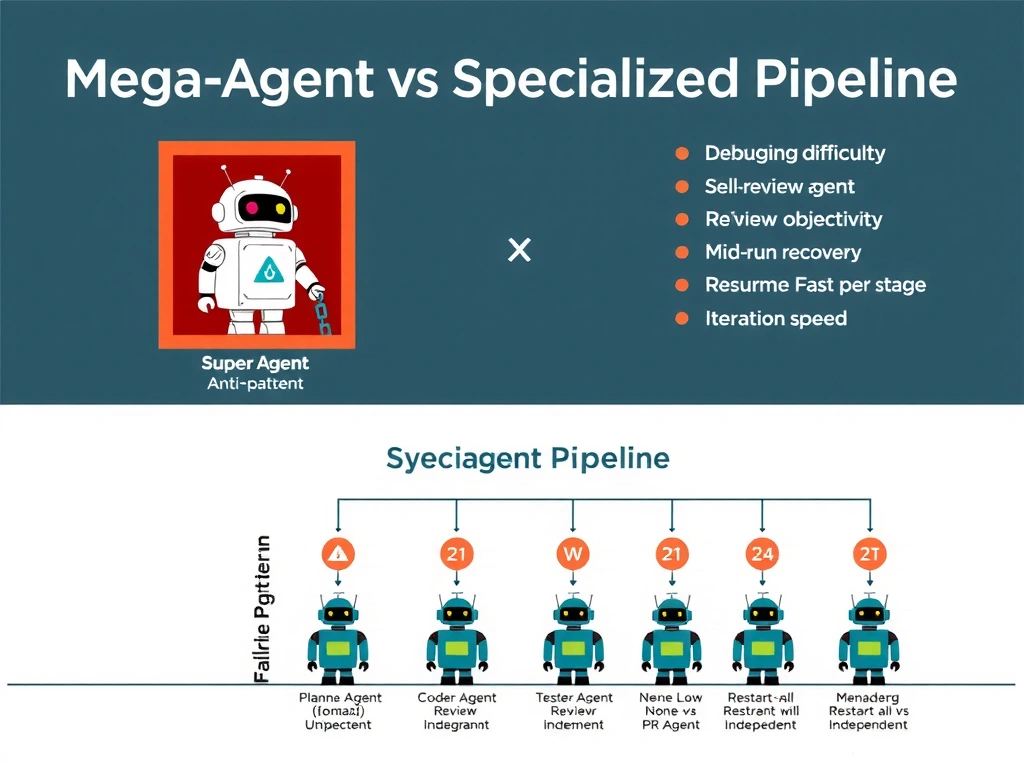
Full Explanation
The 'mega-agent' anti-pattern is one of the most common architectural mistakes teams make when first adopting agentic systems. It feels efficient to chain everything together, but it violates single-responsibility in ways that compound over time.
Option A is wrong. Write access is appropriate for an agent that creates code — the problem is architectural, not permissions-based. Removing write access would prevent the agent from doing its job.
Option B is correct. When planning, implementation, self-review, and PR creation all occur in one loop, several problems emerge: (1) Failure isolation is impossible — if the implementation step generates bad code, the self-review step is reviewing output from the same model with the same biases, so it cannot provide an independent quality signal. (2) Mid-run failures discard all completed work, requiring a full restart. (3) Observability collapses — you cannot tell whether the PR quality problem originates in planning, implementation, or review. (4) Iteration is painful — improving the review step requires testing the entire pipeline. Specialized agents for each stage enable independent evaluation, parallel development, and targeted remediation.
Option C (smaller context window) addresses a symptom but not the cause. Even with a focused context window, a single agent combining all roles will still have self-review blind spots and opaque failure modes.
Option D is wrong because autonomous PR creation is a legitimate and useful capability. The problem is not PR creation autonomy; it is the architectural decision to combine all roles into one agent. A specialized PR-creation agent that receives reviewed, validated output from upstream agents is a sound design.