
A multi-agent pipeline that generates API documentation produced an incorrect output three days ago. The pipeline included a research agent, a drafting agent, and a formatting agent. Logs exist but are unstructured. Audit artifacts were not created during the run. What limitation does this create for post-hoc analysis?
Select an answer to reveal the explanation.
Short Explanation and Infographic
Trying to reconstruct a car accident without dash cam footage, witness statements, or a police report means you're guessing based on the damage — not analyzing evidence. On the exam: the absence of structured audit artifacts makes post-hoc analysis guesswork; this is why audit artifact creation is a required part of multi-agent pipeline design.
Full explanation below image
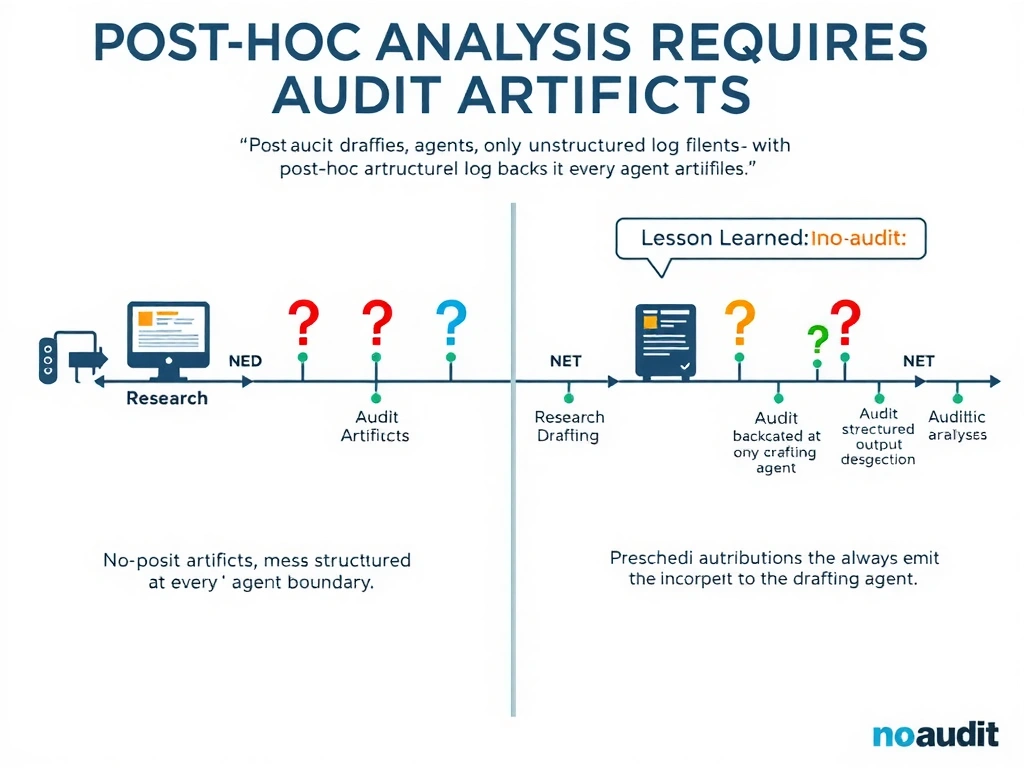
Full Explanation
Structured audit artifacts serve as the authoritative record of a pipeline run: they capture each agent's input, intermediate outputs, decisions made, and the final result in a structured, queryable format. Without them, post-hoc analysis (option B) is severely limited: the team cannot definitively determine which agent produced which content, cannot trace a specific incorrect claim back to its originating agent, and cannot distinguish whether the error occurred in the research phase, the drafting phase, or the formatting phase. Unstructured logs may capture some events but not the structured agent-attribution data needed for precise fault localization.
Option A is incorrect because the pipeline's ability to re-run is unrelated to the logging infrastructure. The pipeline ran three days ago — its infrastructure is presumably intact. The post-hoc analysis limitation is about missing historical evidence, not current operational capability.
Option C is incorrect because the formatting agent's output validation does not depend on whether the artifact was published. The issue is the lack of intermediate audit data, not the published state of the final artifact. The final artifact exists and can be inspected.
Option D is incorrect because the absence of error logs does not indicate a model-level issue, and it certainly does not make the failure unclassifiable. Silent correctness failures (wrong output without errors) are common in agentic systems and can be attributed to instruction, context, or tool failures — but without audit artifacts, you cannot determine which. 'Must be a model issue' is a premature and incorrect conclusion.