
Two worker agents independently review the same pull request and produce mutually contradictory suggestions for the same function: Worker A recommends extracting the function into a utility module, while Worker B recommends inlining it for performance. The coordinator must produce a single review. How should it handle the conflict?
Select an answer to reveal the explanation.
Short Explanation and Infographic
When two doctors give opposite recommendations about a treatment, the patient needs to hear both opinions and the reasoning — not a coin flip or a compromise that neither doctor recommended. On the exam: coordinators must surface genuine conflicts with attribution and trade-off explanation, then defer to human judgment rather than synthesizing an arbitrary resolution.
Full explanation below image
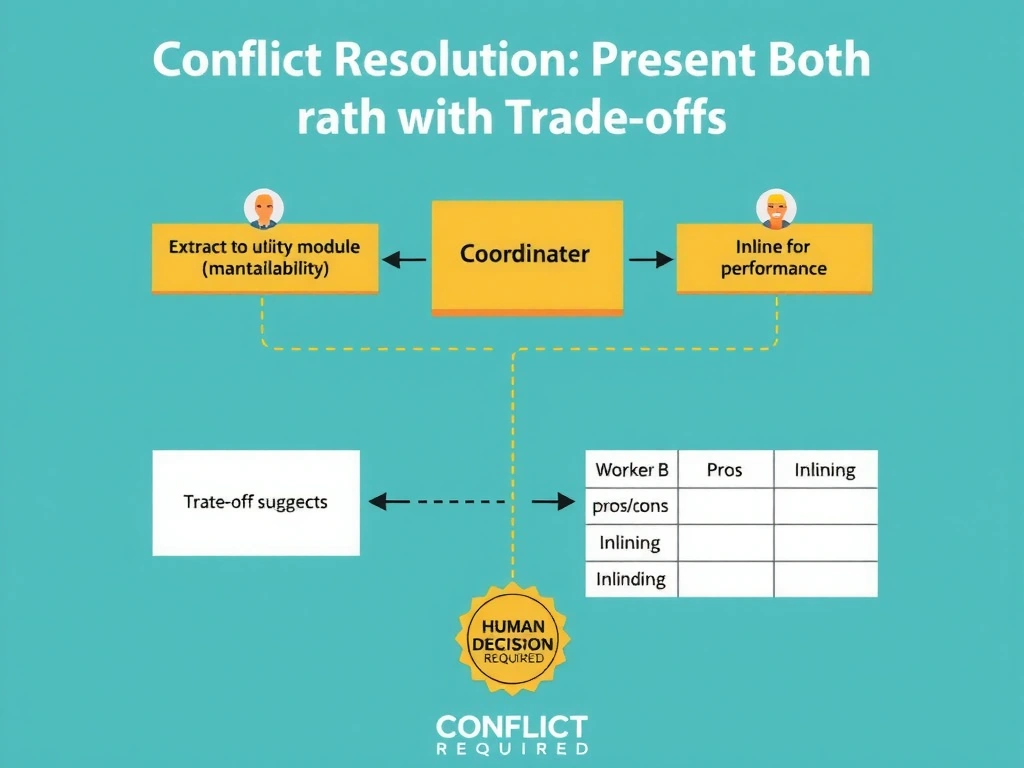
Full Explanation
Contradictory agent suggestions represent a genuine trade-off decision — extraction vs. inlining are both valid software design choices depending on context (team conventions, performance requirements, codebase size). Neither worker agent is wrong in isolation; they are optimizing for different goals. The coordinator's job in this scenario is not to arbitrate the technical dispute but to present both positions clearly and identify that this is a decision point requiring human judgment. Option C achieves this by including both suggestions, explaining the trade-offs (maintainability/reuse vs. performance), and flagging the item for human decision.
Option A (using the first-to-complete suggestion) introduces a spurious ordering heuristic. Completion time has no relevance to recommendation quality. This approach silently discards one valid perspective based on a non-technical criterion.
Option B (averaging) is not meaningful for discrete architectural choices. 'Partial extraction' is not a recognized resolution of the extraction-vs-inlining debate — it may produce code that is worse than either original suggestion. Synthesizing a compromise between binary architectural choices typically yields the worst of both worlds.
Option D (discarding both) is the worst response. The function clearly warrants review — that's why both agents commented on it. Omitting it from the review because two agents disagreed leaves the PR reviewer without any guidance on a point of genuine importance, and the conflict itself signals that the decision deserves attention.