
A multi-agent CI pipeline includes a linting agent, a test-writing agent, and a code-review agent running in sequence. After a pipeline run, the final code review flags 23 style violations that should have been caught by the linting agent. Which step most effectively identifies which agent introduced the gap?
Select an answer to reveal the explanation.
Short Explanation and Infographic
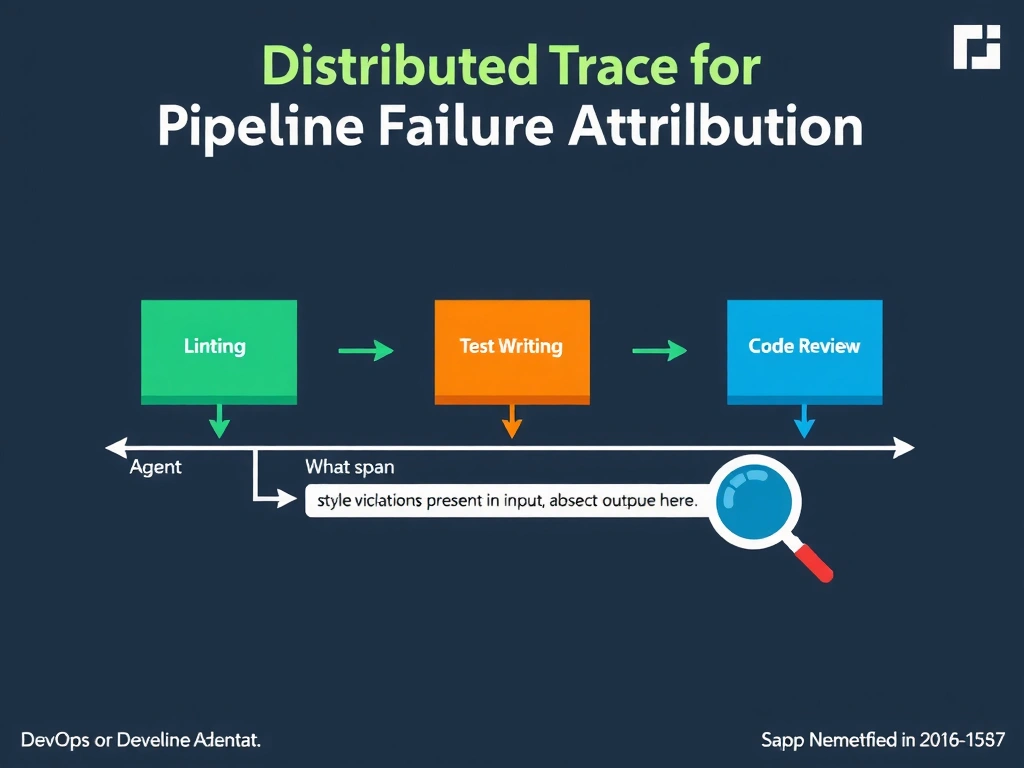
When a relay team loses a race, you watch the race video — not just the finish line — to see exactly where the baton was fumbled. On the exam: distributed traces are the primary tool for attributing failures to specific agents in a multi-step pipeline; re-running or inspecting config files only reveals future state, not what happened in the failing run.
Full explanation below image
Full Explanation
In a multi-agent pipeline, distributed traces capture the inputs, outputs, and tool calls of every agent at every stage, creating a complete causal record of the pipeline run. To find where style violations were missed, you examine the linting agent's output in the trace: if violations were present in its input code but absent from its output findings, the linting agent is the source of the gap. If the linting agent correctly flagged them but the test-writing agent's input shows them removed or filtered, the gap is in the handoff. Option B correctly uses distributed traces as the investigation tool.
Option A (re-running with verbose logging) is a prospective action — it tells you what happens in a new run, not what happened in the failing run. The violations might not even reproduce. Additionally, verbose logging alone does not provide the structured per-agent input/output visibility that traces do.
Option C is incorrect because asking the code-review agent to explain why it flagged violations does not answer the question of why the linting agent didn't catch them. The code-review agent has no insight into the linting agent's behavior or configuration — it only sees its own input.
Option D (inspecting the linting agent's configuration file) may be a follow-up action after identifying the linting agent as the culprit, but it should come after trace analysis, not before. The config reflects current state, not the state during the failing run. The config may have already been changed, or the failure may be in the instructions rather than the config.