
An agent tasked with generating a database migration script consistently produces scripts that are syntactically valid but target the wrong table. Traces show the agent correctly calls the schema-inspection tool, but interprets the results incorrectly. How should this failure be classified for remediation purposes?
Select an answer to reveal the explanation.
Short Explanation and Infographic
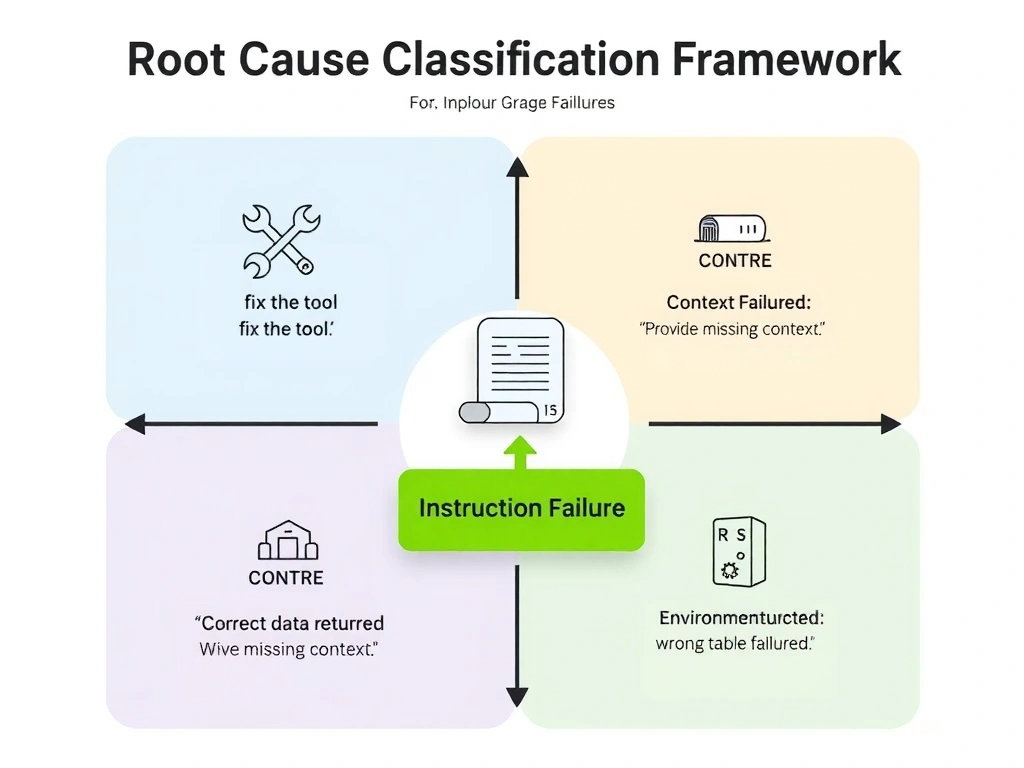
If the GPS gives you correct directions but you keep turning the wrong way, the problem isn't the GPS — it's how you're reading it. On the exam: when a tool returns correct data but the agent acts incorrectly on it, the failure class is instruction failure — fix the agent's instructions, not the tool.
Full explanation below image
Full Explanation
Root cause classification determines where the remediation effort goes. The traces tell us the schema-inspection tool is being called and returning data, but the agent misinterprets that data. This is an instruction failure (option B): the agent's instructions or prompt do not clearly specify how to parse and use the tool's output to identify the correct target table. The fix is to revise the instructions with clearer guidance on interpreting schema output — for example, specifying naming conventions, which fields indicate primary vs. secondary tables, or what disambiguation steps to take when multiple tables match.
Option A (tool failure) is ruled out by the traces, which confirm the tool is returning data correctly. If the tool itself were returning wrong data, the fix would be in the tool layer — adding validation, correcting the query, or replacing the tool. But the trace shows correct tool behavior.
Option C (context failure) would apply if the agent lacked access to necessary information — for example, if it couldn't see which migration was currently active or what the database topology looked like. But the trace shows it has access to the schema data; it just misuses it.
Option D (environment failure) would apply if the database schema environment itself were misconfigured — wrong tables present, incorrect permissions, stale schema. But the traces confirm schema data is available and the agent can retrieve it, ruling out environment issues as the root cause.