
A developer submits the prompt 'Clean up the repo' to an autonomous agent that has write access to the GitHub repository. Without requesting clarification or generating a plan, the agent immediately deletes branches it classifies as stale, removes files it judges redundant, and closes issues it considers resolved. The repository owner later discovers that a critical hotfix branch and several open feature branches were deleted. Which agent anti-pattern caused this outcome?
Select an answer to reveal the explanation.
Short Explanation and Infographic
A contractor who hears 'fix things up' and immediately demolishes a load-bearing wall isn't incompetent — they're reckless for not asking first. On the GH-600 exam, an agent that acts on an ambiguous prompt without clarifying intent, producing a plan, or obtaining approval is exhibiting the premature execution anti-pattern. Ambiguity in the input is a mandatory pause signal, not a green light.
Full explanation below image
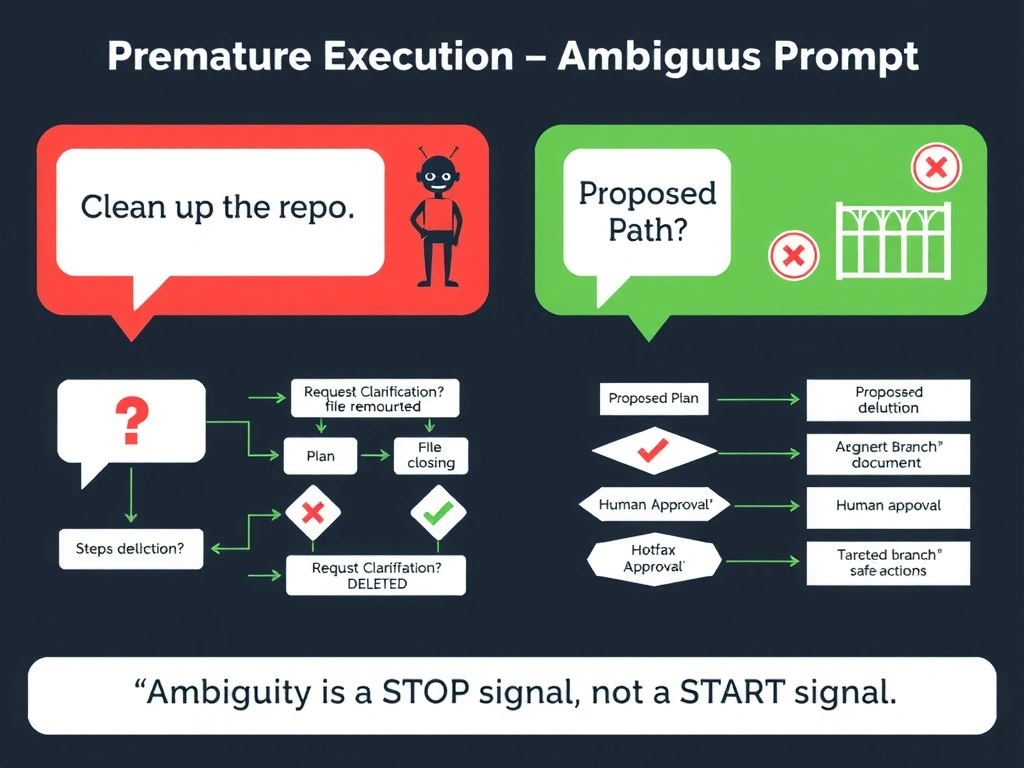
Full Explanation
This scenario highlights a compound failure of multiple Domain 1 requirements, but the root cause is premature execution — the agent treated an ambiguous, natural-language prompt as sufficient authorization to take irreversible action.
Domain 1 identifies several principles that were violated simultaneously:
1. Prevent premature action: The agent should have paused when it encountered an ambiguous prompt and either requested clarification or generated a proposed plan for review before executing. 2. Separate planning from execution: A correct implementation would have generated a list of proposed deletions and closures as a plan artifact, presented it for human approval, and only then proceeded. 3. Define success criteria: Without clarifying what 'cleaned up' means to the repository owner, the agent had no reliable metric for distinguishing stale branches from active hotfix branches. 4. Configure human intervention: Deleting branches and closing issues are irreversible or semi-irreversible operations that warrant a human checkpoint.
Why (a) is wrong: Tool over-provisioning (excessive permissions) may have enabled the damage, but it doesn't describe the behavioral failure. An agent with appropriate permissions can still exhibit premature execution if it acts without a plan or approval.
Why (b) is wrong: Memory gaps could contribute to classification errors, but the primary failure is not knowing the repository's context — it's acting on an ambiguous prompt without clarification at all.
Why (c) is wrong: Scope creep refers to an agent expanding beyond its defined responsibilities over time. Here, the agent's scope was genuinely ambiguous from the start. The failure is not scope expansion but rather acting without first resolving the ambiguity.
Why (d) is correct: Ambiguous prompt + no clarification + no plan + no approval + irreversible action = premature execution. This is the anti-pattern Domain 1 is designed to prevent.