
In a multi-agent deployment system, a planning agent generates a JSON deployment plan and writes it to a shared artifact store. An execution agent is subscribed to the same artifact store and will begin deploying resources as soon as a plan appears. A Domain 1 reviewer flags this design as incomplete. What is missing?
Select an answer to reveal the explanation.
Short Explanation and Infographic
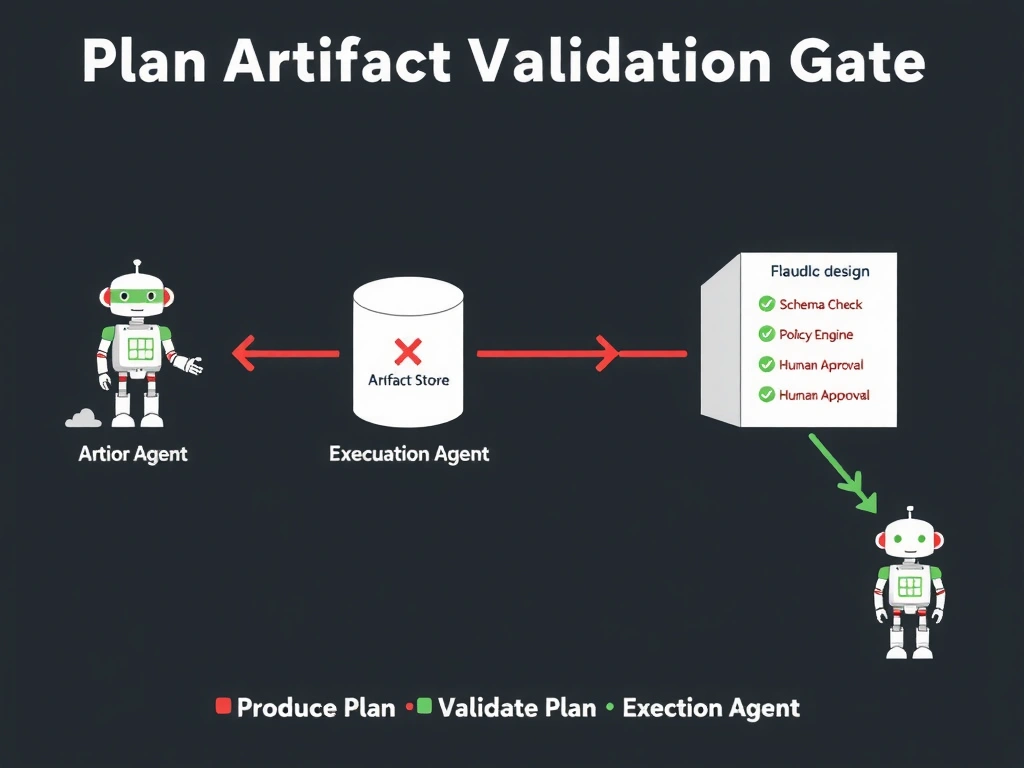
Writing a plan to a shared store and then immediately acting on it is like posting a draft surgery schedule on the board and letting any available surgeon start — without anyone verifying the draft is correct. On the GH-600 exam, producing a plan artifact is necessary but not sufficient: the plan must pass a validation gate before the execution agent is permitted to act. The artifact store is a transport layer, not a validator.
Full explanation below image
Full Explanation
This scenario tests the validate plans and prevent premature action objectives from Domain 1. The design described has the right structural elements — a dedicated planning agent, a shared artifact store, and a separate execution agent — but it is missing the critical gate between plan production and execution.
The execution agent subscribing directly to artifact arrival means any plan, including one that is malformed, policy-violating, or generated from a corrupted input, will trigger immediate execution. Domain 1 requires that a validation step intercept the plan before the execution agent acts. This validation can take multiple forms: an automated schema validator that checks the JSON structure against a known schema, a policy engine that verifies the plan doesn't violate organizational guardrails, a human reviewer who inspects the plan and provides an explicit approval signal, or some combination of all three.
Why (a) is wrong: Email notification is an observability practice, not a validation gate. Informing a human after the plan is produced does not prevent the execution agent from acting on an invalid plan if the human hasn't responded yet.
Why (b) is wrong: Having the planning agent monitor execution in real time is a useful pattern for error detection, but it does not prevent a flawed plan from being executed in the first place. Monitoring is a reactive control; validation is a preventive control.
Why (d) is wrong: Independent plan regeneration would detect non-determinism between agents but is computationally expensive, adds latency, and still doesn't validate the plan against policy or business rules. It's also not a Domain 1 pattern.
Why (c) is correct: A validation gate — whether automated, human-reviewed, or hybrid — is the missing element. It decouples plan production from plan execution and is the control that 'prevents premature action' by the execution agent.