
A team uses two agents to generate code for different modules of the same service. When the modules are integrated, developers find they use completely different naming conventions, error handling patterns, and code structure — one uses camelCase with try/catch blocks, the other uses snake_case with result tuples. No conflicts occur during generation. What coordination element is missing?
Select an answer to reveal the explanation.
Short Explanation and Infographic
Two agents generating code independently without a shared style guide are like two contractors building different rooms using different building codes — each room is fine on its own but they don't connect. A shared coding standards document injected into both agents' system prompts, plus a cross-agent consistency check, are the coordination glue that keeps multi-agent output coherent.
Full explanation below image
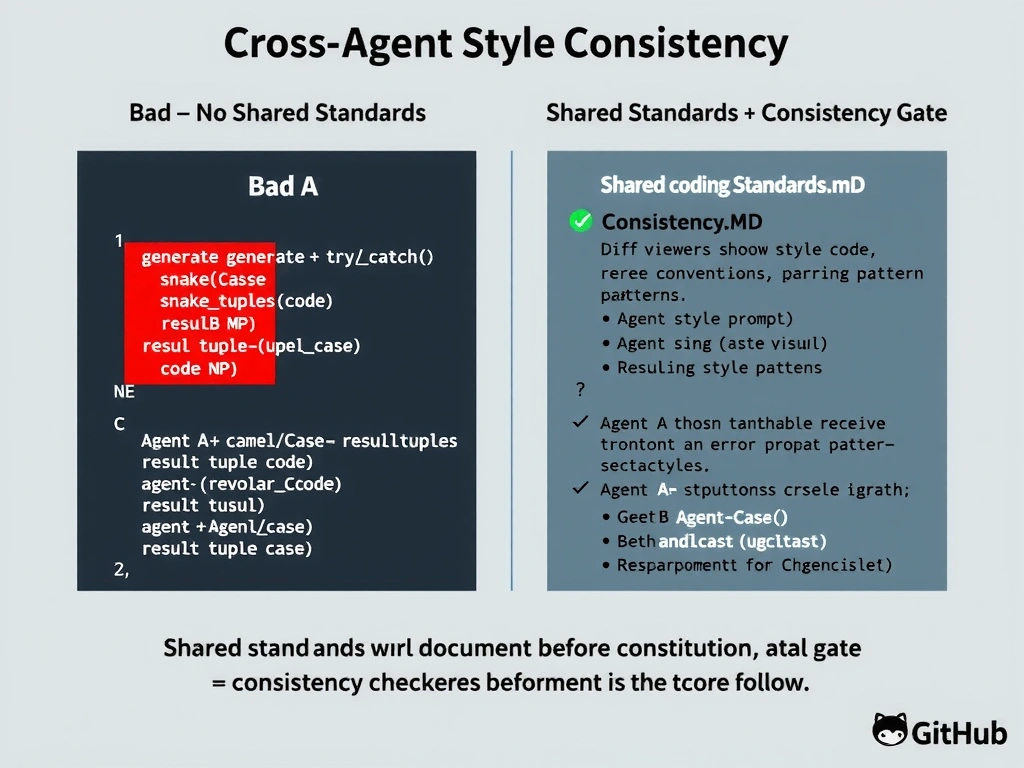
Full Explanation
Stylistic and structural consistency across multi-agent code generation requires explicit coordination of standards. When two agents each generate code independently using their own default style, the outputs will reflect each model's individual patterns, training distributions, and prompt phrasing — producing internally consistent but mutually inconsistent codebases.
The two coordination mechanisms that address this are: (1) Shared standards injection: provide both agents with the same coding standards document as part of their system prompt — naming conventions, error handling patterns, file structure expectations, type annotation requirements, etc. This aligns their generation from the start; (2) Cross-agent consistency gate: after both agents complete generation, run a consistency check (automated linting against the shared standards, or an LLM judge comparing the two outputs for stylistic alignment) before integration.
Option A (merge into one agent) would solve the consistency problem but eliminates the parallelism, specialization, and modularity of the multi-agent design. It is a valid choice for small scopes but is not the right answer for maintaining the multi-agent architecture.
Option C (prevent concurrent generation) imposes serial execution, which eliminates one potential source of inconsistency (concurrent divergence) but does not actually align the agents' styles. The second agent would still generate in its own style unless given the first agent's output as a style reference — which is a different coordination approach (style-from-example) rather than serial execution itself.
Option D (discard one agent's output) wastes the work of the discarded agent and eliminates the productivity benefit of multi-agent generation.
Shared coding standards with consistency validation is the scalable solution for multi-agent code coherence.