
A team decides to replace Agent V1 with a new Agent V2 that has been tested and validated. Agent V1 is currently mid-task on three long-running workflows. The team immediately stops Agent V1 and deploys Agent V2. Agent V2 is not given the in-progress workflow state, context from prior steps, or any record of what Agent V1 had completed. All three workflows must restart from scratch. What process should have been followed?
Select an answer to reveal the explanation.
Short Explanation and Infographic
Yanking an agent mid-task without handing off state is like firing a surgeon mid-operation with no briefing for the replacement — everyone loses. A structured retirement process lets V1 finish or checkpoint first, packages the workflow state, and transfers it to V2 so the new agent can pick up the thread, not start over.
Full explanation below image
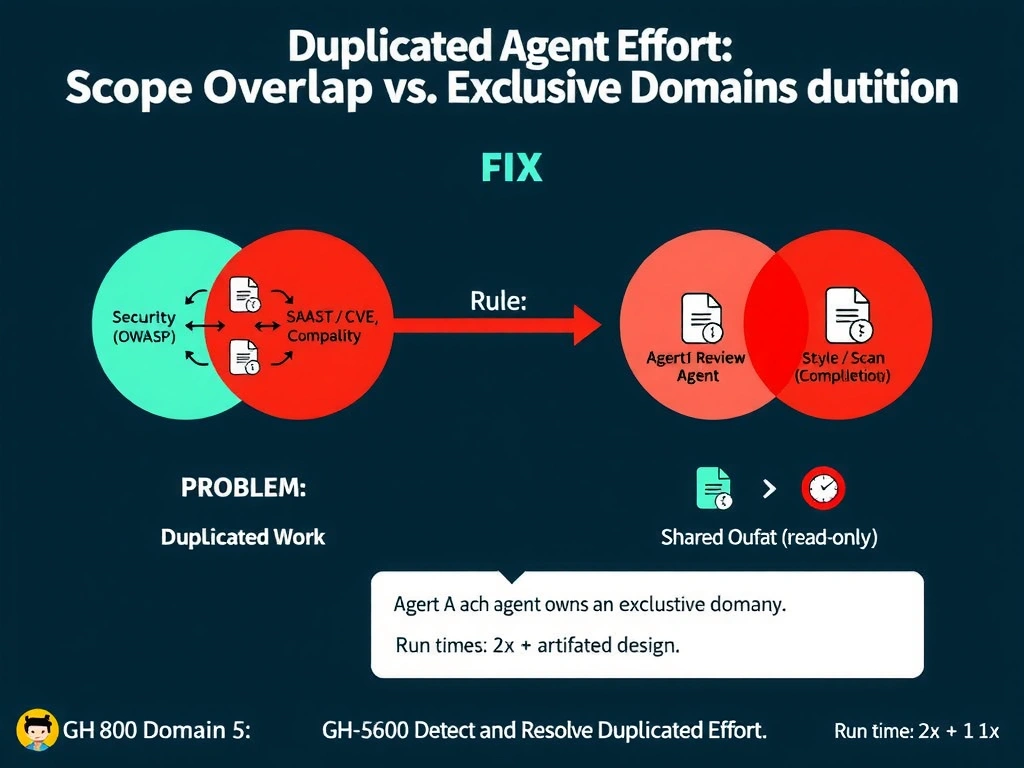
Full Explanation
Agent retirement in a production multi-agent system requires a structured handover process analogous to personnel transitions in any operational context. Immediately stopping an agent mid-task without state transfer causes all in-progress work to be lost.
A structured retirement process includes: 1. Drain period: stop assigning new tasks to Agent V1; allow it to complete or reach a safe checkpoint on all in-progress tasks 2. State capture: at each checkpoint, Agent V1 serializes its current state — task progress, decisions made, accumulated context, pending steps — to a durable store 3. State transfer: Agent V2 is configured to load the captured state for each in-progress workflow before resuming 4. Verification: Agent V2 performs a brief context review of the transferred state to confirm it understands the current position in each workflow 5. Agent V1 shutdown: only after all state is transferred and Agent V2 has acknowledged each in-progress workflow
Option A (training V2 on V1's outputs) allows V2 to understand V1's style and format but does not give it the actual task-specific state of the three in-progress workflows. General training does not substitute for specific workflow context.
Option C (never retire V1) is operationally unsustainable. Agents must be upgradeable. Perpetually running V1 alongside V2 for all existing workflows defeats the purpose of the upgrade and creates indefinitely branching maintenance obligations.
Option D (parallel execution + human selection) is suitable for evaluation/testing phases before retirement, not for mid-retirement transition of in-progress production workflows.