
An agent's logs consistently show tool call failures on a file-read operation. The team responds by replacing the file-read tool with a different implementation. After the change, the agent still fails in the same way. A deeper review reveals the agent was constructing the wrong file path before calling the tool — the path was always invalid. What root cause classification best describes the original failure?
Select an answer to reveal the explanation.
Short Explanation and Infographic
Blaming the hammer when you're hitting the wrong nail — that's a misclassified root cause. The tool worked fine; the agent was reasoning its way to a bad file path before ever calling it. Replacing the tool was wasted effort because the failure lived in the agent's planning layer, not its execution layer. The exam tests your ability to classify failures correctly: reasoning errors are agent-side logic failures, distinct from tool errors, environment issues, or context gaps.
Full explanation below image
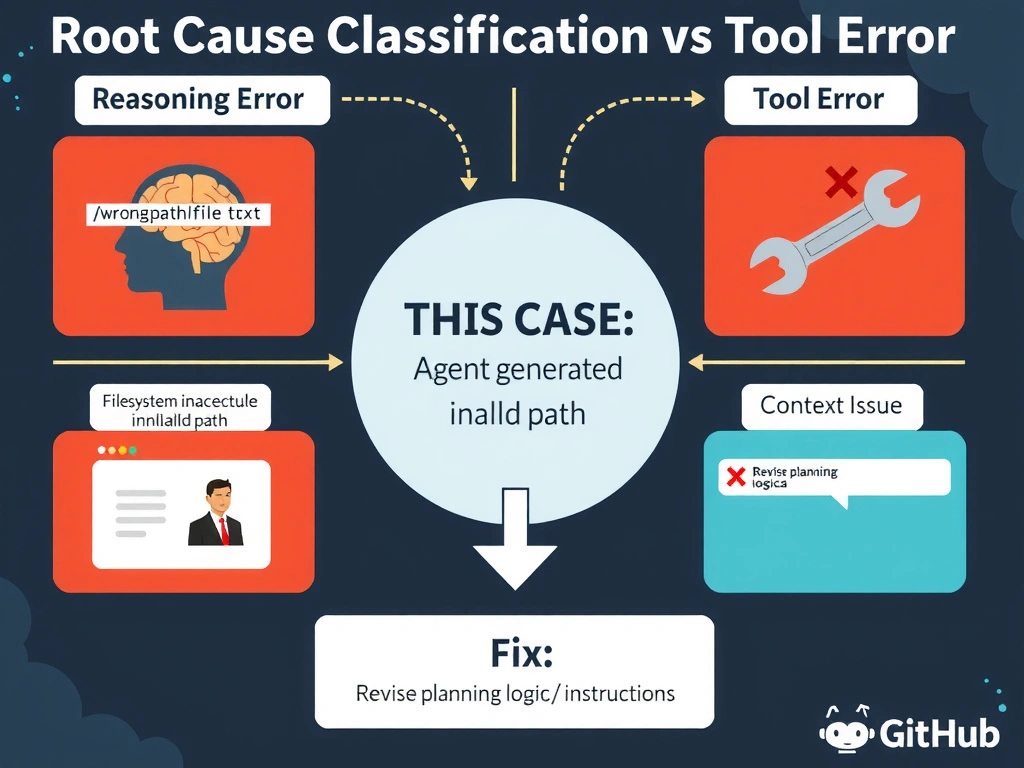
Full Explanation
This question tests root cause classification — a critical evaluation skill for agentic systems. Misclassifying a root cause leads to wasted remediation effort and recurring failures.
The correct answer is C. A reasoning error occurs when the agent's internal logic — its planning, inference, or input construction — produces incorrect results, even when all tools and environment components are functioning correctly. In this case, the agent was computing an invalid file path. The file-read tool was working as designed; it received a bad path and correctly returned an error. Replacing the tool had no effect because the defect was upstream in the agent's reasoning chain. The fix is to revise the agent's instructions, prompt, or planning logic so it constructs valid file paths.
Option A is incorrect. Tool misconfiguration would mean the tool itself was incorrectly set up — wrong permissions, missing dependencies, bad configuration parameters. But the tool was functioning correctly when given valid paths; the problem was the agent's input generation.
Option B is incorrect. An environment constraint would manifest as the tool failing consistently regardless of the path (e.g., the file system being inaccessible from the CI container). Here the tool failed only because the paths were invalid, not because of access issues.
Option D is incorrect, though tempting. A context issue refers to the agent lacking information it needs to complete its task — for example, not knowing which repository it's operating in. While related, the specific failure here is that the agent had enough context but made a reasoning error in how it processed that context to construct the path.
Proper root cause classification — reasoning error vs. tool error vs. environment vs. context — is essential because each class has a different remediation strategy: prompt/instruction revision for reasoning errors, tool configuration for tool errors, environment setup for environment issues, and context enrichment for context gaps.