
A team wants to upgrade their documentation agent (v1) to a newer version (v2) that uses a different output format. Five other agents currently depend on the documentation agent's output. A direct cutover to v2 would break all five downstream agents simultaneously. What approach BEST minimizes risk during this lifecycle transition?
Select an answer to reveal the explanation.
Short Explanation and Infographic
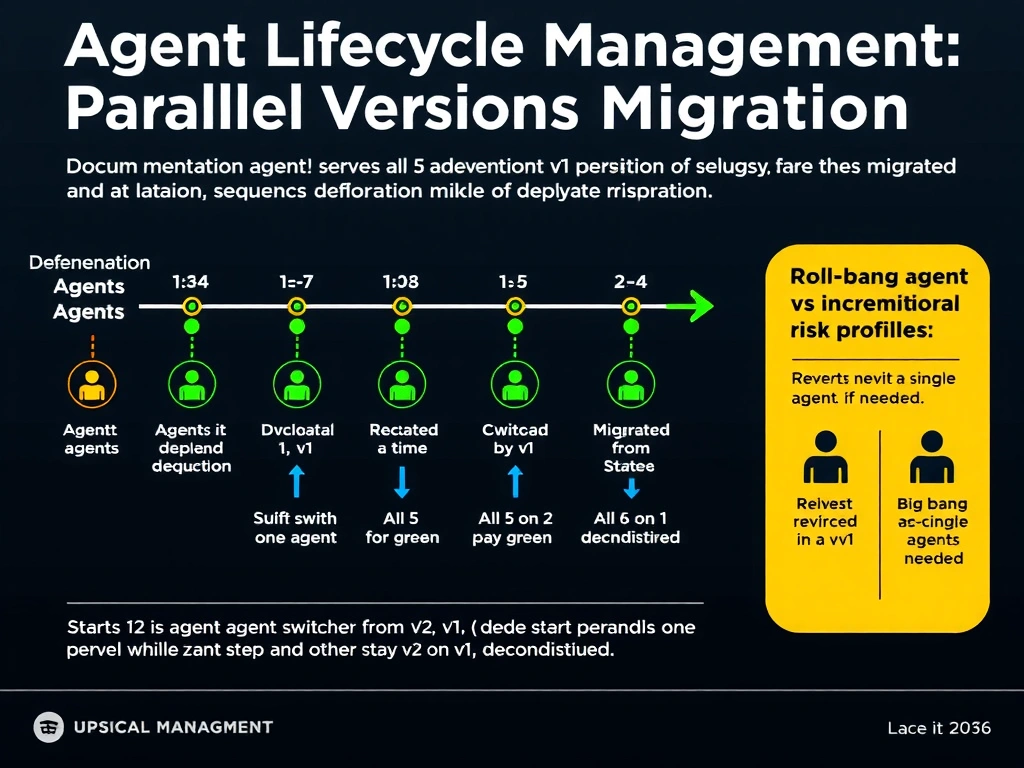
You don't pull a ship's engine while it's sailing — you swap it engine by engine at port. The blue-green / versioned routing pattern runs v1 and v2 simultaneously. Each dependent agent migrates to v2 on its own schedule, and v1 stays live until every consumer is confirmed migrated. Zero simultaneous breakage, full rollback capability at any step.
Full explanation below image
Full Explanation
Agent lifecycle management — particularly version upgrades with downstream dependents — requires a migration strategy that prevents simultaneous breakage of dependent systems. The correct approach is a parallel-run/versioned-routing strategy (often called blue-green deployment in service contexts).
The migration sequence is: 1. Deploy documentation agent v2 in parallel with v1 (both running simultaneously) 2. Configure the routing layer to direct each dependent agent to its designated version 3. Migrate dependent agents to v2 one at a time, testing each after migration 4. If any migration causes issues, roll back that single dependent agent to v1 without affecting the others 5. After all five dependent agents have successfully migrated and been validated, decommission v1
This approach ensures: - At no point are all five dependents broken simultaneously - Each migration step can be individually verified and rolled back - The system remains operational throughout the entire migration period - v1 serves as a guaranteed fallback until v2 is fully validated
Why the other options fail: - Option A (big-bang cutover) requires a full system stop, simultaneous updates to six agents, and a coordinated restart. Any single failure in any of the six components requires restarting the entire migration. Risk is maximized by concentrating it in a single moment. - Option C (break first, adapt later) is not a migration strategy — it is deliberate system breakage. Dependent agents do not self-adapt to format changes; they fail with parse errors and halt until manually corrected. - Option D (dual-format output forever) is a maintenance burden that doesn't actually solve the migration problem — it defers it indefinitely and eventually creates a permanent compatibility complexity. This is technical debt, not a migration strategy.
Parallel deployment with versioned routing and incremental migration is the risk-minimizing pattern for agent lifecycle management.