
A multi-agent system has five coordinating agents. One subagent begins returning malformed JSON in its inter-agent messages. The other four agents are consuming this malformed JSON, failing to parse it, and propagating the error by passing partial data to their own downstream consumers. The cascading failure is spreading across the system. What is the correct immediate response?
Select an answer to reveal the explanation.
Short Explanation and Infographic
A sick node poisoning the network must be quarantined first — same as network security, same as epidemiology. Stop the spread before you diagnose the cause. Isolate the bad actor, intercept the contaminated messages, restore clean coordination between the healthy agents, then investigate the root cause on the isolated node separately.
Full explanation below image
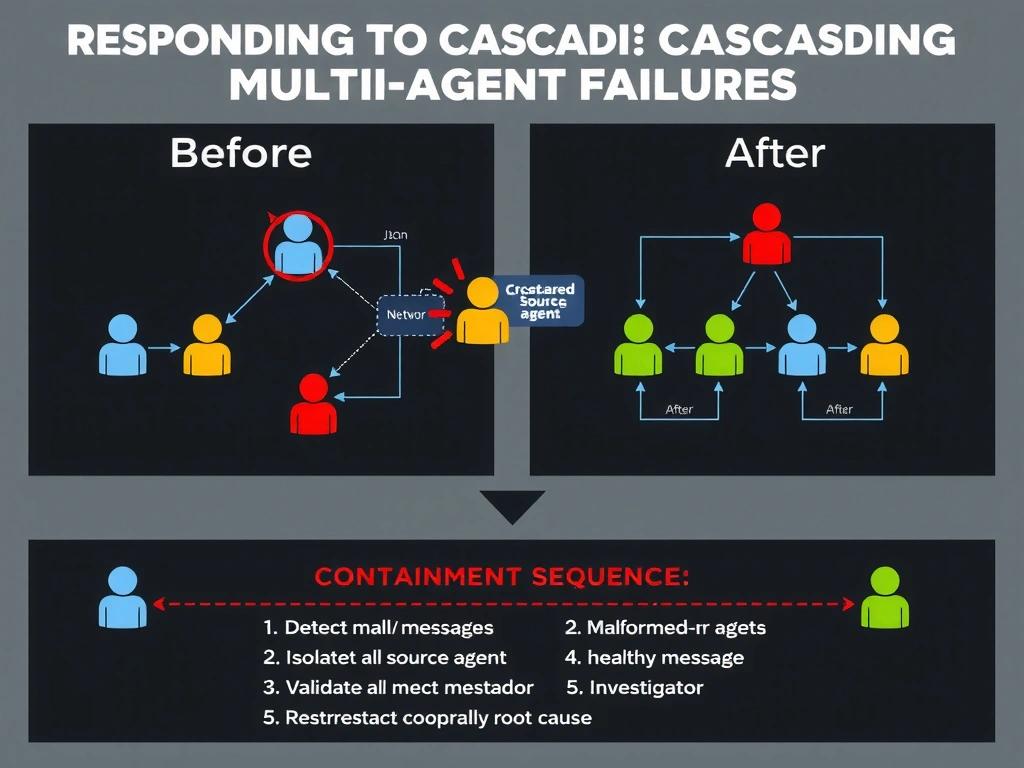
Full Explanation
Cascading failures in multi-agent systems occur when a malfunctioning agent's bad output propagates through inter-agent communication channels to downstream consumers. The immediate priority is containment — stopping the cascade from spreading further — before attempting diagnosis or repair.
The correct immediate response has two components:
1. Isolate the malfunctioning agent: Remove the bad actor from the coordination network so it cannot send additional malformed messages. This may mean suspending its task, revoking its access to the shared communication channel, or having the orchestrator stop forwarding its messages to downstream agents.
2. Stop propagation: The orchestrator should intercept all inter-agent messages and validate them before forwarding. Malformed messages should be discarded or quarantined rather than passed to consumers. This prevents further contamination of downstream agents.
After containment, the team can investigate the root cause of the malformed JSON (a bug, a model change, a corrupted context) and decide whether to restart the isolated agent, replace it, or escalate.
Why the other options fail: - Option A (restart all agents) is too disruptive. The four healthy agents are not the problem — restarting them loses their current work state unnecessarily. Targeted isolation of the failing agent is more precise than a full system restart. - Option C (continue operating with partial data) accepts the cascade and allows corrupted state to spread further through the system. Partial data in coordination messages produces increasingly unreliable behavior in all downstream agents. The failure must be stopped. - Option D (increase timeouts) addresses a completely different failure mode — timeout errors, not malformed data. Longer timeouts give agents more time to process bad input, which doesn't fix the parsing failure and simply delays when the error surfaces.
The correct immediate response to any cascade failure is: isolate the source, stop the spread, then diagnose.