
You are building an agent that generates database migration scripts. Before any scripts are written, you want the agent to output a machine-readable plan that downstream systems can validate and log. Which configuration produces the most useful structured plan output?
Select an answer to reveal the explanation.
Short Explanation and Infographic
A pilot doesn't describe the flight plan in conversation — the FAA requires a standardized form with specific fields. Agents are the same: a freeform paragraph or Markdown list cannot be machine-validated, logged, or programmatically approved. A structured JSON plan with typed fields (step_id, operation, rollback) can be parsed, stored, diffed, and approved by downstream systems automatically.
Full explanation below image
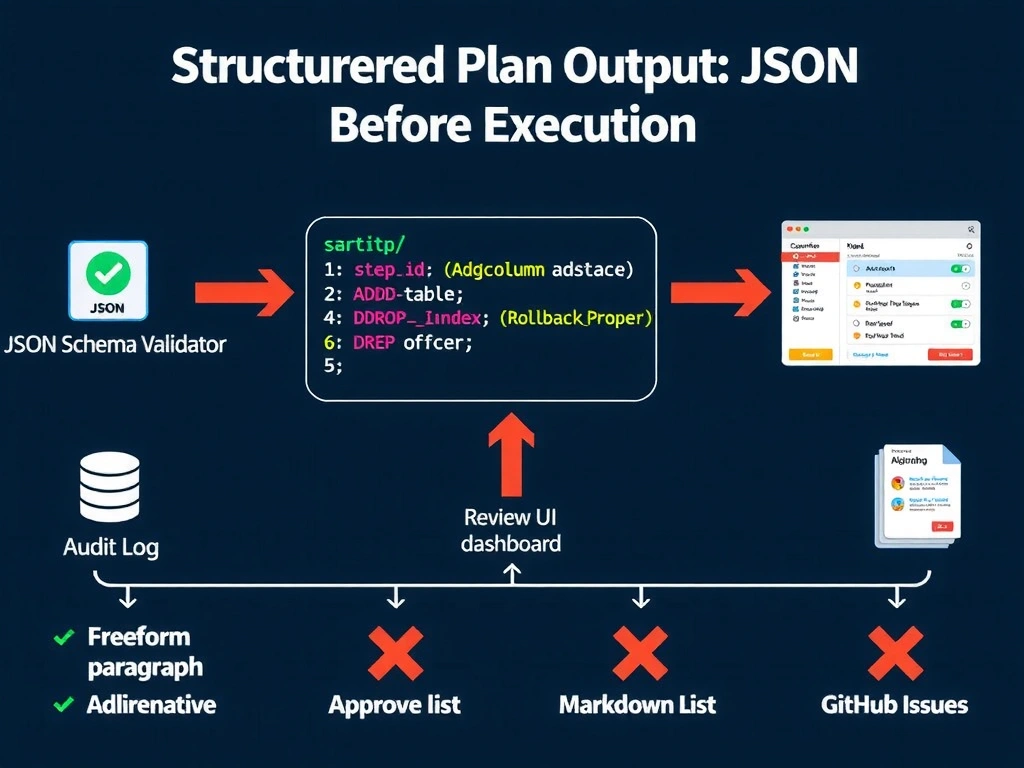
Full Explanation
Configuring an agent to output a structured plan means producing a machine-readable artifact — typically JSON or a validated schema — before any destructive or write operations occur. This plan becomes the basis for automated validation, human review, audit logging, and rollback planning.
Option B is correct. It specifies a JSON array of migration steps, each with typed fields: step_id (for referencing and ordering), target_table (scope), operation type (e.g., ADD_COLUMN, DROP_INDEX), estimated_rows_affected (risk indicator), and rollback_procedure. This schema can be parsed and validated by a JSON schema validator, logged to an audit trail, displayed in a review UI, and used to generate rollback scripts automatically. Downstream systems can approve or reject individual steps without human reading comprehension.
Option A produces freeform prose. While readable by humans, it cannot be parsed reliably, cannot be machine-validated against a schema, and cannot be logged in a structured audit system. Two agents might produce semantically identical plans in syntactically incompatible forms, making comparison impossible.
Option C improves on A slightly (ordered list vs. paragraph), but Markdown is not machine-parseable in a reliable way. A numbered list of migration names gives no information about operation type, rollback, or risk — insufficient for validation or approval.
Option D (GitHub Issue) is creative but wrong. A GitHub Issue is a UI artifact designed for human collaboration, not machine ingestion. It adds latency, requires API calls, and cannot be directly consumed by a validation pipeline. The plan should exist as a structured output artifact in the agent's response context, not as a side-effect action.
The exam objective is: 'Configure an agent to output a structured plan.' The canonical pattern is a typed, schema-validated JSON document emitted before any execution tools are called.