
A team is configuring a GitHub Copilot Extension agent that will automatically generate and merge dependency update PRs. They want to ensure the agent reasons about what to update before taking any action. Which configuration approach enforces the separation of planning from execution?
Select an answer to reveal the explanation.
Short Explanation and Infographic
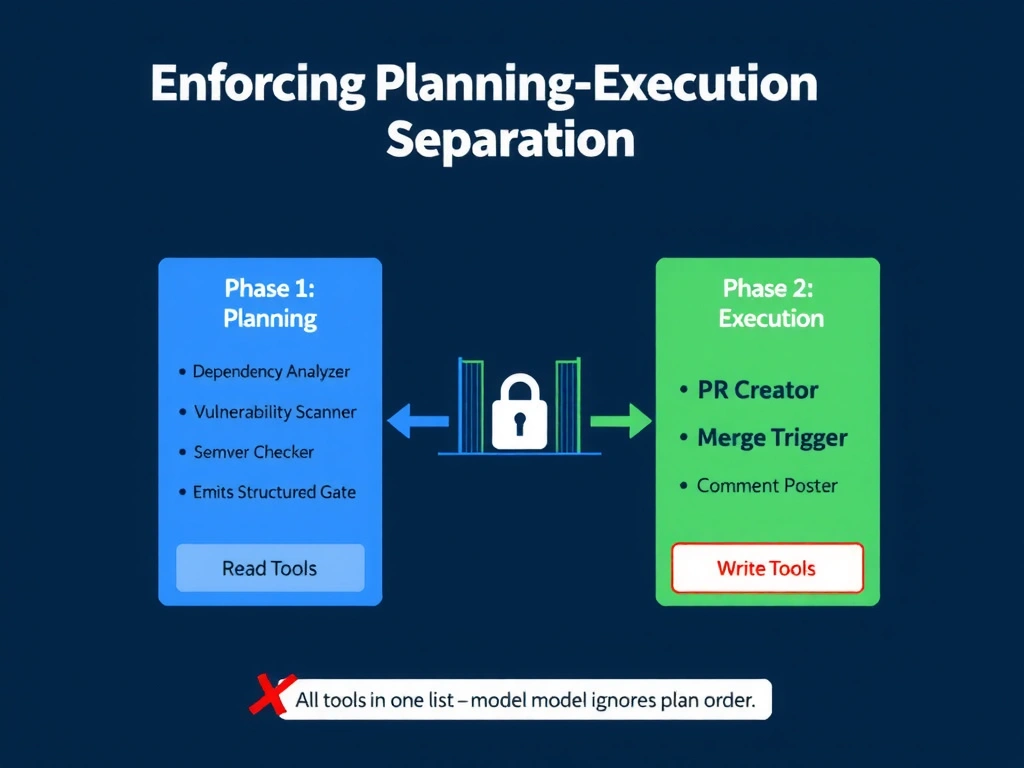
Telling someone 'think before you act' works better if you physically can't act yet — like handing a surgeon the scalpel only after the pre-op checklist is signed. Option B does exactly that: the planning phase has no write tools, so the agent literally cannot execute. Only after a plan is emitted do the write tools unlock. System prompt instructions alone can't enforce this — the model can still call a write tool if it's registered.
Full explanation below image
Full Explanation
Separating planning from execution is one of the most important structural safeguards in agent design. It prevents the plan-skipping anti-pattern and ensures that reasoning and action are temporally and mechanically distinct phases — not just suggested by a prompt.
Option B is correct. It enforces separation at the tool-registration level: during the planning phase, only read-only tools are available (e.g., dependency graph analysis, vulnerability scanning). The agent literally cannot create a PR or trigger a merge because those tools are not registered in that phase. After the plan is emitted as a structured artifact, a second invocation phase loads the write tools. This is a structural guarantee, not a behavioral request.
Option A relies on system prompt instruction ('plan before acting') to enforce order. This is insufficient because if all tools are registered simultaneously, the model can call a write tool at any point — including before completing its reasoning. Prompt-based ordering is unreliable, especially with complex multi-step tasks where context windows fill up.
Option C confuses temperature tuning with planning architecture. Temperature affects output randomness, not whether the agent structures its reasoning before executing. A high-temperature planning prompt might produce more varied outputs, but it does not create a structural separation between phases — write tools are still callable at any time.
Option D (30-second sleep) is a non-solution. Clock time has no relationship to reasoning quality or phase separation. The agent can still call a write tool immediately if it chooses — sleeping does not change tool availability.
The exam objective is: 'Configure agent planning to be distinct from agent execution.' The canonical pattern is two separate invocations with different tool sets, where execution tools are gated behind plan emission.