
An agent performs automated dependency upgrades in a monorepo. The team wants all intermediate agent reasoning and proposed changes to be inspectable within their existing GitHub-based development workflow — without requiring engineers to access external dashboards or log aggregation tools. Which approach best satisfies this requirement?
Select an answer to reveal the explanation.
Short Explanation and Infographic
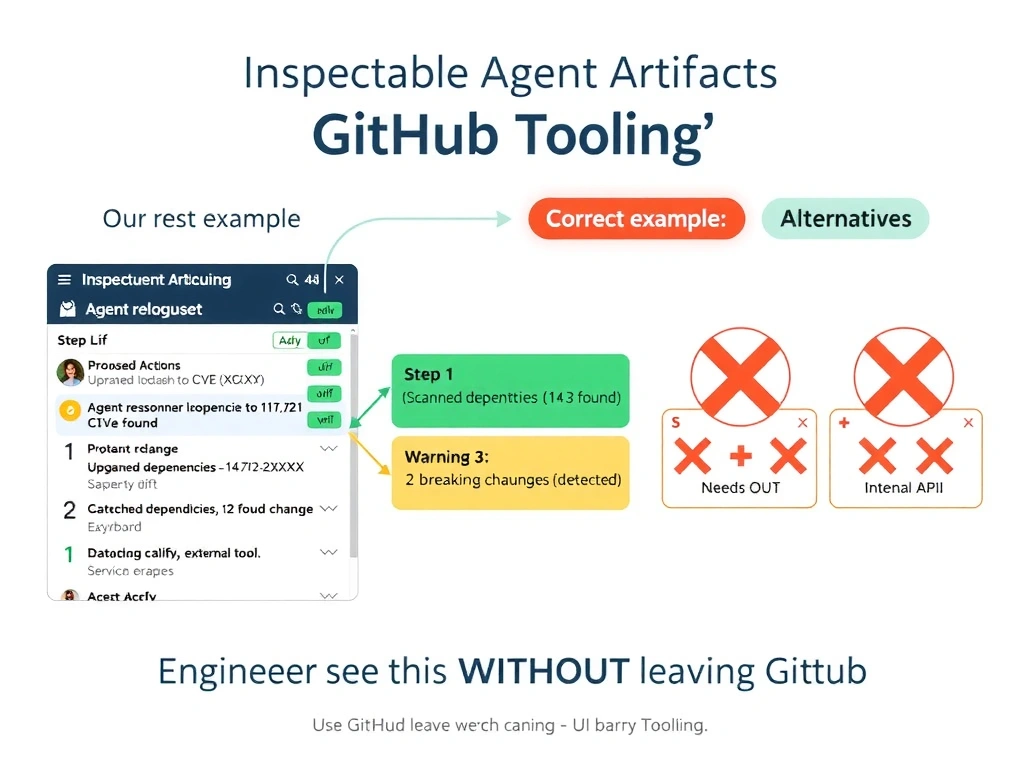
If a pilot's flight data was only accessible by calling the airline's IT department, nobody would trust the plane. Inspectable artifacts need to be where engineers already work — in GitHub, on the PR, where the review happens. PR comments and workflow annotations put the agent's reasoning exactly where developers look, no extra tools required.
Full explanation below image
Full Explanation
A core principle of agentic AI in software development is that agent reasoning and actions should be inspectable within standard development tooling — the tools engineers already use every day. This reduces friction, increases transparency, and ensures that oversight does not require learning a new system.
Option B is correct. GitHub pull requests and GitHub Actions workflow runs are the natural home for artifacts produced during a dependency upgrade. PR comments allow the agent to surface its reasoning ('I upgraded lodash from 4.17.20 to 4.17.21 because a security advisory was found in CVE-2021-XXXX') in a format that is threaded, searchable, and associated with the code change. GitHub Actions workflow annotations (warnings, notices, errors) allow step-level inspection of what happened during each phase of the agent's run. Both are native GitHub features that require no additional tooling or credentials beyond what engineers already have.
Option A is incorrect. An S3 bucket is an external storage service. Even with a link in the PR description, engineers must leave GitHub, authenticate to S3 (or an S3-compatible viewer), and navigate to the log file. This adds friction and breaks the 'within standard development tooling' requirement. Additionally, S3 logs are typically unstructured and difficult to browse.
Option C is incorrect. Datadog is a powerful observability platform, but it is explicitly an external dashboard. Even with SSO, engineers must context-switch out of GitHub to inspect agent reasoning. The requirement explicitly excludes 'external dashboards or log aggregation tools,' which Datadog is.
Option D is incorrect. An internal API requires engineers to make API calls (likely with curl or a custom tool) to retrieve agent reasoning. This is the least accessible option — it requires knowing the API endpoint, authentication, and query parameters, all of which are barriers absent in native GitHub tooling.
Key principle: produce artifacts in GitHub-native formats (PR comments, check annotations, issue comments, commit statuses) so the agent's work is reviewable where engineers already spend their time.