
An engineering team is deploying an agent to manage GitHub repository labels — creating new labels, updating colors, and deleting obsolete ones. The team wants the agent to operate autonomously for low-risk actions but require human approval for deletions. Which configuration best implements this tiered autonomy model?
Select an answer to reveal the explanation.
Short Explanation and Infographic
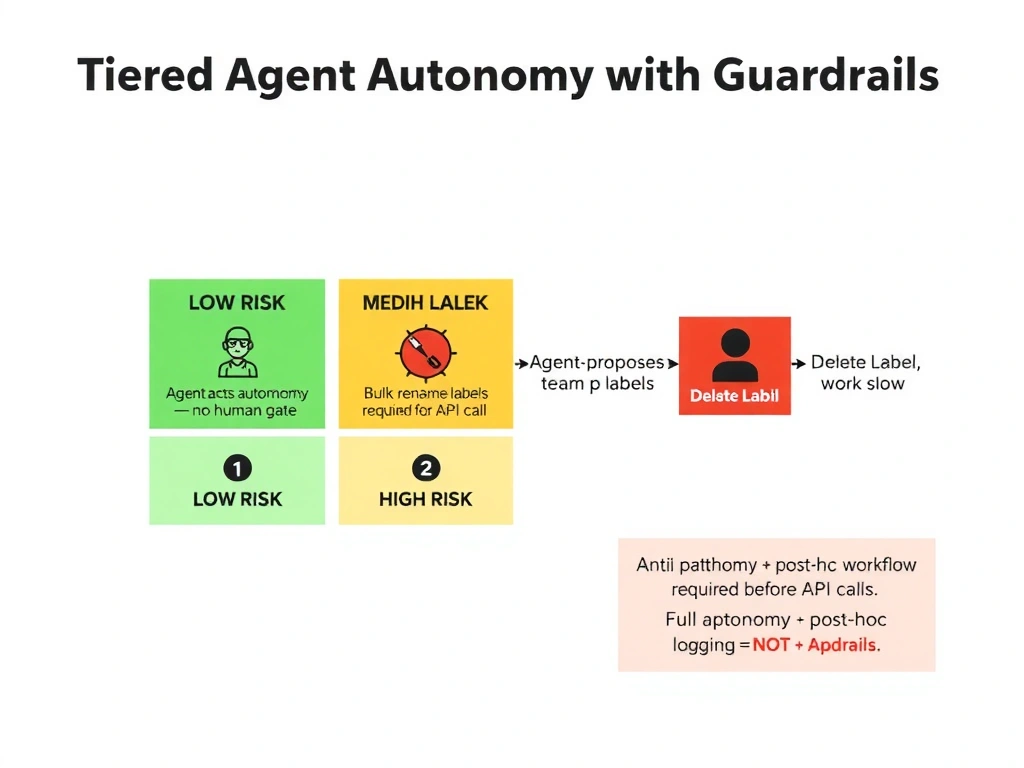
A new employee can rearrange their own desk without asking, but needs a manager's sign-off before shredding company documents. Tiered autonomy works the same way — let the agent handle low-risk actions freely, and install a human gate only where the stakes are higher. The exam tests whether you can configure autonomy that's proportional to risk, not binary.
Full explanation below image
Full Explanation
Tiered autonomy is the practice of calibrating the degree of agent independence based on the risk profile of each action type. Rather than choosing between 'full autonomy' and 'no autonomy,' a well-designed agent has different permission levels for different actions, with guardrails that scale to the potential impact.
Option C is correct because it implements exactly this model. Creating and updating labels are reversible, low-risk actions — if the agent creates a label with the wrong color, it can be corrected easily. Deleting a label is more consequential: it may remove a label that is referenced in open issues, PR filters, or automation rules, and deletion may not be easily undone without manual effort. Routing deletions through a human-approval workflow before the API is called is the right guardrail for this higher-risk action, while leaving lower-risk operations autonomous preserves the efficiency benefit of using an agent.
Option A is incorrect. Logging deletions after the fact is not a guardrail — it is an audit trail. Post-hoc logging can help with forensics but does not prevent harmful deletions. If a label used by 200 open issues is deleted, the log does not undo the damage.
Option B is incorrect. Read-only access eliminates the agent's utility for automation entirely. If a human must perform every create, update, and delete, the agent provides no labor savings. This overcorrects by making the agent fully passive.
Option D is incorrect. Time-based autonomy (full access during business hours, read-only on weekends) is not risk-based — it is schedule-based. A harmful deletion is equally harmful on a Tuesday as on a Saturday. The risk of an action does not change with the time of day, and this configuration provides no protection when engineers are actively working.
Key principle: guardrails should be proportional to risk, not binary or time-based. Grant autonomy where actions are reversible and low-impact; require human gates where actions are irreversible or high-impact.