
What is the primary effect of enabling an organization required workflow that targets selected repositories?
Select an answer to reveal the explanation.
Short Explanation and Infographic
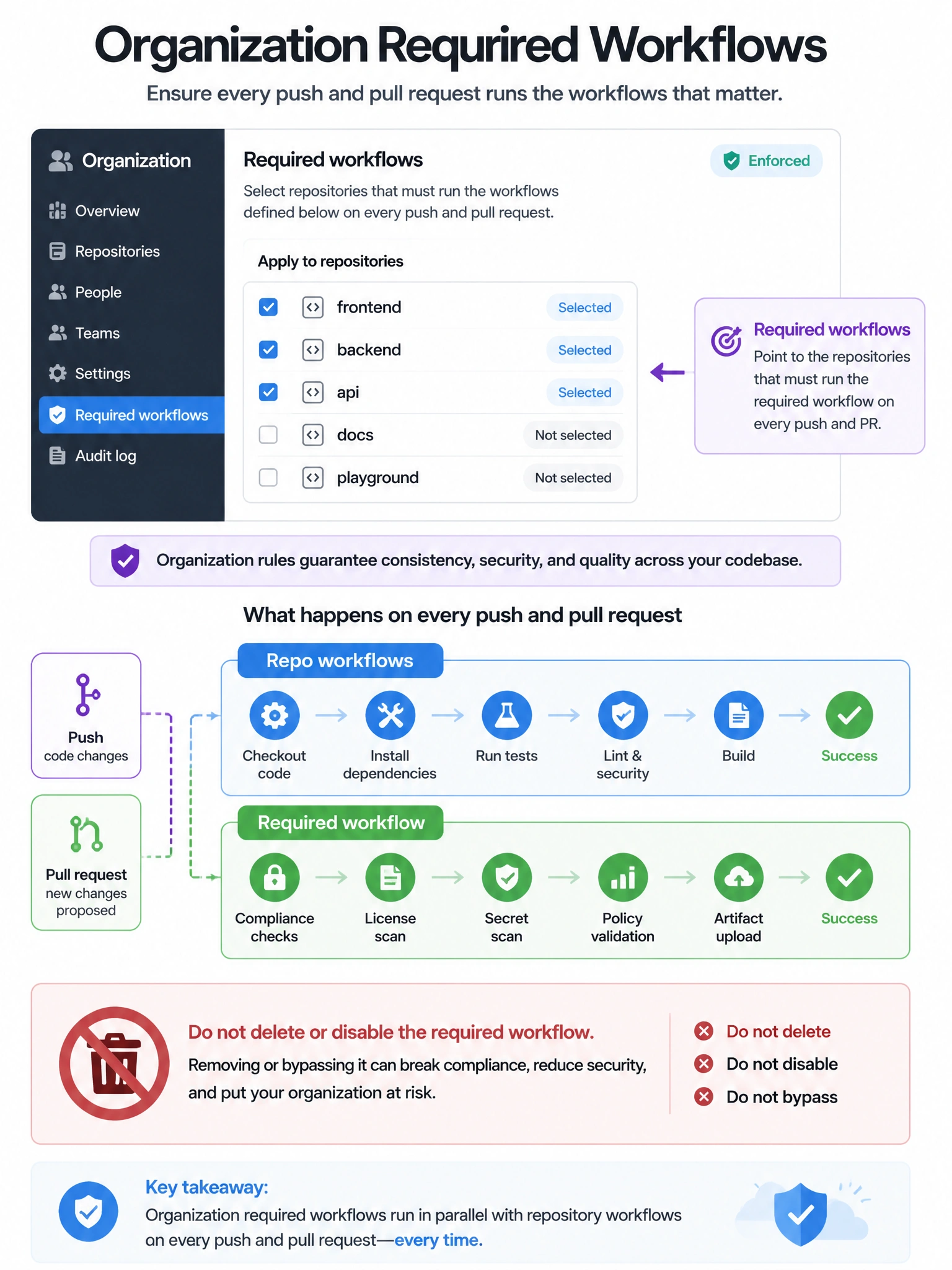
Required workflows are extra org-enforced checks—they ride alongside each repo’s own Actions files. They do not wipe local workflows, turn off Actions entirely, or rewrite reusable workflows into composites.
Full explanation below image
Full Explanation
Organization required workflows let administrators enforce a central workflow definition (for example, security scanning or license checks) on repositories that match configuration. When an event fires, GitHub runs the required workflow in addition to workflows defined in the target repository; it does not delete or overwrite repository-owned workflow files. Repos can still define their own CI, CD, and automation. Required workflows are not a switch that disables all other Actions usage, and they are unrelated to converting reusable workflows into composite actions. Operators should understand that required workflows still consume Actions minutes, still respect permissions and runner settings, and still need careful scoping so they do not run on repositories that lack the expected project layout. Status checks from required workflows can be made mandatory via branch protection or rulesets just like any other check name.