
What is the 'repository network' in GitHub and how do forks relate to it?
Select an answer to reveal the explanation.
Short Explanation and Infographic
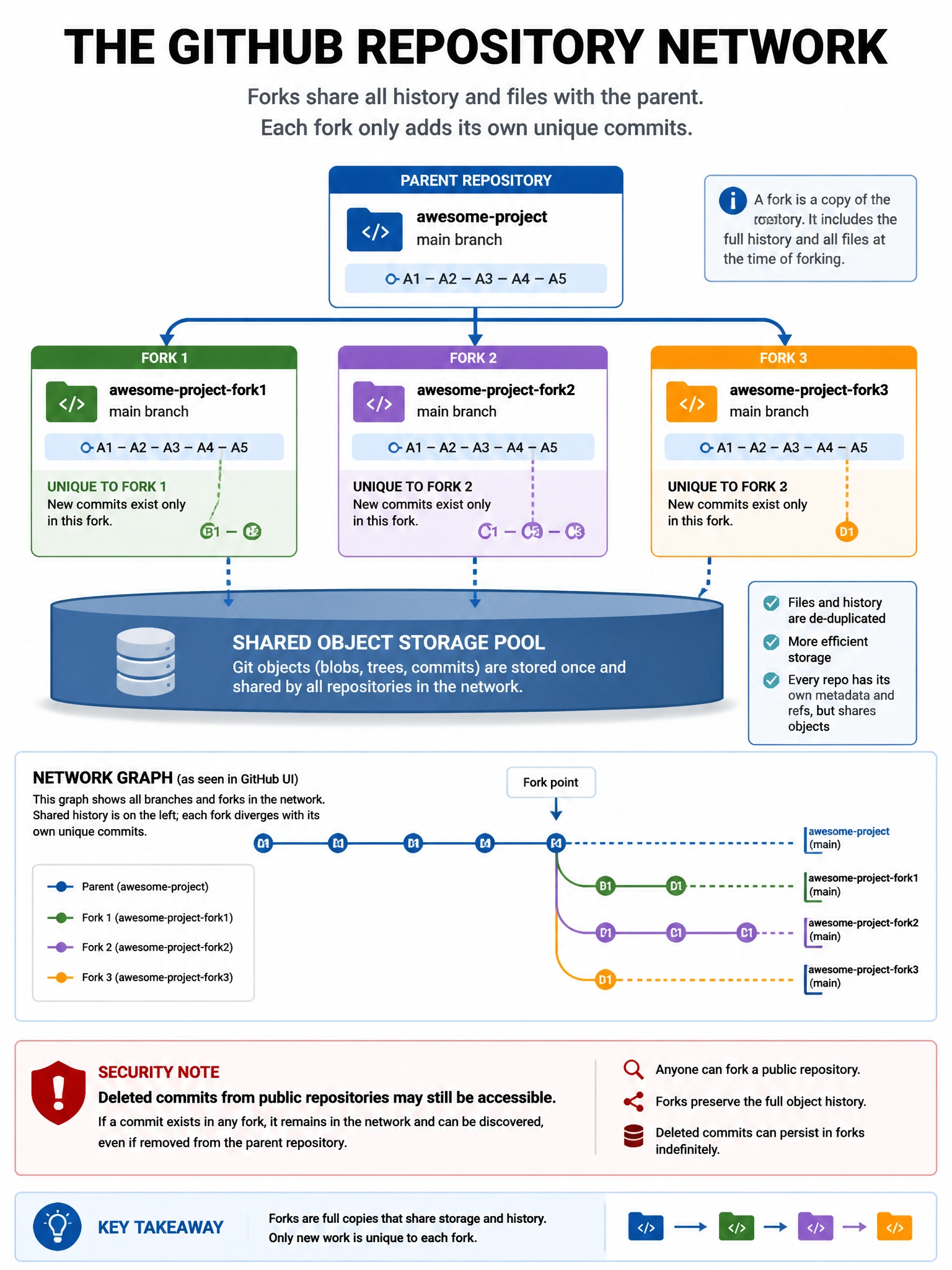
Forks and their parent share git object storage behind the scenes. That means a commit in any fork is technically visible in the 'network' — the repository network graph in GitHub shows all forks and their unique commits. This is how GitHub handles storage efficiently for open source.
Full explanation below image
Full Explanation
GitHub's repository network refers to the graph of a repository and all its forks. Key characteristics: (1) Shared git object storage — when a repository is forked, GitHub doesn't duplicate all the git objects. The fork shares the object store with the parent (and other forks). Only new objects created in the fork are stored separately. (2) Network graph — the 'Network' tab in GitHub shows all forks and their commits as a visual branch graph. (3) Cross-fork visibility — a commit SHA that exists in one fork is technically present in the network. This can have security implications: if a commit was ever pushed to a public repo (even if deleted), it may still be accessible through the network. (4) Upstream contributions — the fork retains a relationship to its parent enabling pull requests across the repository network.