
A transit authority discovers its coding agent occasionally calls a deprecated internal API that should have been removed from its available tool list months earlier. What does this reveal about how the authority should treat its coding agent's tool and MCP server configuration going forward?
Select an answer to reveal the explanation.
Short Explanation
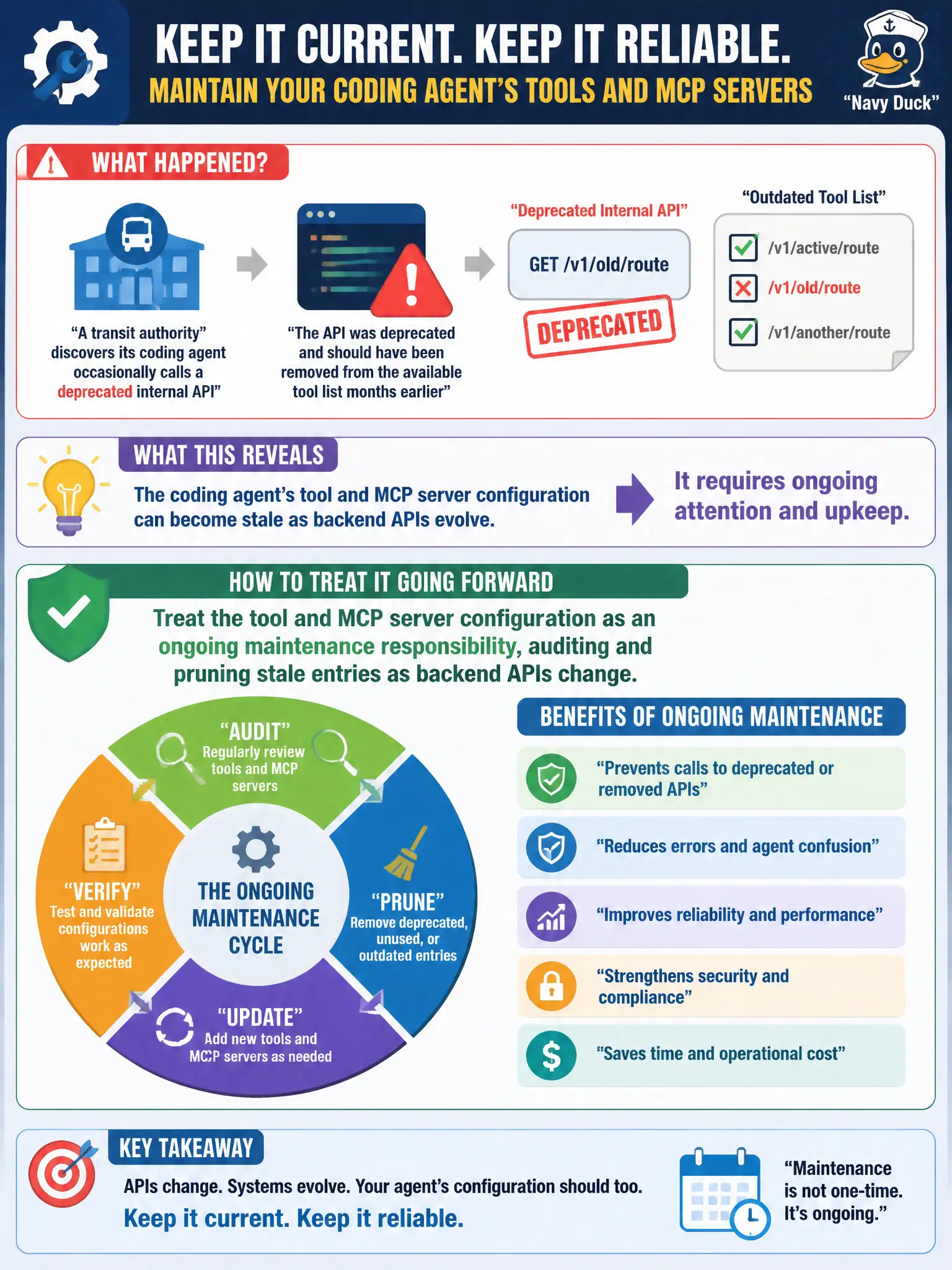
A coding agent's tool list is more like a set of keys on a ring than a one-time badge photo — keys that open doors which no longer exist just sit there waiting to be used by mistake. Backend APIs get deprecated and swapped out constantly, but nobody automatically tells the agent's tool list about it. You've got to keep pruning the ring, or the agent will eventually reach for a key that shouldn't work anymore.
Full Explanation
The mechanism here is drift: an MCP server or tool registry entry stays valid from the agent's point of view until someone explicitly removes or updates it, even after the backend it points to has been deprecated. Treating configuration as a one-time setup step assumes the environment behind those tools is static, but internal APIs, schemas, and endpoints change on their own schedule, independent of when the agent was onboarded. Retraining the underlying model addresses reasoning quality, not the actual list of callable tools the agent is offered — the model can reason perfectly well and still invoke a stale tool if that tool is still sitting in its available set. Restricting the agent to only the newest deployments trades one blind spot for another, since it skips the review step that would have caught the deprecated API in the first place rather than just avoiding new problems. The scope caveat: this applies to any tool source the agent can reach, not just custom MCP servers built in-house. As an operational check, schedule a periodic audit that diffs the agent's registered tool list against the current set of supported backend APIs.