
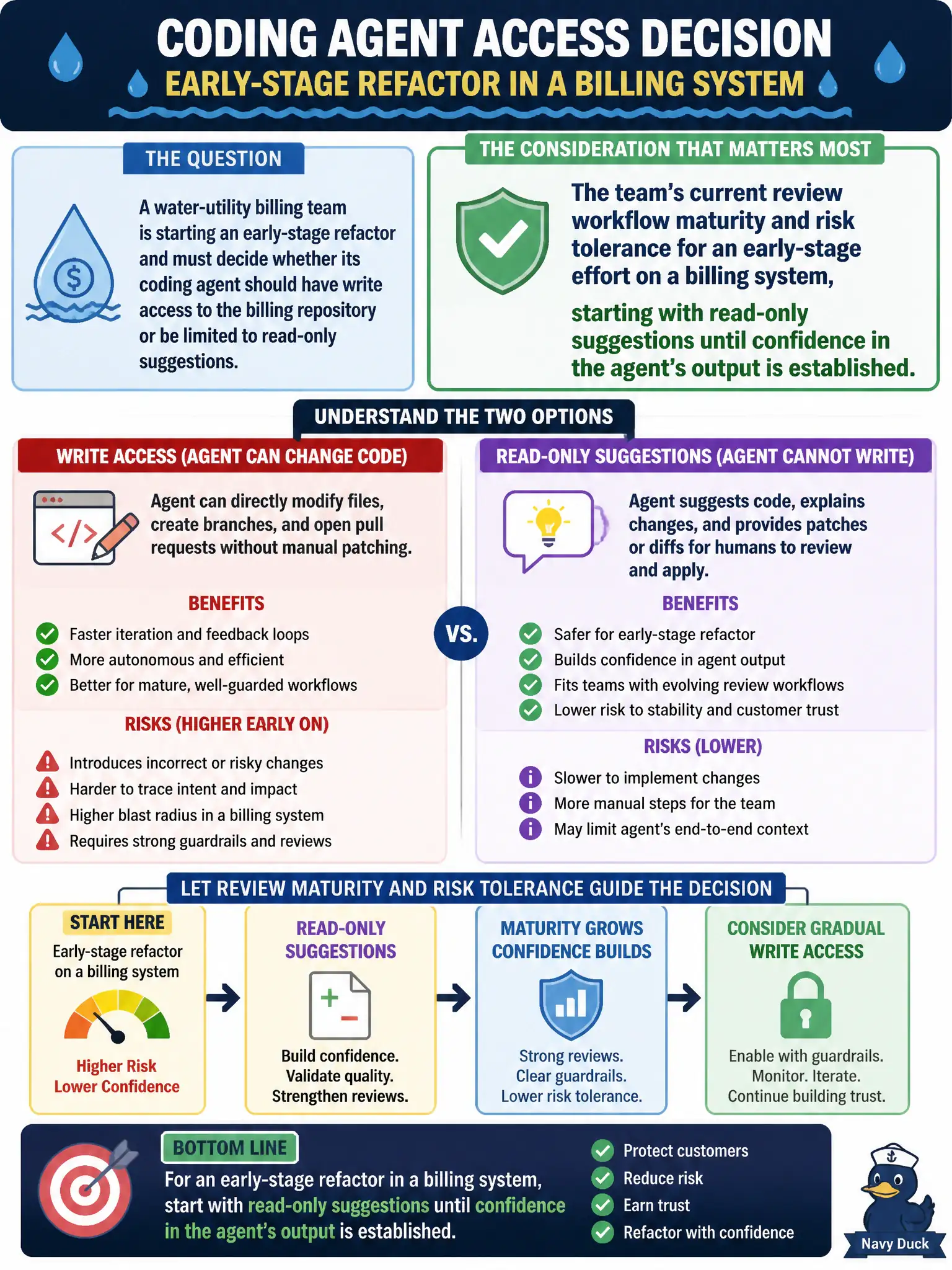
A water-utility billing team is starting an early-stage refactor and must decide whether its coding agent should have write access to the billing repository or be limited to read-only suggestions. Which consideration should most influence that decision?
Select an answer to reveal the explanation.
Short Explanation
Think of it like a new hire on their first week handling the water bills: you don't hand them commit access to production billing code before you've seen their work. Early in a refactor, especially on something as consequence-heavy as billing, start the agent at read-only suggestions and earn write access as the team builds confidence and review habits around its output. Access level should track how mature and trusted the workflow actually is, not how capable the agent theoretically is.
Full Explanation
The mechanism is matching access level to workflow maturity and risk tolerance: an early-stage effort on a billing system, where incorrect charges have real financial and resident-facing consequences, benefits from starting the agent at read-only suggestions so a human reviews every change before it lands, then expanding to write access as the team accumulates evidence the agent's output is reliable in this codebase. This is a staged-trust model, not a fixed setting.
Defaulting to write access to avoid wasting capability ignores that capability isn't the constraint, review confidence is, and granting broad write access before that confidence exists just moves the risk earlier rather than removing it. Assuming billing systems change infrequently doesn't reduce risk, it just means an incorrect automated commit sits unnoticed longer before the next planned change would have caught it, which if anything raises the stakes of an early mistake. Relying on version-control revertibility as a safety net ignores that a bad billing commit lives in production between the moment it merges and the moment it's caught, and depending on the change, an incorrect charge to a resident may already have gone out before the revert happens.
Scope caveat: this is a temporary posture tied to early-stage risk, not a permanent limit, mature teams with strong test coverage on a billing system may reasonably grant broader access later. A concrete check: review a sample of the agent's recent suggestions for accuracy before deciding to expand its access to direct commits.