
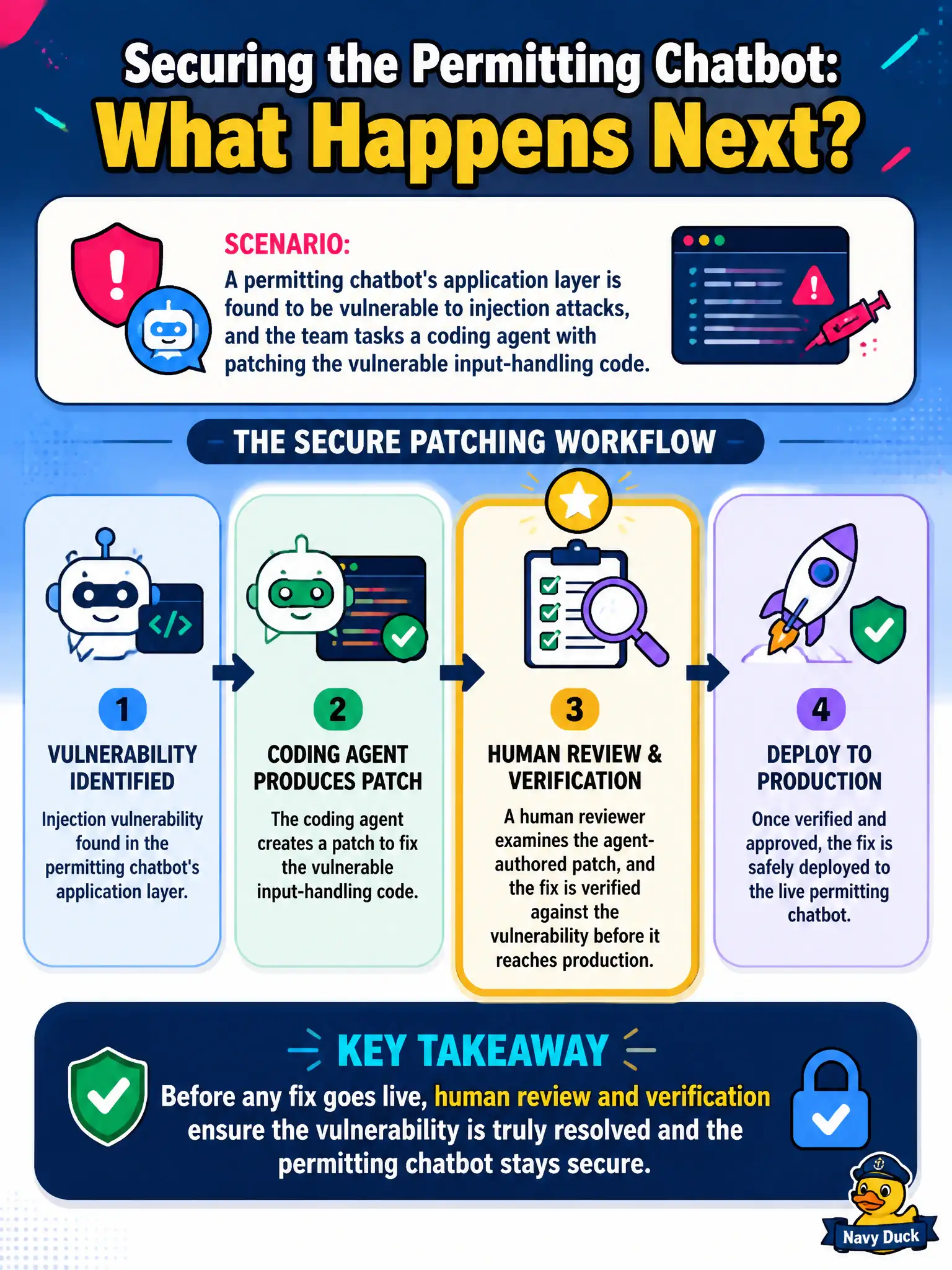
A permitting chatbot's application layer is found to be vulnerable to injection attacks, and the team tasks a coding agent with patching the vulnerable input-handling code. What should happen after the coding agent produces its patch, before the fix is deployed to the live permitting chatbot?
Select an answer to reveal the explanation.
Short Explanation
Patching a security hole with a coding agent is like calling a locksmith to fix a broken lock — you still check that the door actually locks before you call it done. Application-layer vulnerability patching is a real coding-agent task, but an agent-authored security fix needs a human reviewer and verification against the original vulnerability before it goes live. Skipping that step turns a fix into an unverified guess.
Full Explanation
Patching application-layer vulnerabilities is a named coding-agent use case, but a security fix carries higher stakes than a routine change because a flawed patch can leave the vulnerability open or introduce a new one. That's why review is the necessary follow-up step: a human reviewer examines the patch and the team verifies it actually closes the reported injection path, rather than trusting the agent's own account of success. Deploying immediately on the agent's self-assessment treats the agent as both the author and the sole judge of its own security fix, which removes the independent check that catches a patch that looks right but misses an edge case in the input handling. Granting the agent standing production deployment access to skip future review trades a one-time convenience for a persistent broadening of what the agent can do unsupervised, which runs counter to keeping security fixes gated. Holding the patch indefinitely for a full rewrite ignores that the vulnerability is live now; deferring the fix to a future modernization effort leaves the permitting chatbot exposed in the meantime. A concrete operational check is to re-run the original vulnerability test or a proof-of-concept input against the patched code in a staging environment and confirm it no longer succeeds before promoting the change.