
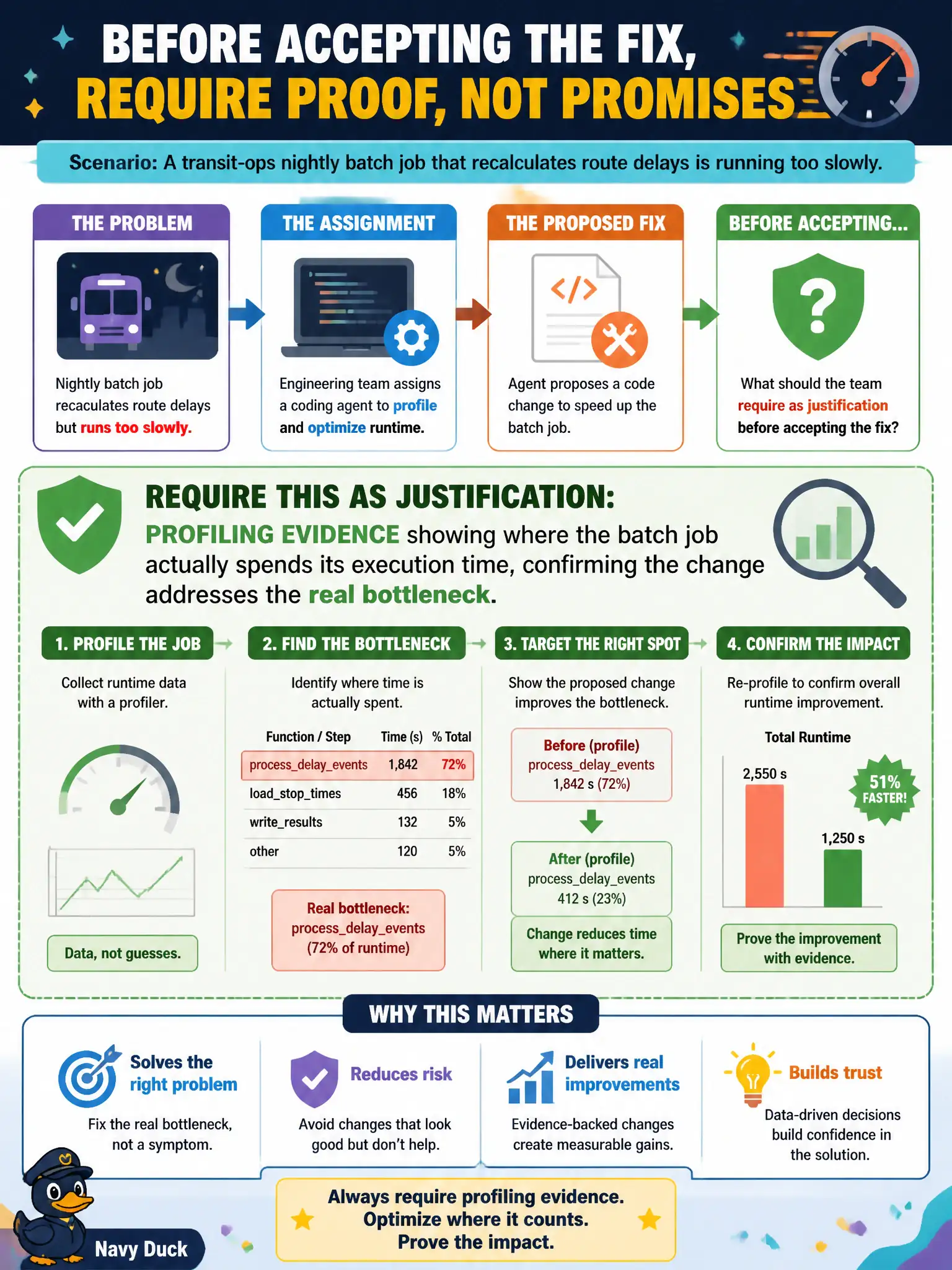
A transit-ops nightly batch job that recalculates route delays is running too slowly, and the engineering team assigns a coding agent to profile and optimize its execution runtime. Before accepting the agent's proposed change as the fix, what should the team require as justification?
Select an answer to reveal the explanation.
Short Explanation
Optimizing without profiling is like tightening random bolts on a car because it's making noise somewhere in the engine bay. Runtime optimization is a legitimate coding-agent task, but a proposed fix only earns trust when profiling evidence shows it actually targets where the batch job is spending its time. Otherwise the team has just changed code, not sped anything up.
Full Explanation
Monitoring and optimizing agents for performance is explicitly in scope, and identifying real bottlenecks such as latency and logic errors is part of that discipline — which means the justification for any optimization has to come from evidence of where time is actually being spent, not from intuition about what looks slow. Profiling data ties the proposed change directly to the measured hot path, so the team can verify the fix targets the actual cause of the slow nightly run rather than an assumed one. Judging the fix by whether the new code is shorter substitutes a stylistic proxy for a performance measurement; shorter code can easily run slower, and length says nothing about where cycles are consumed. Treating the first suggested change as sufficient justification rewards speed of suggestion over correctness of diagnosis, and a first guess is exactly the kind of unverified assumption profiling is meant to replace. Judging the fix by variable-name readability evaluates code quality, which matters for maintainability, but it has no bearing on whether execution time actually improved. A concrete operational check is to re-run the profiler against the optimized version and compare wall-clock time on the same bottleneck function the original profile flagged, confirming the measured improvement before the change ships.