
A county permitting department's coding agent needs to query a legacy permitting database through a newly registered MCP server. The database also stores applicant Social Security numbers and internal fee-waiver notes unrelated to the coding agent's task. How should the architect configure the MCP server so the coding agent can do its job?
Select an answer to reveal the explanation.
Short Explanation
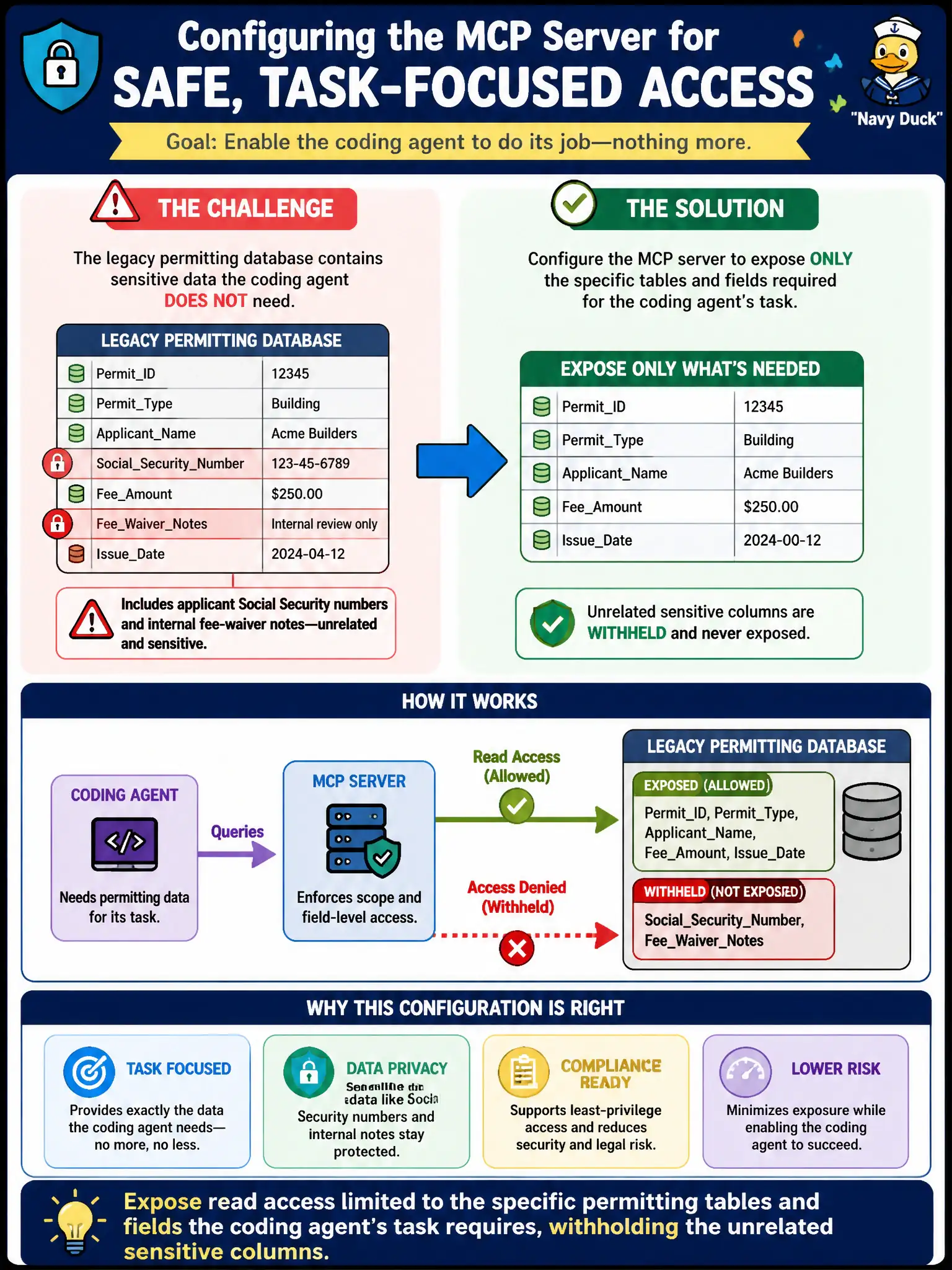
Think of the MCP server like a key ring you hand a contractor: you give them the key to the room they're working in, not the master key to the whole building. Scoping the server to just the permitting tables the task needs keeps the fee-waiver notes and SSNs out of reach entirely, rather than trusting the agent to politely ignore them. Least privilege isn't a suggestion here — it's the configuration.
Full Explanation
MCP server configuration determines what an agent can see and act on, and the architecturally sound approach is to expose only the tables, fields, and operations the current task actually needs, withholding everything else at the connection layer. That containment is durable because it does not depend on the agent's judgment or on prompt wording holding up under adversarial or accidental misuse. Reusing staff-portal credentials fails because it collapses the boundary between a human operator's broad access and an automated agent's narrow task, inheriting risk the task never required. Exposing the full schema and relying on prompt instructions to steer the agent away from sensitive columns confuses a behavioral nudge with an access control; prompts can be overridden, misread, or simply fail under edge-case inputs, and sensitive data left reachable is still a live exposure. Disabling the MCP connection in favor of manual exports abandons the coding agent's core value of live, governed data access and introduces staleness the task cannot tolerate. A useful operational check is to review the MCP server's exposed capability list after configuration and confirm the SSN and fee-waiver fields simply do not appear, rather than trusting a policy statement that they are off-limits.