
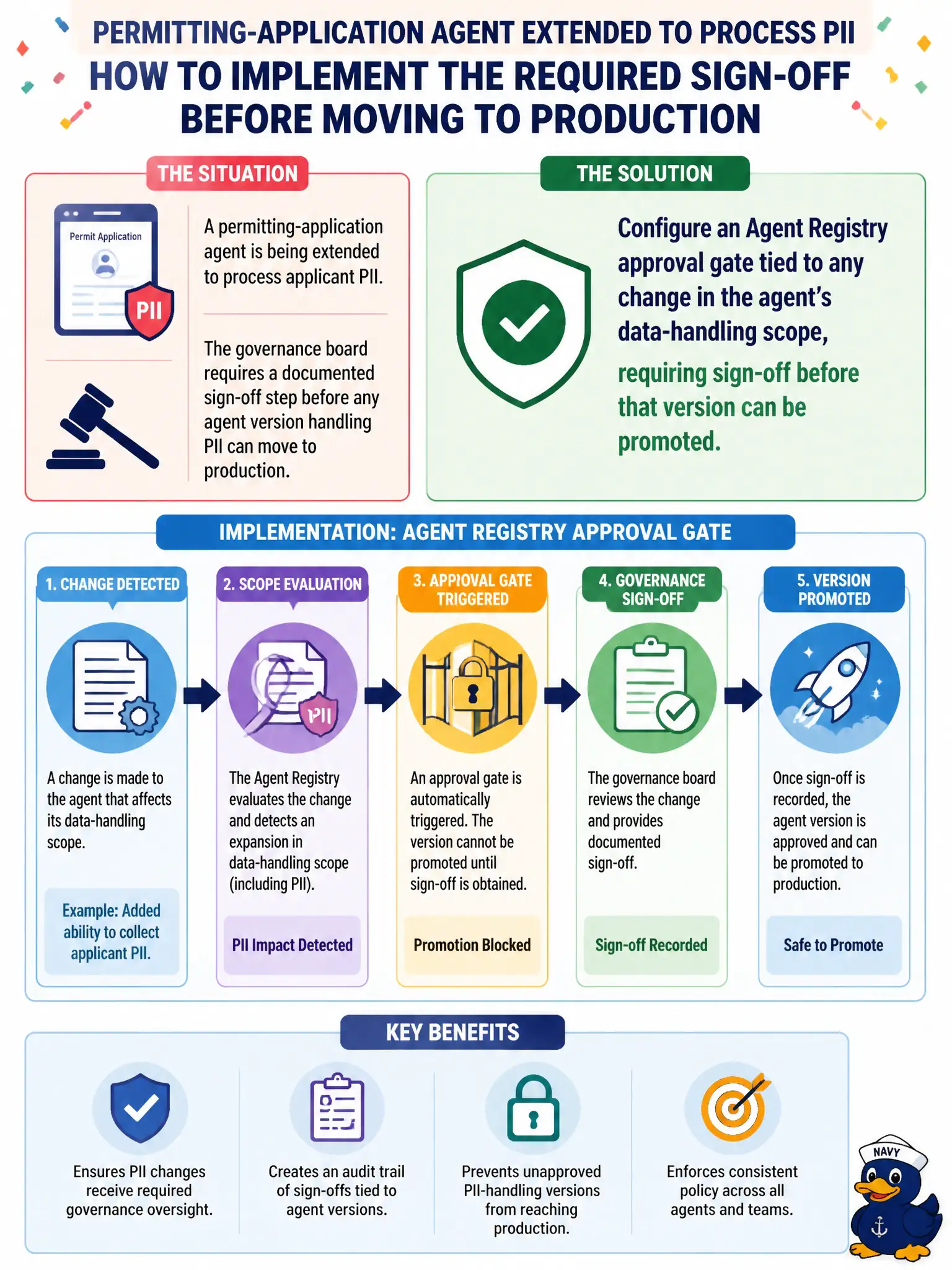
A permitting-application agent is being extended to process applicant PII, and the governance board requires a documented sign-off step before any agent version handling PII can move to production. How should this be implemented?
Select an answer to reveal the explanation.
Short Explanation
A governance sign-off is like a building inspector who has to stamp the plans before construction starts — not a general contractor's gut-check, and not a speed limit on how fast trucks can arrive at the site. Agent Registry's approval gate is that inspector's stamp, tied specifically to a change that matters: the agent now touches PII. A rate limit or a content filter might be good ideas elsewhere, but neither one is a sign-off.
Full Explanation
Agent Registry can be configured with approval gates that block a new agent version from reaching production until a required reviewer signs off, and tying that gate specifically to changes in the agent's data-handling scope means the control fires exactly when PII enters the picture, which is what the governance board is asking for. An informal team agreement to review PII changes before merging code is a process intention, not an enforced control; it depends entirely on people remembering to follow it every time, with no system preventing a skipped review from reaching production anyway. An Agent Gateway rate limit changes how fast traffic flows, not whether a version is authorized to exist in production at all, so it doesn't provide a documented sign-off step in any meaningful sense. A Model Armor content filter tuned for PII strings addresses runtime leakage of PII in conversation, which is a useful complementary guardrail, but it operates after deployment on live traffic rather than gating whether a version should be deployed in the first place. A scope caveat: an approval gate only helps if the trigger condition, a change in data-handling scope, is reliably detected each time the agent is modified, so that detection needs its own review. As an operational check, a governance lead can attempt to promote a PII-handling version without the required sign-off and confirm the registry blocks the promotion.