
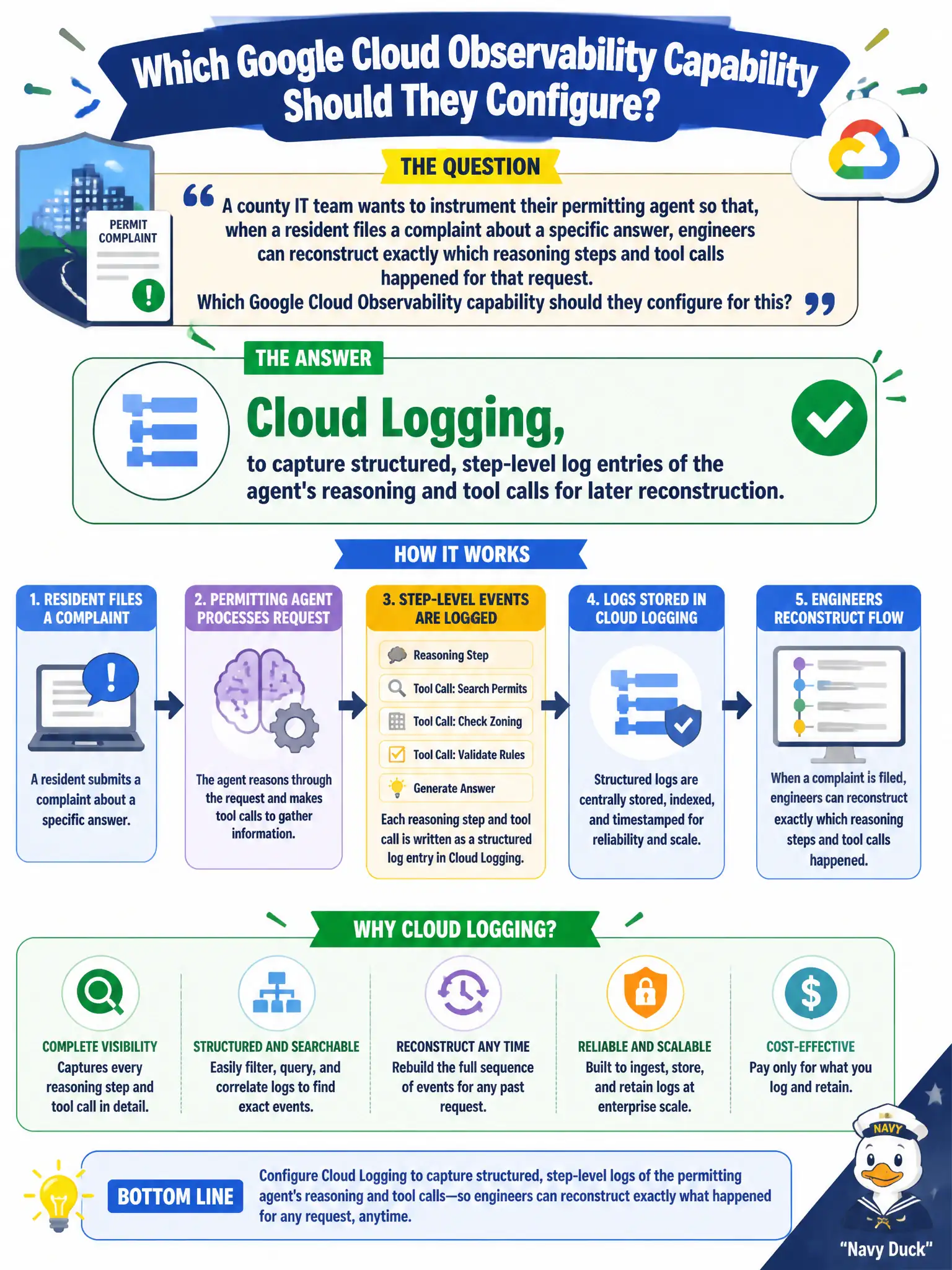
A county IT team wants to instrument their permitting agent so that, when a resident files a complaint about a specific answer, engineers can reconstruct exactly which reasoning steps and tool calls happened for that request. Which Google Cloud Observability capability should they configure for this?
Select an answer to reveal the explanation.
Short Explanation
Think of a flight recorder rather than a speedometer: it's not enough to know the trip took forty seconds, the full play-by-play of every step matters. Structured log entries give exactly that play-by-play for one resident complaint. Cloud Logging is the black box here; the other tools tell you speed or version, not the story.
Full Explanation
Cloud Logging captures structured, per-step entries — which tool was called, with what arguments, and what the agent reasoned at each stage — that engineers can query and reconstruct after the fact for a specific request, which is exactly the post-hoc debugging need described. Cloud Trace is built to show timing and duration across spans, useful for latency work, but it isn't designed to carry the semantic detail of what the agent decided at each step. Model Armor screens incoming content for injection and unsafe patterns rather than recording execution history. Agent Registry tracks which build or version is authorized and running, which helps confirm the version involved but says nothing about what that version actually did during the request. Scope caveat: logging every reasoning step at high verbosity carries a cost and retention tradeoff, so teams typically scope structured logging to production-relevant detail rather than maximal verbosity everywhere. Operational check: search Cloud Logging by request ID or complaint timestamp and confirm the full sequence of tool calls and reasoning steps for that request is present and readable.