
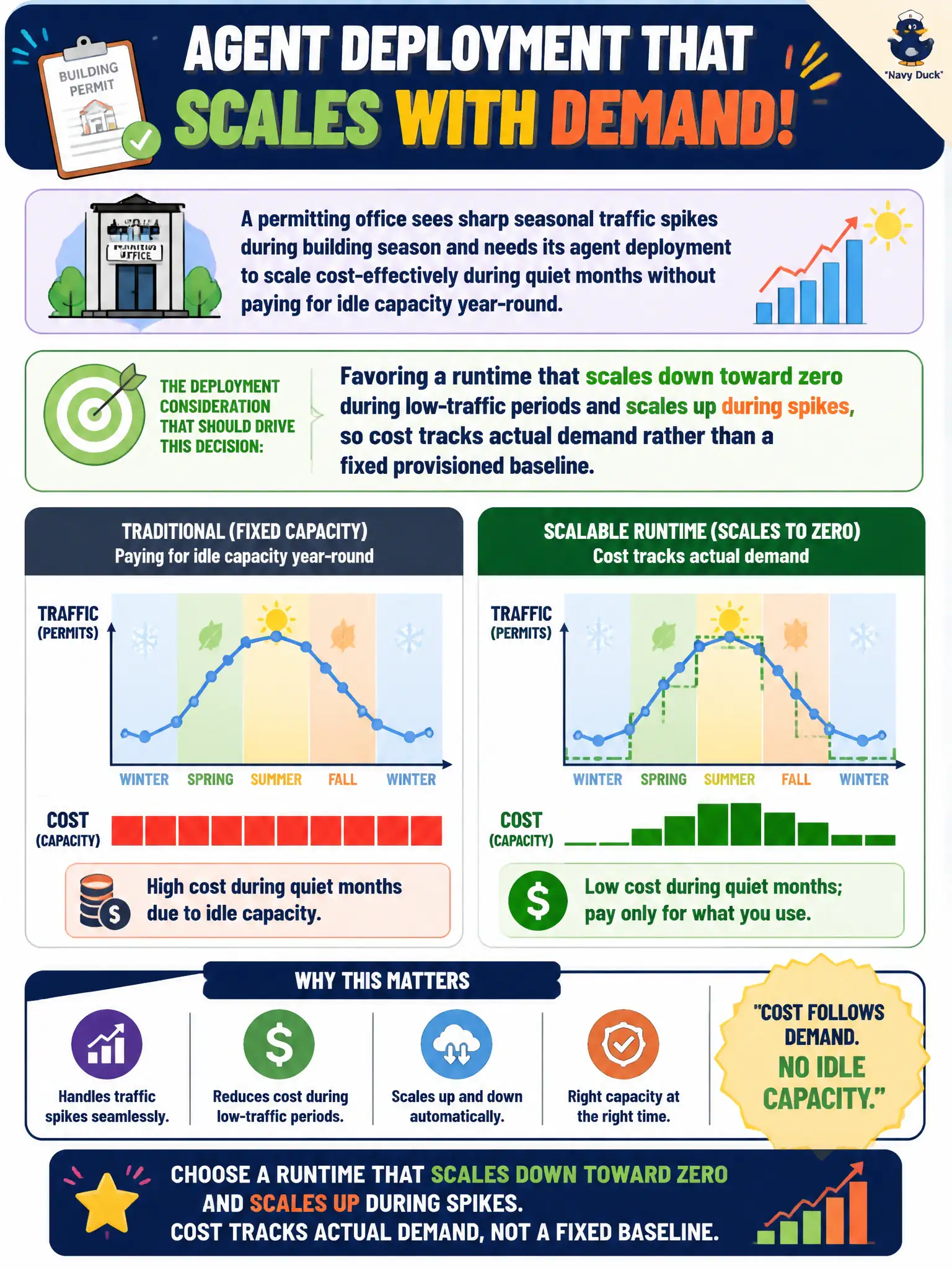
A permitting office sees sharp seasonal traffic spikes during building season and needs its agent deployment to scale cost-effectively during quiet months without paying for idle capacity year-round. Which deployment consideration should drive this decision?
Select an answer to reveal the explanation.
Short Explanation
Paying for a fixed fleet of servers all year to cover one busy season is like keeping a whole snowplow crew on staff in July. What the permitting office actually needs is capacity that grows during the storm and shrinks back down to almost nothing once it passes, so the bill tracks the weather instead of sitting flat all year.
Full Explanation
Cost-effective scaling under bursty, seasonal traffic hinges on a runtime's ability to scale down toward zero, or near it, during quiet periods and scale up automatically as demand rises, so the county pays roughly in proportion to actual usage rather than for a fixed baseline of provisioned capacity sized for the peak and left running through the slow months. That elasticity is the deciding factor for this specific requirement, distinct from other deployment considerations that matter in different contexts. Prioritizing setup simplicity ignores that ongoing operating cost, not one-time setup effort, is the stated problem, and a runtime that's easy to stand up but scales poorly still leaves idle capacity paid for year-round. Choosing based on team familiarity optimizes for comfort rather than for the cost-scaling behavior the scenario explicitly calls out as the constraint. Assuming the highest maximum capacity always minimizes cost gets the relationship backwards; a runtime provisioned for a high ceiling that stays available continuously can cost more during idle periods than one that scales down, regardless of how high its peak capacity goes. Scope caveat: scale-to-zero behavior can introduce cold-start latency on the first request after an idle period, which needs weighing against the resident experience during the ramp-up of building season. Operational check: review the runtime's billing during last year's off-season months and confirm cost actually dropped in proportion to the lower traffic, not just in theory.