
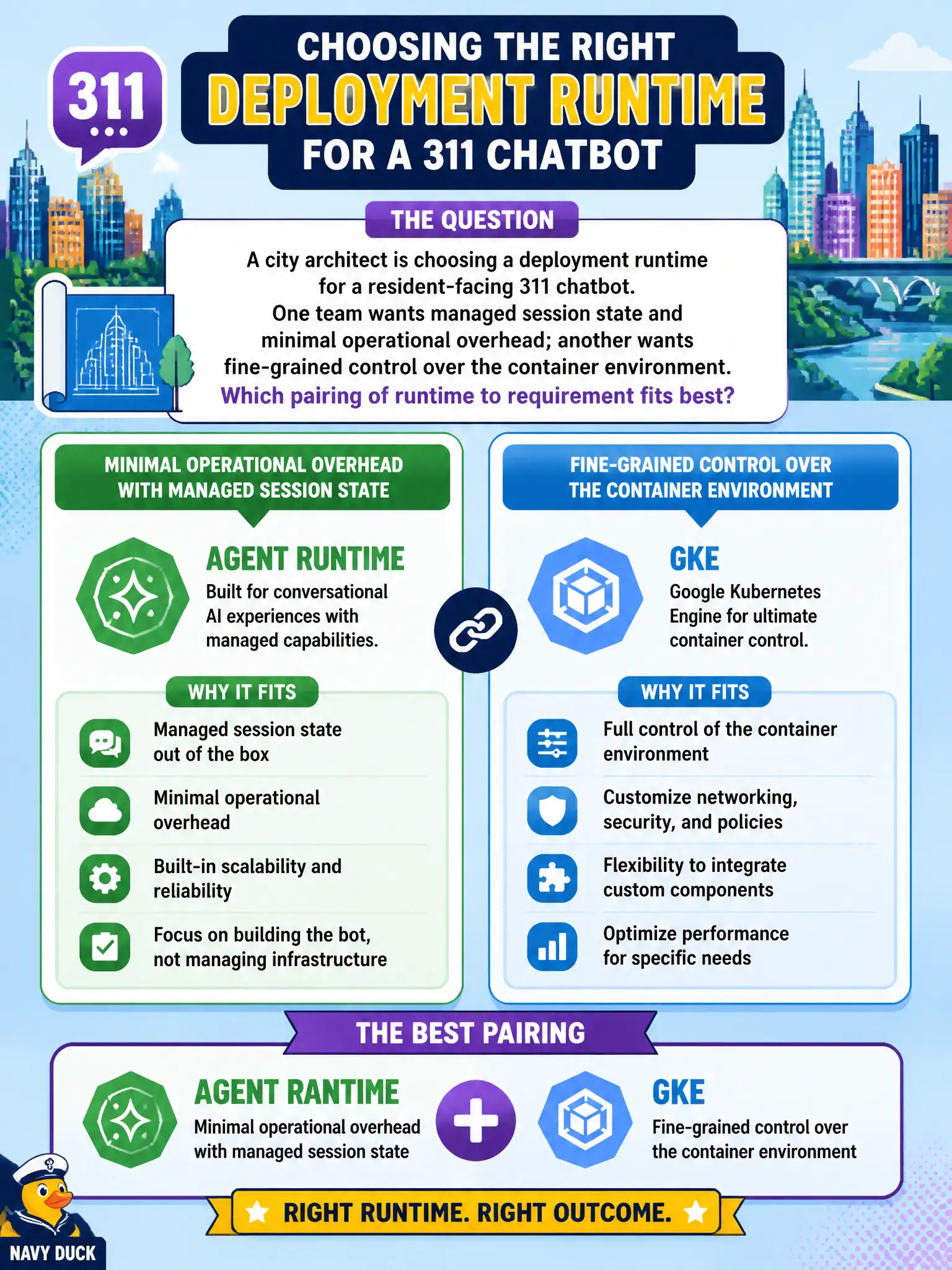
A city architect is choosing a deployment runtime for a resident-facing 311 chatbot. One team wants managed session state and minimal operational overhead; another wants fine-grained control over the container environment. Which pairing of runtime to requirement fits best?
Select an answer to reveal the explanation.
Short Explanation
Think of Agent Runtime as renting a fully furnished apartment: the plumbing and utilities are handled, you just move in. GKE is more like buying the building outright — total control over every wall and pipe, but you're the one maintaining it.
Full Explanation
Agent Runtime is a managed hosting environment for agentic workloads that handles session and infrastructure concerns like managed sessions on the platform's behalf, which matches a team prioritizing minimal operational overhead and built-in managed session state for a resident-facing chatbot. GKE gives a team direct control over the container orchestration layer, letting them configure networking, scaling, and resource allocation in fine detail, which is exactly what a team wanting granular container control needs, at the cost of that team owning more of the operational burden. Swapping the pairing gets the tradeoff backwards, since GKE is the higher-control, higher-overhead option and Agent Runtime is the lower-overhead, managed option. Claiming Cloud Run is the only option supporting agentic workloads overstates its exclusivity; multiple runtimes, including Agent Runtime and GKE, can host agentic workloads, each with different operational tradeoffs, and Cloud Run itself sits as its own middle-ground option outside this specific comparison. Claiming more infrastructure control always means lower overhead inverts the actual relationship — greater control over containers generally comes with more operational responsibility, not less. Scope caveat: cost also factors into runtime selection beyond just control versus overhead, so the final choice should weigh expected traffic patterns and budget alongside these operational tradeoffs. Operational check: confirm which team owns on-call responsibility for the chosen runtime, since that ownership should match the level of operational overhead the runtime actually requires.