
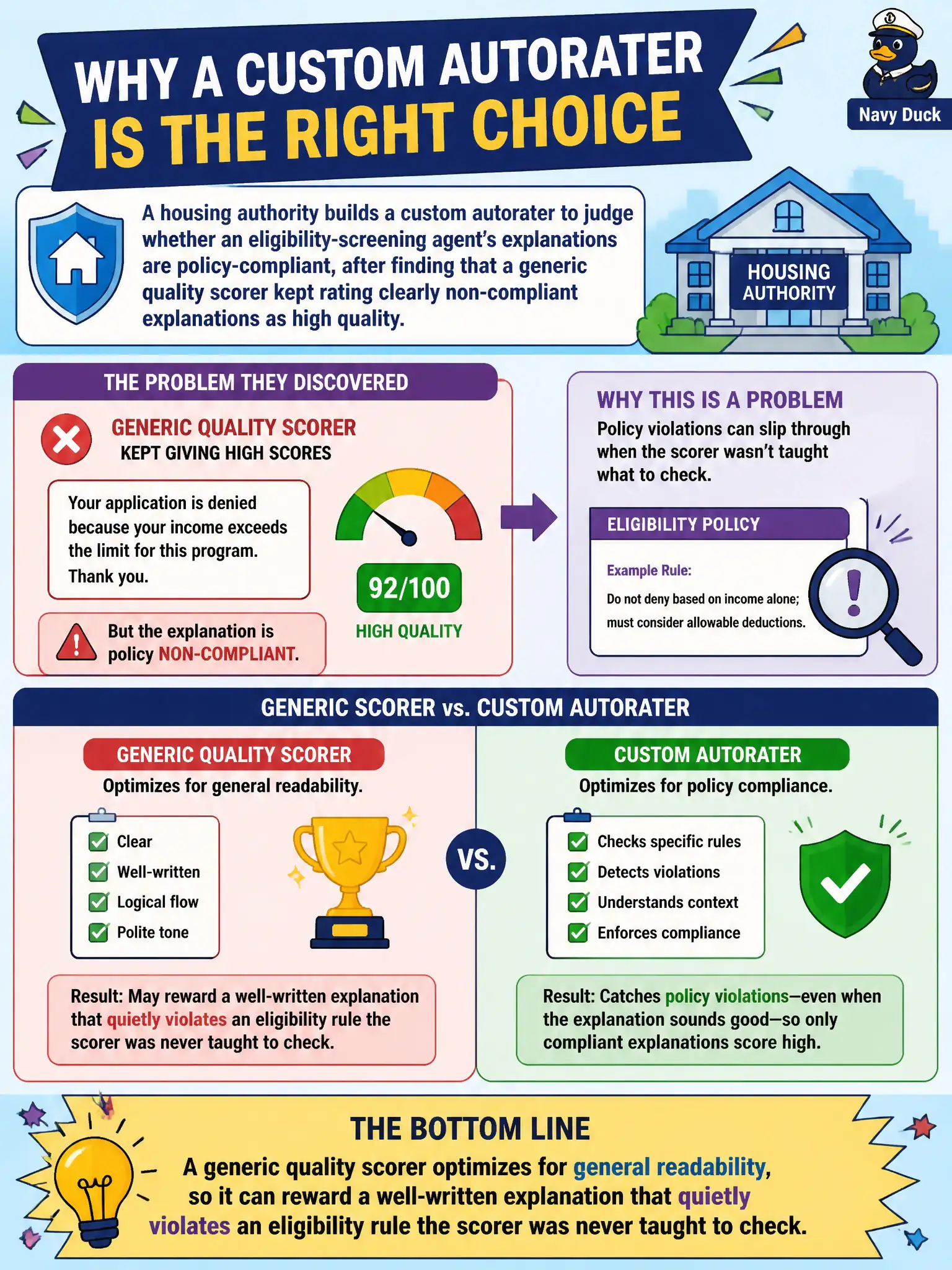
A housing authority builds a custom autorater to judge whether an eligibility-screening agent's explanations are policy-compliant, after finding that a generic quality scorer kept rating clearly non-compliant explanations as high quality. What justifies choosing a custom autorater over the generic scorer here?
Select an answer to reveal the explanation.
Short Explanation
A generic scorer grades like an English teacher: it rewards clear, well-organized writing, not whether the content actually followed housing policy. A custom autorater is what you build when you need someone grading for policy compliance specifically, not just how nice the sentence sounds.
Full Explanation
Generic evaluation scorers are typically trained or configured to judge broad quality signals like coherence, fluency, and relevance, none of which encode a specific regulatory or policy rule set — so an explanation can read smoothly, sound confident, and still violate an eligibility criterion the scorer has no representation of. A custom autorater closes that gap by being built specifically to check the agent's output against the housing authority's actual policy rules, which is what a domain-blind generic scorer structurally cannot do. Claiming a custom autorater is always faster confuses implementation choices with an inherent property; speed depends on how each is built, not on which category it falls into. Claiming it removes the need for human review overstates what any autorater can guarantee — even a well-built one benefits from periodic human validation to catch drift. Restating that the generic scorer misses domain-specific compliance without naming why (its optimization target is fluency, not policy) leaves the actual mechanism unexplained, which is the distinction this question is testing. Scope caveat: a custom autorater is only as good as the policy rules encoded into it, so it needs updating whenever eligibility criteria change. Operational check: feed the autorater a known non-compliant explanation and confirm it flags the violation before trusting its scores on live traffic.