
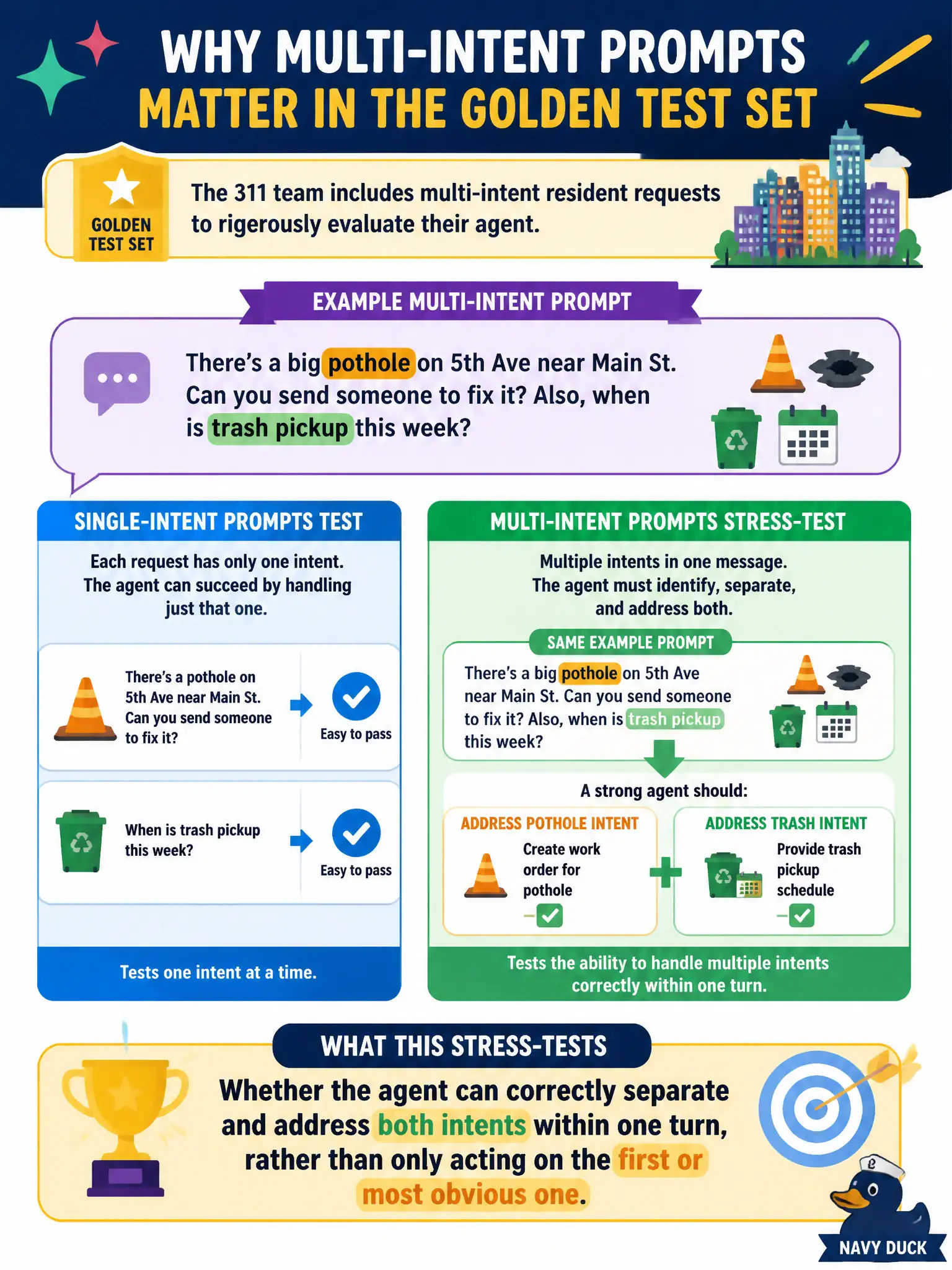
A city 311 team drafts prompts for their golden test set that intentionally include multi-intent resident requests, such as reporting a pothole while also asking about the trash pickup schedule in the same message. What does including these multi-intent prompts stress-test that single-intent prompts cannot?
Select an answer to reveal the explanation.
Short Explanation
A single-intent prompt is like handing someone one errand; a multi-intent prompt hands them two at once and watches whether they drop one on the floor. That's exactly the failure single-intent prompts can never surface, no matter how many of them you write.
Full Explanation
Multi-intent handling is a distinct capability from single-intent accuracy: the agent has to first recognize that a message contains more than one request, then route or resolve each one without the second intent getting silently dropped or misattributed to the wrong handler. A test set built entirely from single-intent prompts, however large, never forces that recognition step, so it can report high accuracy while a real resident's combined pothole-and-trash-schedule message quietly loses half its content. Formatting consistency across volume is a presentation concern unrelated to whether both intents were even detected. Latency from longer prompt text is a performance dimension, not a correctness dimension, and a long single-intent prompt would test it just as well. Authentication happens independently of how many intents a message carries, so it isn't what the multi-intent design targets. Scope caveat: multi-intent prompts should specify, in the golden answer, what handling both intents correctly looks like — a partial credit or all-or-nothing rubric — since ambiguity there undermines the test's usefulness. Operational check: run the agent against a multi-intent prompt and confirm the transcript shows two distinct resolved actions, not one action followed by a generic acknowledgment of the second request.