
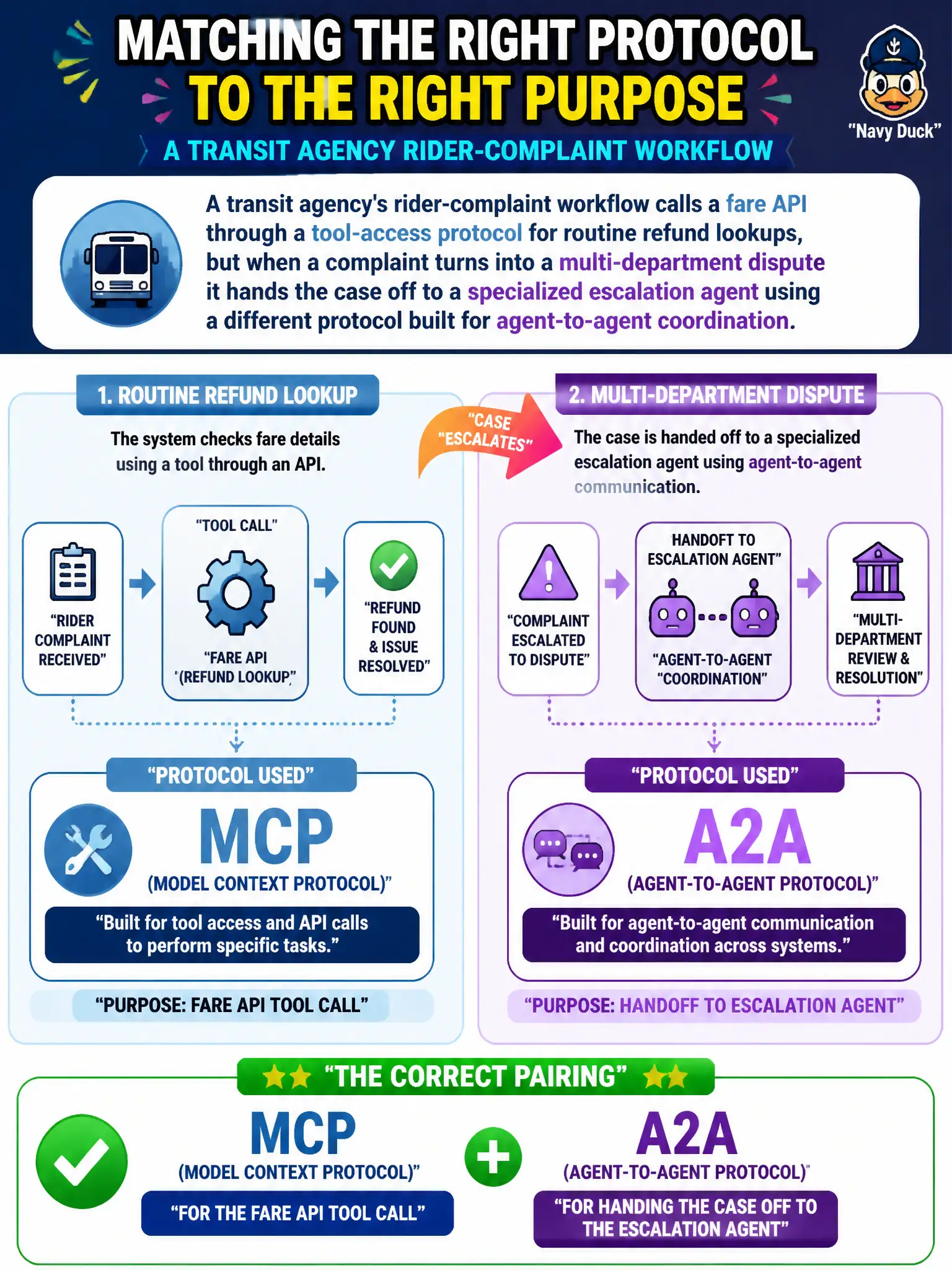
A transit agency's rider-complaint workflow calls a fare API through a tool-access protocol for routine refund lookups, but when a complaint turns into a multi-department dispute it hands the case off to a specialized escalation agent using a different protocol built for agent-to-agent coordination. Which pairing correctly matches each protocol to its purpose in this workflow?
Select an answer to reveal the explanation.
Short Explanation
Think of MCP as the plug that lets an agent reach out and use a tool, and A2A as the phone line that lets one agent talk to another agent. The fare API is a tool, so MCP wires it up; the escalation agent is a peer, so A2A is what carries the hand-off between them.
Full Explanation
The Model Context Protocol standardizes how an agent discovers and invokes external tools and data sources, which is exactly the job of calling a fare API to look up a refund — a tool-shaped interaction with a defined set of operations and no independent reasoning on the other end. Agent2Agent is built for a different relationship: coordinating between two autonomous agents, each with its own context and decision-making, which is what happens when a complaint gets routed to a specialized escalation agent that will independently reason about the dispute. Using A2A for the fare lookup misapplies a peer-coordination protocol to what is really a simple tool call, adding unnecessary complexity. Using MCP for both steps collapses the escalation agent into a passive tool, discarding the semantics needed for an agent to receive full case context and act on it independently. Forcing a single protocol across the whole workflow ignores that these are architecturally different interactions — tool access versus agent coordination — each with its own protocol for a reason. Scope caveat: a workflow can legitimately mix both protocols in the same session, and doing so is not itself a design smell. Operational check: trace one complaint through logs and confirm the fare lookup shows an MCP tool-invocation trace while the escalation hand-off shows an A2A message exchange.