
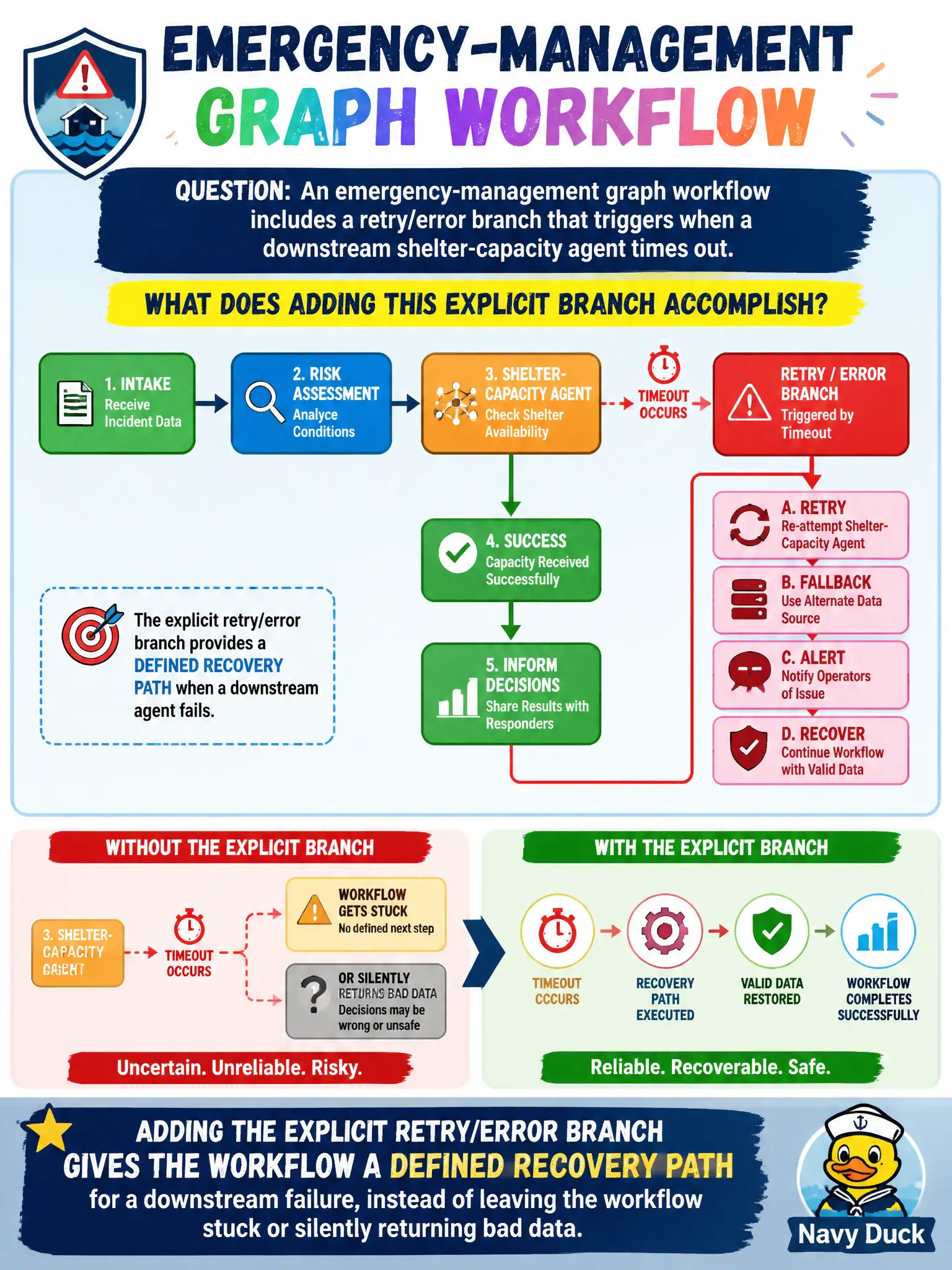
An emergency-management graph workflow includes a retry/error branch that triggers when a downstream shelter-capacity agent times out. What does adding this explicit branch accomplish?
Select an answer to reveal the explanation.
Short Explanation
Things time out — that's not a design flaw, it's just reality. What matters is whether the workflow has somewhere to go when it happens: a retry/error branch gives it a defined next move instead of freezing or quietly serving up incomplete results.
Full Explanation
An explicit retry/error branch defines what the workflow does when a downstream call fails, so a shelter-capacity timeout leads to a deliberate recovery action — a retry, a fallback path, or an escalation — rather than the workflow hanging indefinitely or continuing forward with missing or stale data as if nothing went wrong. It doesn't prevent the timeout from happening again; the branch handles the consequence of a timeout, it doesn't fix whatever underlying latency or capacity issue is causing the shelter-capacity agent to time out in the first place. It also doesn't remove the need for monitoring — knowing how often the timeout branch fires is itself valuable operational signal, and monitoring the shelter-capacity agent's latency remains how the team would notice if timeouts start happening more frequently or systemically. And triggering a retry branch doesn't turn the graph workflow into a sequential pattern; it's still a graph with conditional edges, one of which happens to loop back or branch off in response to the failure condition, which is the kind of structure sequential pipelines don't support. Scope note: retry branches should generally include a limit to avoid retrying indefinitely against a persistently failing downstream agent. Operational check: simulate a shelter-capacity agent timeout in a test environment and confirm the workflow follows the retry/error branch rather than stalling or proceeding with incomplete data.