
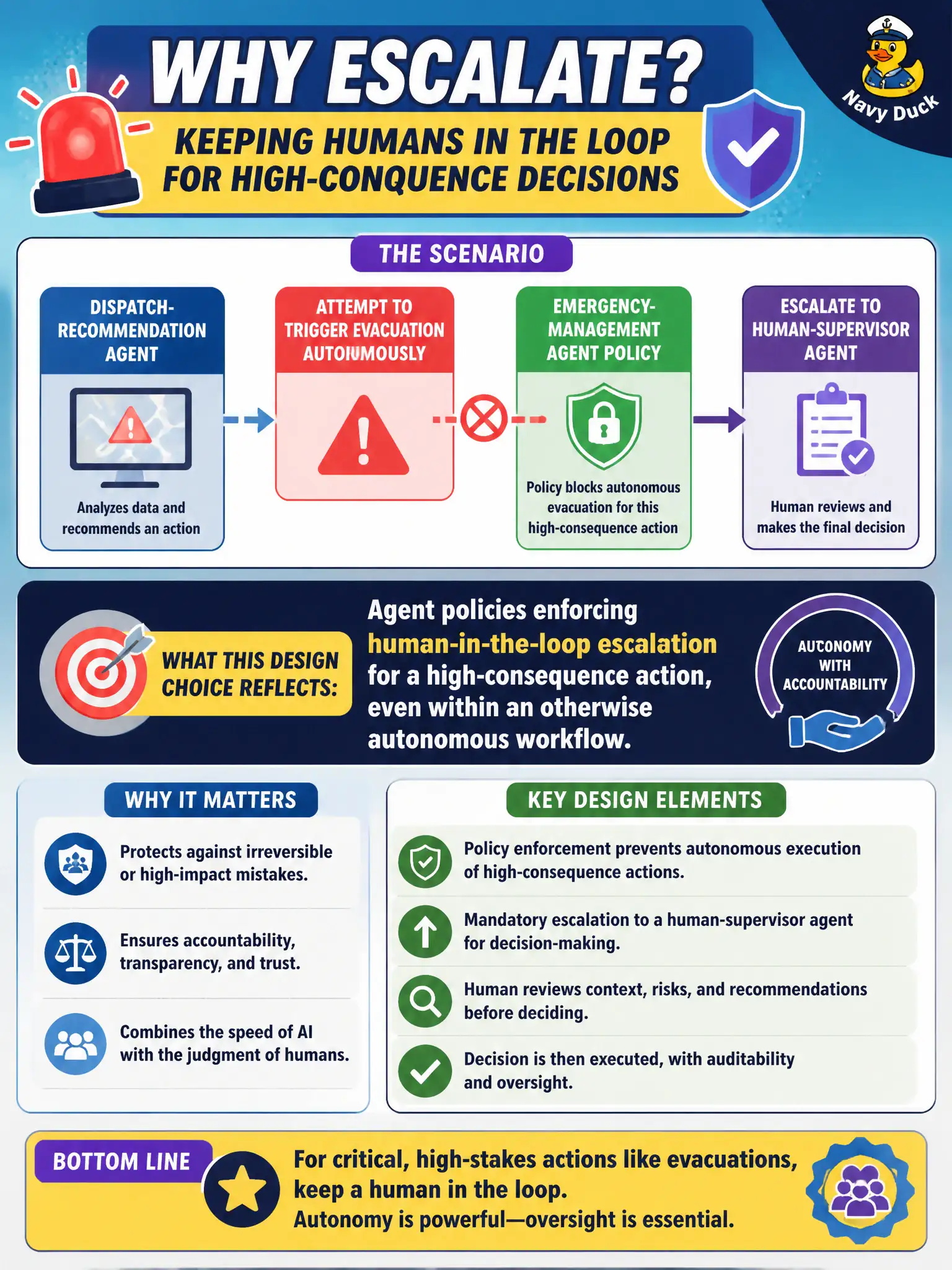
An emergency-management agent policy blocks a dispatch-recommendation agent from autonomously triggering an evacuation, requiring it instead to escalate the decision to a human-supervisor agent. What does this design choice reflect?
Select an answer to reveal the explanation.
Short Explanation
Not every decision should be left to the fastest reasoner in the room, especially one with evacuation-level stakes. Requiring a human-supervisor sign-off on the biggest calls is a guardrail baked into the workflow's policy, not a sign the agent can't handle the reasoning.
Full Explanation
This is a human-in-the-loop policy pattern: the workflow is deliberately designed so a high-consequence action — triggering an evacuation — requires escalation to a human-supervisor agent rather than being executed autonomously, even though the rest of the workflow may run without that checkpoint. It's not that the model lacks the reasoning capacity to recommend an evacuation; the recommendation itself is exactly what the agent is producing, but execution authority for the consequential action is deliberately withheld and routed to a supervisory check. It's also not a registry or discoverability issue — the agent isn't failing to find an evacuation-triggering capability, it's being policy-blocked from invoking one it may well have access to, which is a governance decision rather than a technical gap. And it isn't a latency optimization; adding a human escalation step introduces latency rather than reducing it, trading speed for a safety check on an irreversible, high-stakes action. Scope note: HITL gating is typically reserved for actions with significant real-world consequences or difficult-to-reverse effects, not applied uniformly to every agent decision. Operational check: attempt to trigger the evacuation action directly through the dispatch-recommendation agent in a test environment and confirm the policy layer routes it to escalation instead of executing it.