
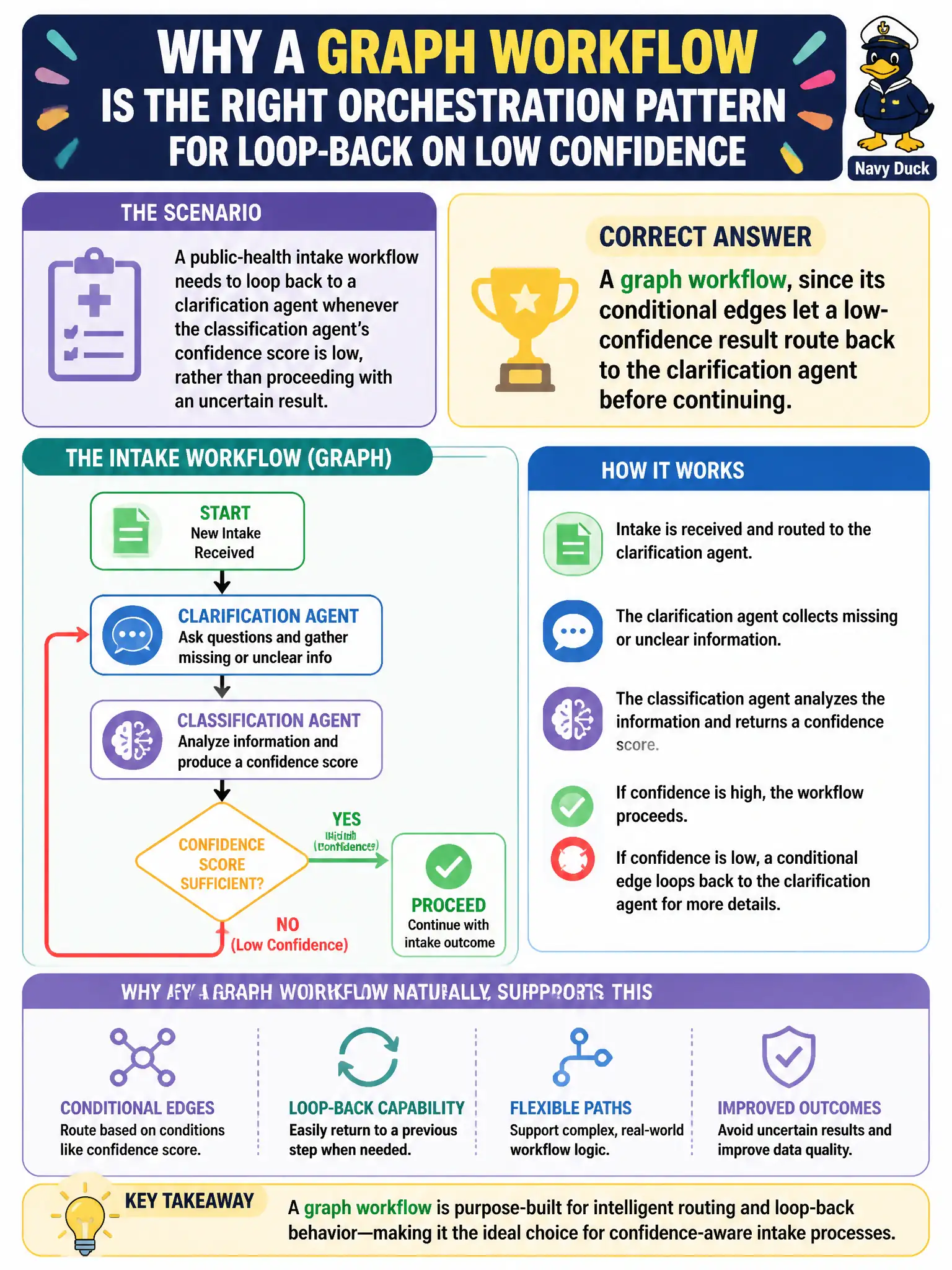
A public-health intake workflow needs to loop back to a clarification agent whenever the classification agent's confidence score is low, rather than proceeding with an uncertain result. Which orchestration pattern naturally supports this loop-back behavior?
Select an answer to reveal the explanation.
Short Explanation
A straight-line pipeline can't double back on itself — once you're past a station, you're past it. A graph workflow is built with branches and loops in mind, so a shaky classification can circle back for clarification before the process moves forward.
Full Explanation
Graph workflows are structured as nodes and conditional edges, which means a low-confidence outcome can trigger an edge back to the clarification agent instead of forcing the pipeline forward — that loop-back is exactly what the pattern is built to express. A sequential pattern models a strict, one-directional chain of stages, so it has no native mechanism for revisiting an earlier stage once execution has moved past it. Running clarification and classification in parallel doesn't solve the problem either, since parallel execution assumes both branches can proceed independently and be aggregated afterward — but clarification genuinely depends on knowing that classification's confidence was low, which is information only available after classification runs. Collapsing both roles into one agent's internal reasoning sidesteps orchestration but loses the auditability and separation of concerns that come from treating classification and clarification as distinct, individually testable steps. Scope note: loop-back edges should include a limit or escalation path to avoid an agent looping indefinitely on persistently low-confidence input. Operational check: feed the workflow a deliberately ambiguous intake case and confirm it routes to clarification exactly once before either resolving or escalating.