
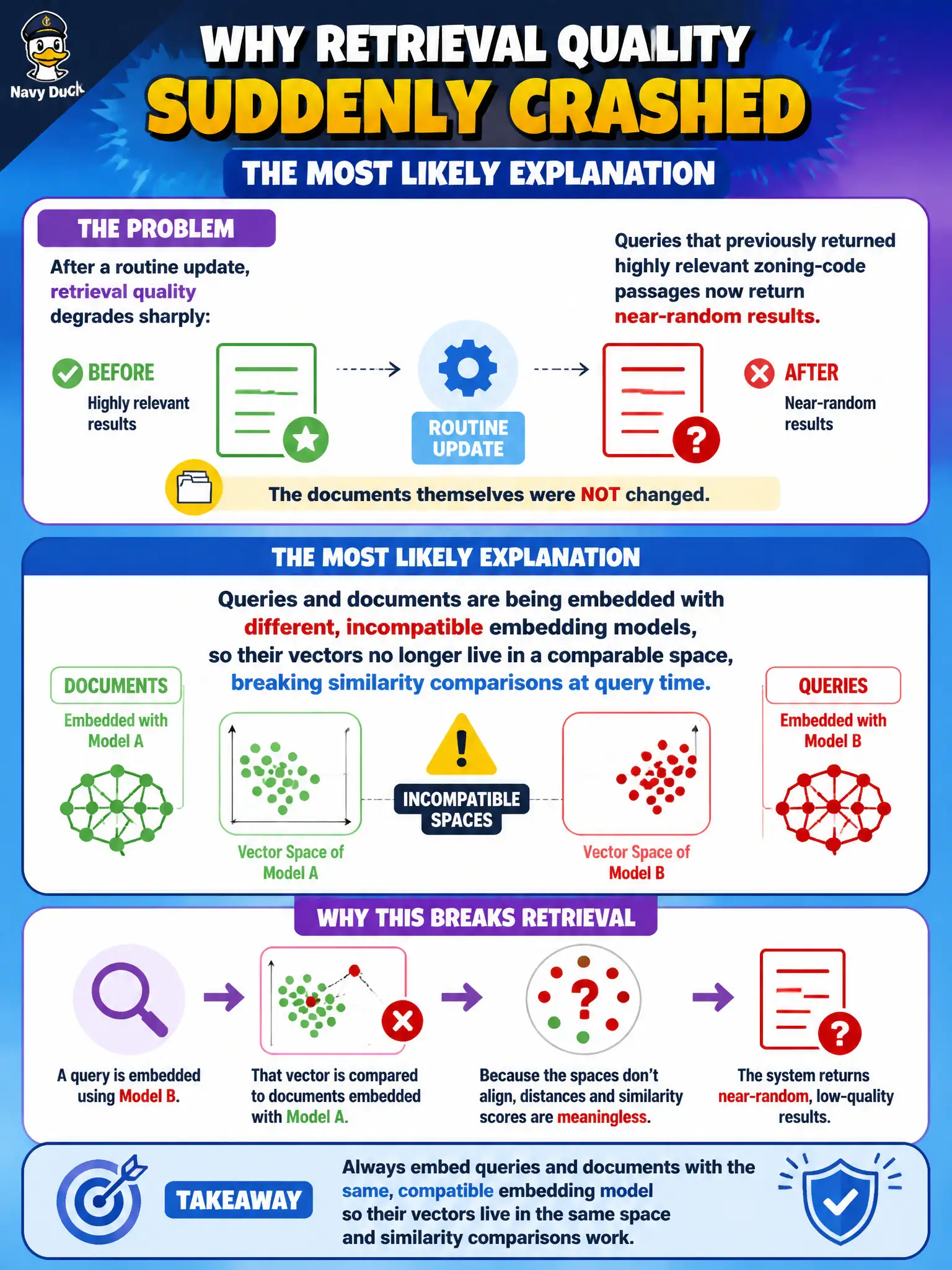
A permitting agent's retrieval quality degrades sharply after a routine update: queries that previously returned highly relevant zoning-code passages now return near-random results, even though the documents themselves weren't changed. What most likely explains this?
Select an answer to reveal the explanation.
Short Explanation
Think of it like two people comparing notes written in different code systems - both might be accurate, but nothing lines up because they weren't written the same way. If an update swaps the query-side or document-side embedding model without re-embedding the whole corpus, vectors that used to sit close together stop being comparable, and similarity search returns noise. A re-chunking pass, a region migration, or a terser system instruction don't produce that same collapse.
Full Explanation
Retrieval in a RAG pipeline depends on queries and documents being embedded into the same vector space, so that semantic similarity between them is meaningful; if a routine update changes which embedding model handles queries or newly indexed documents without consistently re-embedding the whole corpus, the resulting vectors are no longer comparable even though nothing about the documents' content changed - similarity scores stop reflecting actual relevance, which produces the sharp, near-random degradation described. A re-chunking pass into smaller sections can shift precision and recall in either direction depending on how the corpus's structure interacts with chunk boundaries, but it doesn't inherently collapse quality across the board the way an embedding-space mismatch does. A region migration for the retrieval index is an infrastructure relocation; it can affect latency or availability, but it doesn't change which documents are semantically eligible for retrieval, since the underlying vectors and index contents aren't altered by where they're hosted. And a system-instruction change toward more concise answers affects how the agent phrases its final response after retrieval has already happened - it has no mechanism to reach back and degrade what the retrieval step returns beforehand. The scope caveat: this diagnosis assumes the document corpus is genuinely unchanged, as stated; if the corpus was also modified around the same time, that would need to be ruled out separately. A concrete check: compare the embedding-model version or configuration used at index time against what's currently used at query time to confirm they match.