
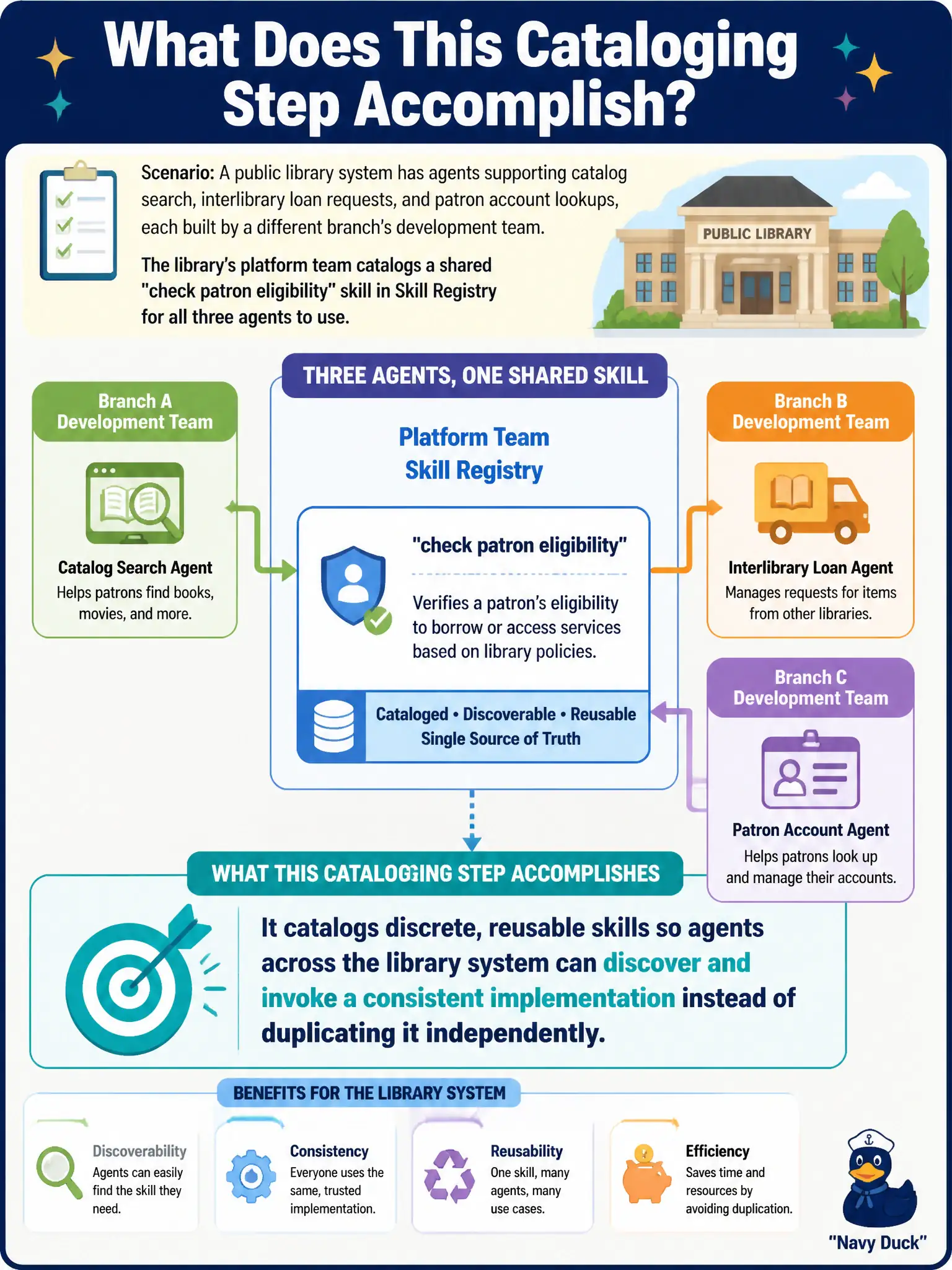
A public library system has agents supporting catalog search, interlibrary loan requests, and patron account lookups, each built by a different branch's development team. The library's platform team catalogs a shared "check patron eligibility" skill in Skill Registry for all three agents to use. What does this cataloging step accomplish?
Select an answer to reveal the explanation.
Short Explanation
Think of Skill Registry like a shared recipe book kept in the library's staff room: once someone writes down a solid recipe for checking patron eligibility, any branch's team can pull it off the shelf instead of guessing at their own version. Cataloging that skill means the catalog-search, interlibrary-loan, and account-lookup agents all invoke the same consistent implementation - it doesn't merge the agents into one, sync databases, or hand out blanket data access.
Full Explanation
Skill Registry's purpose is to catalog discrete, reusable skills so they can be discovered and invoked consistently across an organization's agents, so cataloging a "check patron eligibility" skill means the catalog-search, interlibrary-loan, and account-lookup agents - built independently by different branch teams - can each call the same implementation rather than three teams separately writing their own eligibility logic that might drift out of sync over time. That consistency and reuse is the whole point. It doesn't merge the three agents into a single combined agent; they remain separate agents with separate purposes, each simply gaining the ability to call a shared skill when needed. It also has nothing to do with database synchronization - Skill Registry catalogs callable capabilities, not data replication, so the underlying patron database's consistency across branches is a separate infrastructure concern entirely. And cataloging a skill doesn't grant broad data access as a side effect; each agent still needs its own appropriately scoped Agent Identity to actually invoke the skill and reach whatever patron data the eligibility check requires, and unrestricted access would run against least-privilege design rather than follow automatically from registry membership. The scope caveat: a shared skill becomes a shared dependency, so a change to its logic now affects every consuming agent at once, which argues for careful versioning. A concrete check: confirm each branch's agent calls the registered skill with credentials scoped to only the patron-eligibility check, not broader account access.