
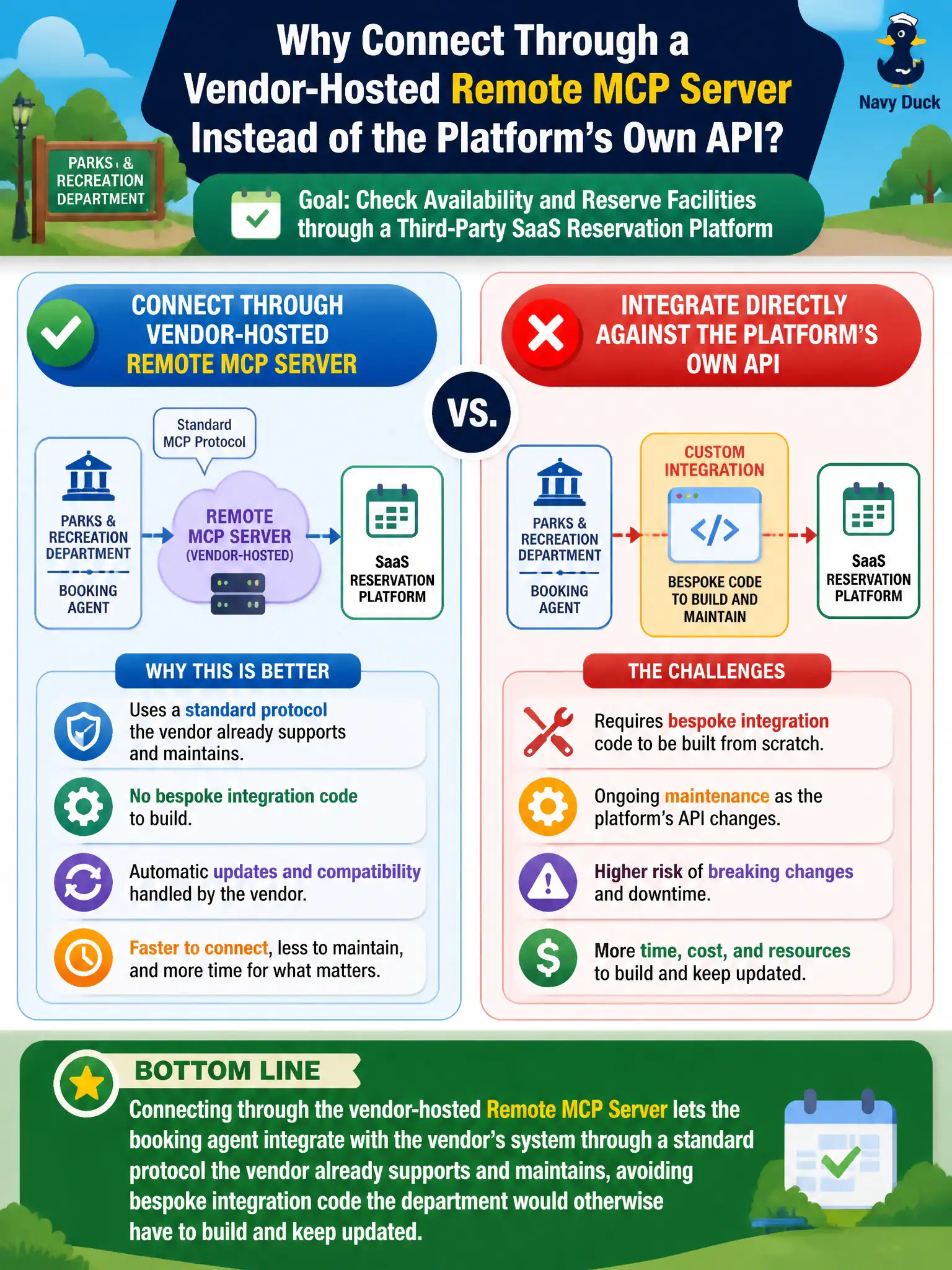
A parks-and-recreation department's booking agent needs to check availability and reserve facilities through a third-party SaaS reservation platform that publishes a remote MCP server. Why would the department connect through that vendor-hosted remote MCP server rather than integrating directly against the platform's own API?
Select an answer to reveal the explanation.
Short Explanation
Think of the vendor's remote MCP server like using a translator the other side has already hired: instead of the parks department building and maintaining its own bespoke integration against the platform's API, it connects through a standard protocol the vendor already built and keeps updated. That's the payoff - less integration code to own, not a change in who authenticates, where data lives, or whether the agent still needs its own identity.
Full Explanation
A vendor-hosted remote MCP server is the SaaS provider's own maintained implementation of a standard protocol, so connecting through it lets the parks department's booking agent reach reservation and availability functionality without the department writing and maintaining bespoke direct-API integration code - the vendor already built and keeps that server updated as their API evolves. That's the practical benefit: reduced integration burden on the department's side, since the vendor absorbs the work of exposing their platform in a standardized, agent-consumable way. It doesn't remove the vendor's own responsibility to maintain authentication for their platform - if anything, the vendor still needs to authenticate and authorize requests reaching their system, remote MCP server or not. It also doesn't relocate the reservation platform's data storage; the platform's data stays wherever the vendor hosts it; connecting through their MCP server is an integration path, not a data-migration mechanism. And it doesn't eliminate the booking agent's need for its own Agent Identity - the agent still needs an appropriately scoped identity to authenticate its calls to the vendor's remote MCP server, since the server accepting standardized requests doesn't mean it accepts unauthenticated ones. The scope caveat: relying on a vendor-hosted MCP server also means depending on that vendor's uptime and protocol-version support, which is a dependency worth tracking. A concrete check: confirm the booking agent authenticates to the vendor's remote MCP server with credentials scoped only to reservation operations the department actually needs.