
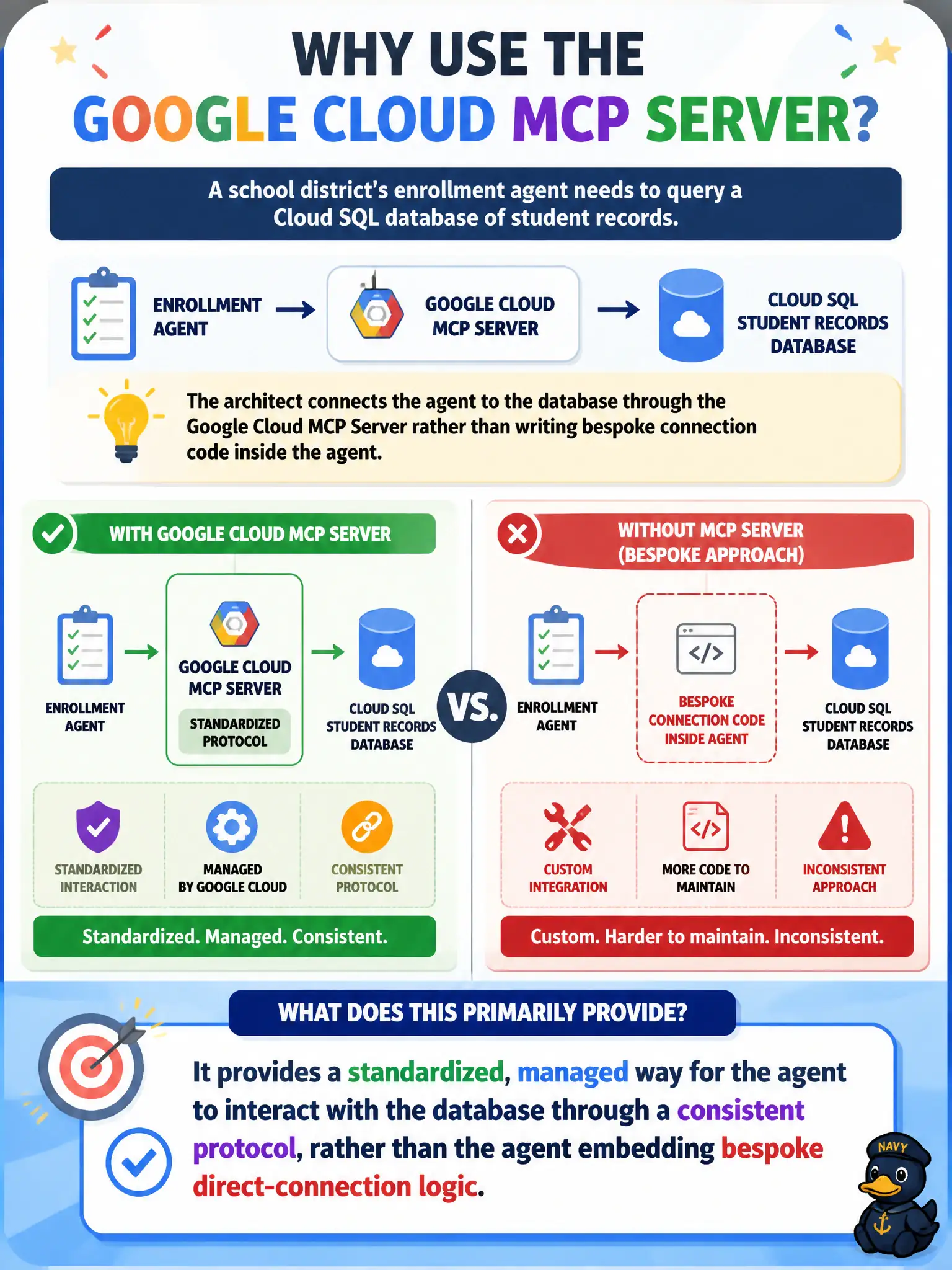
A school district's enrollment agent needs to query a Cloud SQL database of student records. The architect connects the agent to the database through the Google Cloud MCP Server rather than writing bespoke connection code inside the agent. What does this primarily provide?
Select an answer to reveal the explanation.
Short Explanation
Think of the Google Cloud MCP Server like a universal adapter instead of a custom-soldered cable: the enrollment agent talks to Cloud SQL through one standardized protocol instead of the team writing and maintaining its own direct-connection code. That standardization is the value here - it's not a shortcut around configuring access controls, not a way to turn a relational database into a vector store, and not an automatic privacy filter.
Full Explanation
An MCP server acts as a standardized integration layer between an agent and a backend system, so connecting the enrollment agent to Cloud SQL through the Google Cloud MCP Server means the agent interacts with the database through a consistent, managed protocol instead of the team writing and maintaining bespoke connection code for that specific database. That standardization is what's gained - not a change to how access controls need to be configured. The student-records database still needs its own properly scoped access controls; an MCP server is a communication layer, not a substitute for setting permissions correctly on the underlying resource. It also doesn't change the fundamental nature of the data store - Cloud SQL remains a relational database serving structured queries, and using an MCP server to reach it doesn't convert it into a vector store or add similarity-search capability, which is a distinct retrieval pattern. And it doesn't automatically anonymize student records; any de-identification or privacy safeguard required for student data still needs to be deliberately applied, whether through a service like Sensitive Data Protection or application-level logic, rather than assumed as a side effect of using an MCP server. The scope caveat: standardization through MCP reduces bespoke integration code but doesn't eliminate the need to reason about what data the agent should be allowed to see. A concrete check: verify the MCP server connection is configured against a database account with appropriately scoped read permissions for the enrollment agent's task, not a broadly privileged account.