
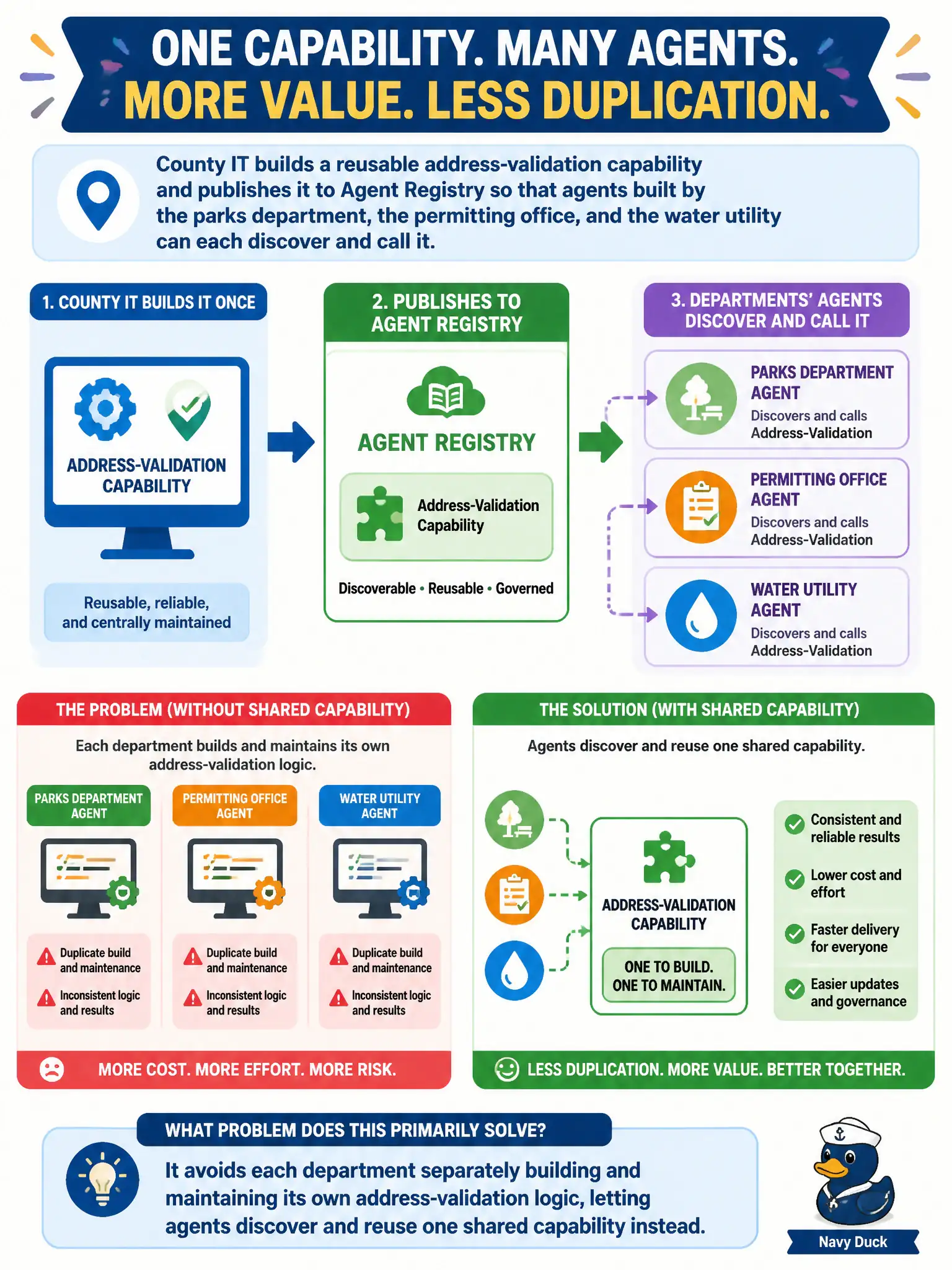
County IT builds a reusable address-validation capability and publishes it to Agent Registry so that agents built by the parks department, the permitting office, and the water utility can each discover and call it. What problem does this primarily solve?
Select an answer to reveal the explanation.
Short Explanation
Think of Agent Registry like a shared tool library at a job site instead of every crew buying their own drill: one department builds the address-validation capability well, publishes it, and the parks, permitting, and water-utility agents can all check it out instead of each building their own version. That's the point - avoiding duplicated effort across teams, not standardizing everyone's prompts or replacing each agent's own identity and permissions.
Full Explanation
Agent Registry's role is discovery and reuse: it lets one team publish a well-built capability, like address validation, and other agents across the organization find and call it instead of each team independently building, testing, and maintaining its own version of the same logic. That's the direct problem this design solves - duplicated engineering effort across the parks, permitting, and water-utility agents. It doesn't standardize each department's system instructions or prompt templates; those remain specific to each agent's own domain tasks and aren't touched by registering a shared capability. It also doesn't substitute for each agent's individual Agent Identity - a shared capability being discoverable through the registry doesn't collapse the separate permission boundaries each department's agent needs for its own data and tools, and the address-validation capability itself should carry its own appropriately scoped access. And nothing about publishing to a registry guarantees a latency improvement over a directly embedded tool call; performance depends on how the shared capability is implemented and hosted, not on the fact that it's discoverable through Agent Registry. The scope caveat: a shared capability becomes a shared dependency, so a bug or an outage in the address-validation service now affects every consuming department's agent at once. A concrete check: confirm each department's agent has its own scoped identity for calling the shared capability rather than assuming registry membership handles authorization.