
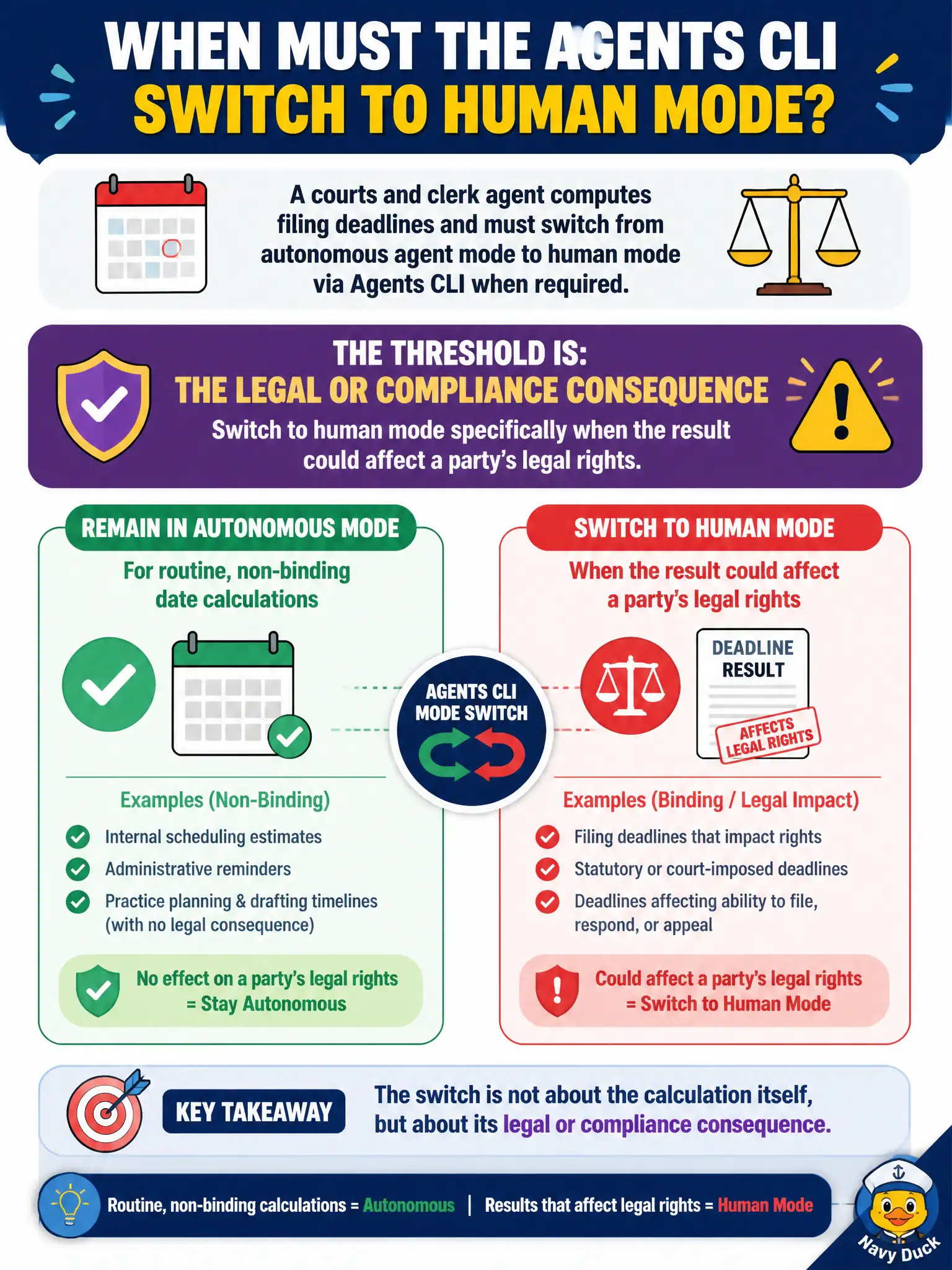
A courts and clerk agent computes filing deadlines and must switch from autonomous agent mode to human mode via Agents CLI whenever a deadline calculation affects a party's legal rights, while continuing to run routine, non-binding date calculations autonomously. What threshold determines when the switch to human mode is required?
Select an answer to reveal the explanation.
Short Explanation
Think of it like a clerk who double-checks the date personally when a deadline could cost someone their case, but doesn't blink at calculating a routine office-closure adjustment. The threshold here isn't how hard the math is or how busy the office is — it's whether getting it wrong could actually affect someone's legal rights. That's what should flip the switch to human mode, and nothing else in the scenario should.
Full Explanation
The threshold for requiring human mode in this workflow is the legal or compliance consequence of the calculation, not its arithmetic complexity, processing volume, or which division happens to be handling it. A filing deadline that affects a party's legal rights carries real consequence if computed incorrectly, which is exactly the risk profile human mode exists to add oversight to, while routine, non-binding date calculations can safely stay autonomous.
Using arithmetic complexity as the threshold conflates how hard a calculation is to perform with how much it matters if it's wrong — a simple date offset can still affect legal rights, and a complex one might not. Using daily filing volume as the trigger ties the safeguard to office throughput rather than to the actual risk of any individual calculation, meaning a single high-stakes deadline computed on a slow day would wrongly stay autonomous. Basing the switch on which division is handling the filing applies a blanket rule that ignores what any specific calculation within that division actually affects, missing cases and over-triggering others.
Scope note: correctly applying this threshold requires the workflow to actually classify each calculation's legal consequence up front, which is itself a design decision worth auditing. Operational check: run a test case where a calculation affects a filing deadline and confirm the workflow switches to human mode rather than completing autonomously.