
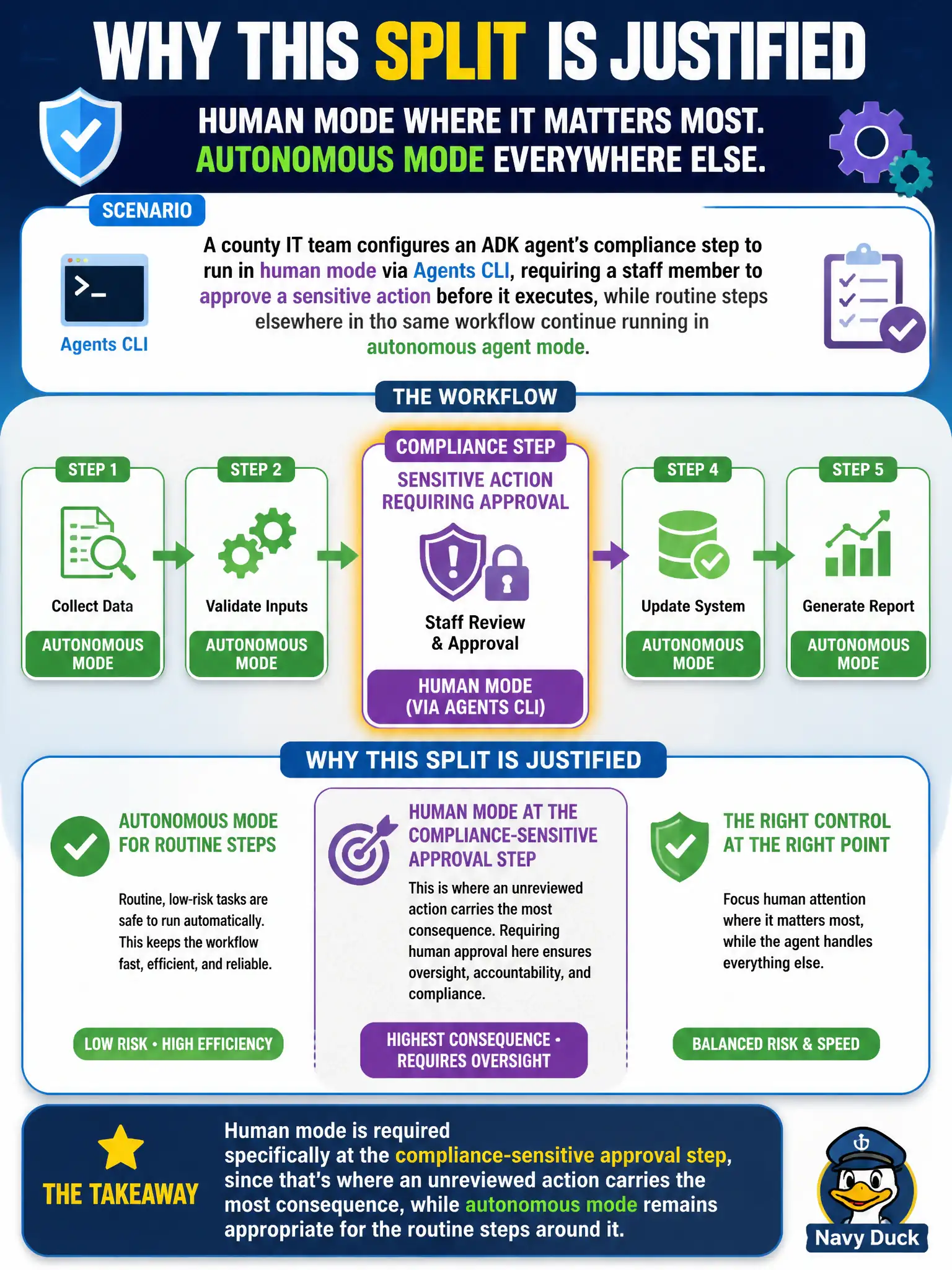
A county IT team configures an ADK agent's compliance step to run in human mode via Agents CLI, requiring a staff member to approve a sensitive action before it executes, while routine steps elsewhere in the same workflow continue running in autonomous agent mode. What justifies this split?
Select an answer to reveal the explanation.
Short Explanation
Think of it like an assembly line where most stations run themselves, but one station has a hard stop where a person has to sign off before the part moves on. That's exactly what's happening here: routine steps keep running autonomously, while the compliance-sensitive approval step specifically requires a person's sign-off in human mode. The split matches the control to where the actual risk sits, not to the whole line at once.
Full Explanation
Agents CLI's human and agent modes can be configured per step within a workflow, which lets a team apply human mode narrowly to the step that carries real consequence, a compliance approval, while leaving lower-risk, routine steps running autonomously. This step-level granularity is what makes the split in the scenario workable rather than an all-or-nothing choice.
Locking every step to whatever mode the first step used treats mode selection as a workflow-wide default rather than a per-step risk decision, which would either over-restrict routine steps or under-restrict the sensitive one, depending on which mode got picked first. Escalating the entire workflow to human mode because one step needs it sacrifices the efficiency of autonomous execution everywhere else in the workflow for a level of scrutiny only the compliance step actually requires. Assuming governance-layer features make a dedicated human-mode step unnecessary conflates oversight tooling with actual human control — governance can flag or log an action, but it doesn't substitute for the staff sign-off the compliance step is specifically there to require.
Scope note: which steps count as compliance-sensitive should be defined explicitly and revisited as the workflow changes, rather than left to case-by-case judgment. Operational check: trigger the compliance step in a test run and confirm execution actually pauses for staff approval rather than proceeding automatically.