
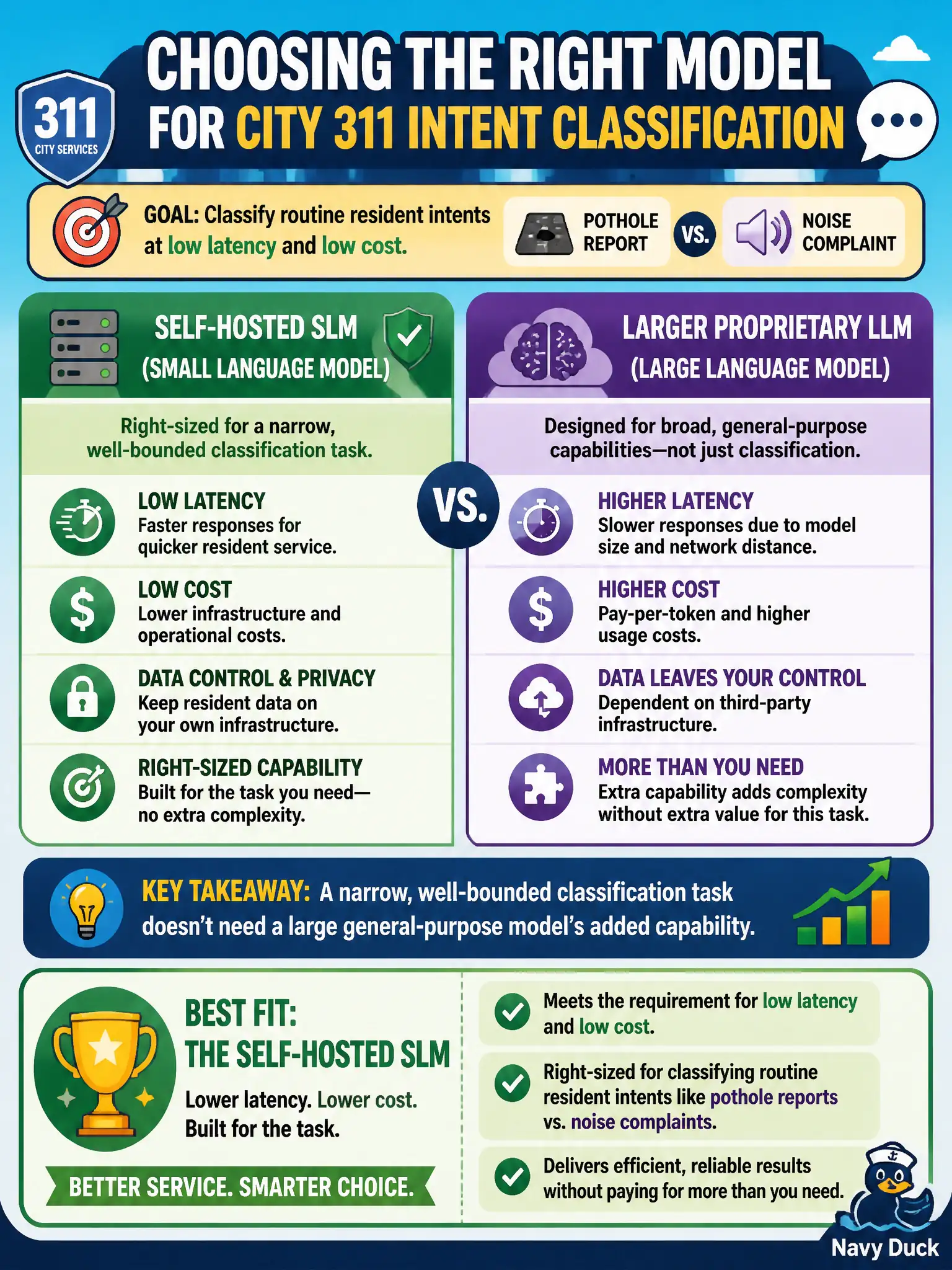
A city 311 assistant needs to classify routine resident intents, like pothole reports versus noise complaints, at low latency and low cost. The team is weighing a self-hosted small language model against a larger proprietary LLM for this specific classification task. Which choice best fits the requirement?
Select an answer to reveal the explanation.
Short Explanation
Think of it like sending a rookie to write parking tickets instead of pulling in a detective for every one of them — pothole-versus-noise classification is routine work, and a small model built for that lane handles it fast and cheap. Save the detective, the large proprietary model, for the cases that actually need that level of reasoning. Matching the model's size to the task is the whole point.
Full Explanation
Model selection between an SLM and an LLM should be driven by the task's actual complexity, latency budget, and cost profile rather than by defaulting to the most capable option available. A narrow intent-classification task with a small, well-defined label set is exactly the profile a self-hosted SLM handles well: it responds quickly, runs cheaper at volume, and doesn't need the broader reasoning capacity a large general-purpose model carries.
Defaulting to the largest proprietary model regardless of task fit ignores the latency and cost requirements stated in the scenario, and over-provisions capability the task doesn't use. Choosing a model because it's simply the newest generation substitutes recency for a genuine fit assessment against the requirements. Routing the task through a low-code workflow instead of a model call sidesteps the actual question being tested, which is model selection, and low-code tooling still ultimately calls some underlying model to do the classification.
Scope note: this reasoning applies specifically to narrow, bounded tasks — a 311 assistant that also needs to handle open-ended resident narratives would need a different model for that portion. Operational check: measure the SLM's classification accuracy against a held-out sample of real intent categories before committing to it in production.