
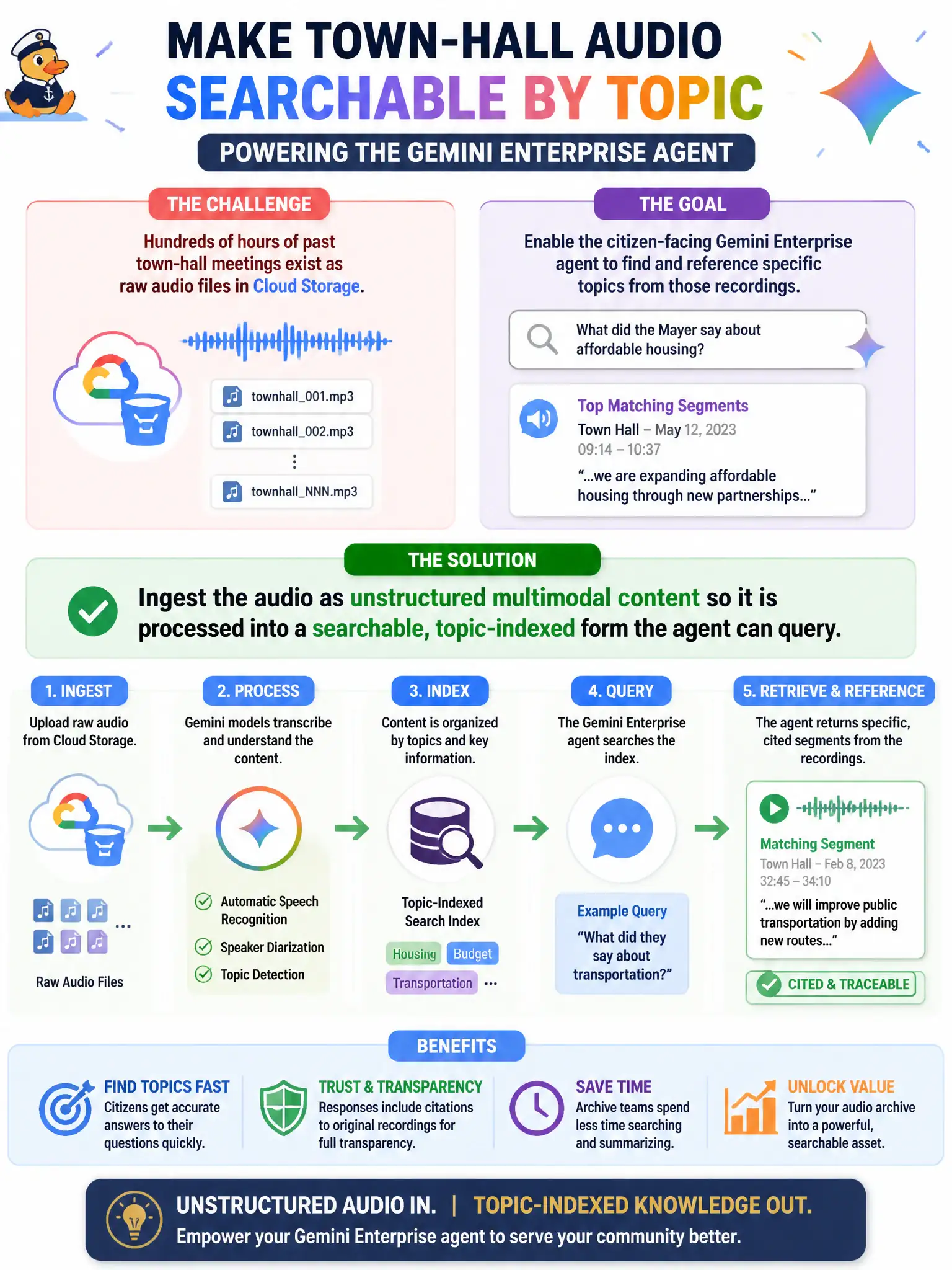
A municipal open-data portal wants audio recordings of past town-hall meetings made searchable by topic through its citizen-facing Gemini Enterprise agent. The archive team has hundreds of hours of raw audio files sitting in Cloud Storage. What should the team do so the agent can retrieve and reference specific topics from those recordings?
Select an answer to reveal the explanation.
Short Explanation
Think of raw audio like a filing cabinet stuffed with unlabeled cassette tapes: nobody can find the right meeting without listening to everything first. Ingesting the recordings as unstructured multimodal content is what gets them transcribed, chunked, and indexed so the agent can jump straight to the topic a resident asks about. It's the difference between a searchable archive and a pile of tape.
Full Explanation
Gemini Enterprise agentic workflows are built to connect to enterprise data sources, and that connection explicitly covers unstructured multimodal content such as audio, video, and images, not just text documents. When audio is ingested this way, the platform processes it into a form the retrieval layer can index and query, so a resident's question about a specific agenda item can surface the relevant segment of a specific town hall rather than forcing a linear listen-through. Manual transcription defeats the purpose of an agentic workflow by pushing the labor back onto staff instead of the platform. Feeding raw audio into system instructions confuses configuration text, which shapes behavior, with data sources, which the agent retrieves from at query time; instructions are not a storage or indexing mechanism. Collapsing every recording into one summary paragraph destroys the granularity residents need, since a single sentence per meeting cannot answer topic-specific follow-ups. As an operational check, confirm the ingestion pipeline reports each audio file as processed and indexed, then run a query naming a narrow topic to verify the agent returns the correct meeting segment rather than a generic answer.