
A substation has two egress paths to the NOC: a fibre link and a cellular modem, both terminated on the same FortiGate and both currently healthy. The utility wants outbound telemetry traffic automatically split across both links based on real-time latency and jitter measurements, rather than always preferring one link unless it fails outright. Which approach fits this requirement?
Select an answer to reveal the explanation.
Short Explanation
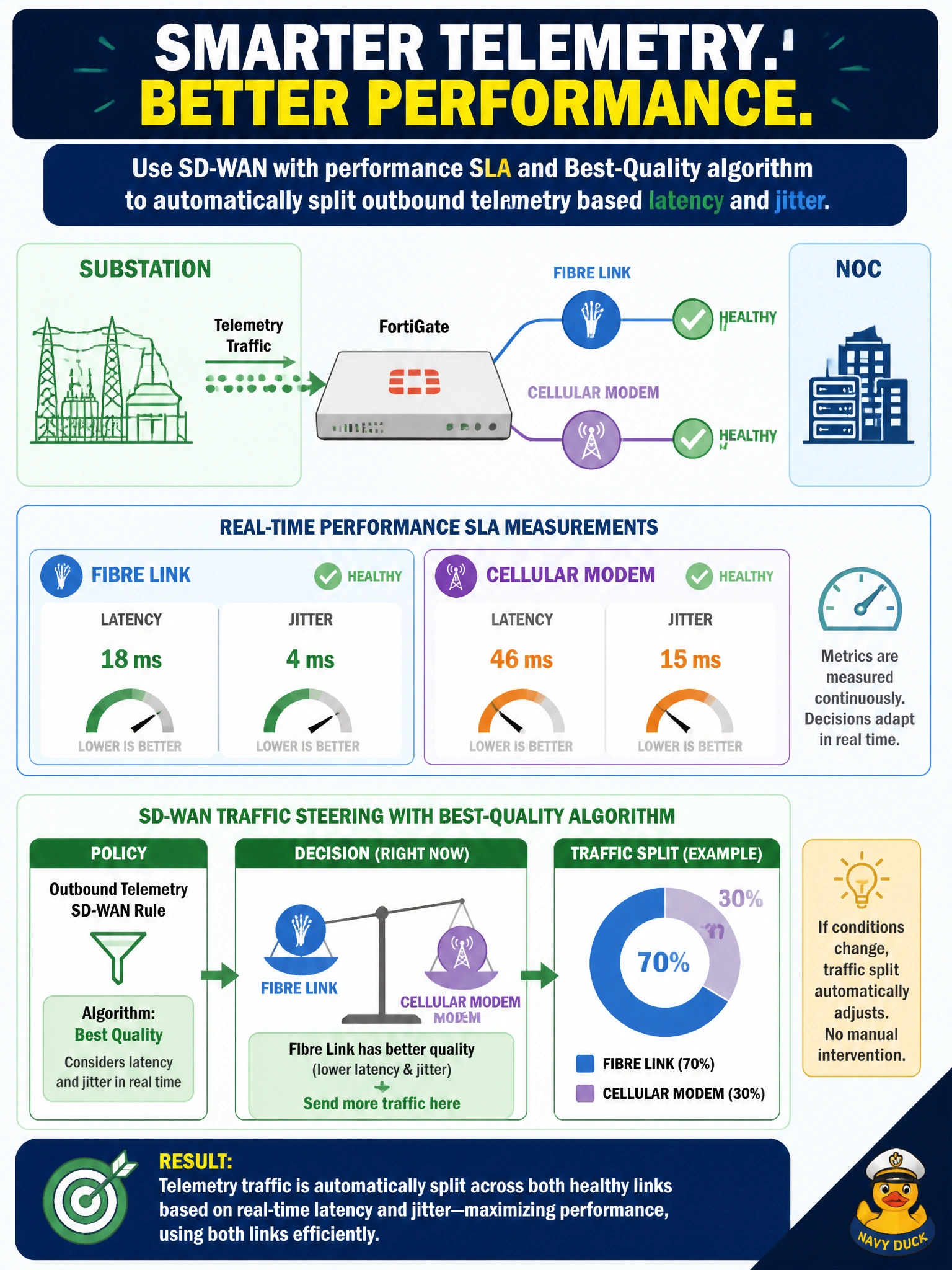
Plain static routes only know two states: up or down, ranked by whatever priority you set. SD-WAN is built for the in-between case — it keeps measuring latency and jitter on every member link and actively steers traffic toward whichever one is performing best right now.
Full Explanation
SD-WAN in FortiOS groups the fibre and cellular interfaces as members of one virtual interface and continuously measures each member against a performance SLA target, tracking metrics like latency, jitter, and packet loss; an SD-WAN rule using the best-quality (or lowest-cost SLA) algorithm then steers new sessions to whichever member currently meets the criteria, which is exactly the real-time, quality-based split the scenario asks for. Two static routes at equal priority produce ECMP, which spreads sessions across both links by a hashing algorithm, not by measured link quality, so a degraded-but-still-up link keeps receiving its share of traffic. Static route priority is a fixed administrative preference the engineer sets once; it never re-evaluates itself against latency or jitter, and the lower-priority route only activates when the preferred route is withdrawn entirely, not when it merely gets slow. Link health monitoring on a single static route only detects reachability failure of that one route's target; it has no concept of comparing performance across two links and does not produce load-balancing behavior on its own. To confirm SD-WAN is steering correctly, check the SD-WAN performance SLA status and the session's selected interface in the GUI or CLI and verify it changes as one member's measured latency degrades.