
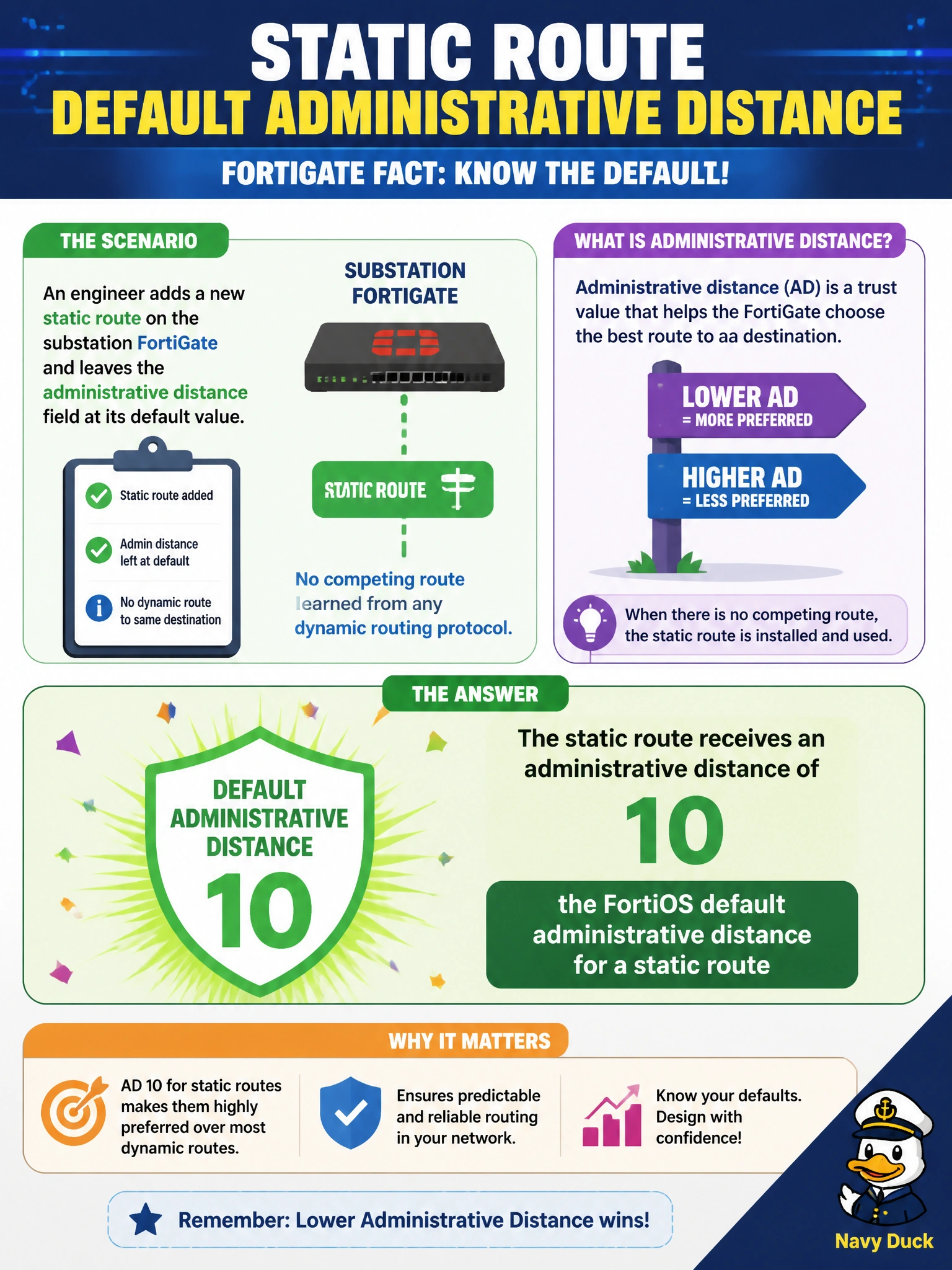
An engineer adds a new static route on the substation FortiGate and leaves the administrative distance field at its default value, without learning any competing route to the same destination from a dynamic routing protocol. What administrative distance does that static route receive by default?
Select an answer to reveal the explanation.
Short Explanation
You don't have to set a trust score for a static route yourself — FortiOS already assigns it a sensible default of 10 out of the box, well ahead of the higher defaults used by dynamic protocols like OSPF.
Full Explanation
FortiOS assigns a default administrative distance of 10 to a manually configured static route when the field is left unset, which places static routes ahead of the higher default distances typically used by dynamic routing protocols, letting a deliberately configured static path take precedence over a dynamically learned alternative to the same destination unless an administrator changes that default. A distance of 0 is reserved for directly connected interfaces, which are inherently the most trusted source since the FortiGate itself owns that subnet; a static route is not directly connected and does not receive that value. A distance of 110 is the commonly cited default for OSPF, a dynamic protocol, not for static routes, so applying it here confuses the two categories. A distance of 255 marks a route as effectively unusable and is sometimes used deliberately, such as for a floating static route intended only as a last resort, but it is not the default value applied automatically to an ordinary static route. To confirm this on a live device, add a static route without touching the distance field and check the routing table or route configuration to see the value FortiOS assigned.